Languages & Culture
American English
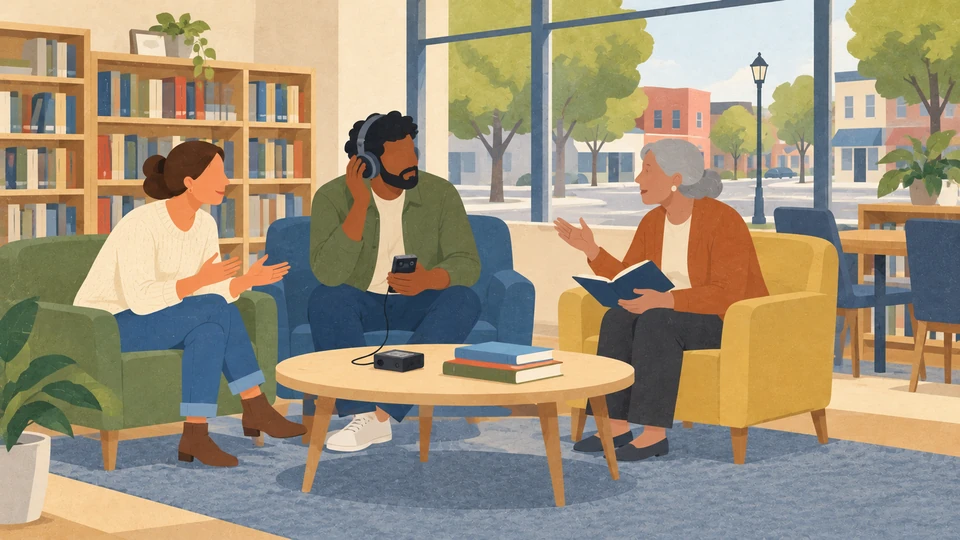
American English encompasses the varieties of English used in the United States. It includes regional and social patterns of pronunciation, vocabulary and grammar, as well as conventions associated with formal writing. English belongs to the Germanic branch of the Indo-European family; “American” specifies a broad setting within its history. It does not turn the speech of the United States into one internally uniform language. The American Speech-Language-Hearing Association explicitly includes African American English, Appalachian English and Standard American English within this larger field, while emphasizing variation among individual speakers.
How a national label emerged
The development of English in North America began well before the United States became a country. A recent scholarly overview traces anglophone settlement from Britain and Ireland to the early seventeenth century and includes the development of varieties in the context of colonial slavery in the southern United States. Another historical synthesis identifies several interacting processes in overseas Englishes: settlers brought different dialects; those dialects encountered one another and Indigenous languages; and new forms developed locally. American English is consequently a history of changing communities and unequal encounters, rather than the transplanting of a single finished accent.
Print culture helped make national language standards visible. The Library of Congress highlights Noah Webster’s A Grammatical Institute of the English Language, published in 1783, as a work intended to standardize spelling and pronunciation while supporting cultural independence. Its familiar blue-backed spelling book became a teaching tool for generations of children. This is a specific connection between language, education and nation-building: a schoolbook could promote shared conventions even as daily conversation continued to vary. A spelling standard and the full range of a population’s speech are different objects of study.
Listening beyond a single standard
Present-day research asks how people actually organize language.
- Yale’s Grammatical Diversity Project investigates differences in sentence structure across North American English.
- Researchers collect speakers’ judgments about sentences, conduct larger surveys and map results alongside geographical and social information.
The focus can be as fine-grained as differences between individuals who consider themselves speakers of the same variety. This helps explain why a national label alone cannot predict every construction a person finds natural. It also makes grammar an empirical question: researchers compare evidence rather than decide that an unfamiliar construction must be careless speech.
Written evidence needs similar care. The American National Corpus project describes a collection containing both writing and transcripts of speech, including edited and unedited material produced from 1990 onward. Comparing these kinds of material helps distinguish a publication convention from a conversational habit. Its description also recognizes regional differences in terminology and syntax within the United States. A corpus is a selected body of evidence, so the date and kinds of texts included matter when interpreting a finding; “American usage” should not be treated as timeless simply because a computer can count it.
Everyday life in the language record
The Dictionary of American Regional English offers another route into that history. In a 2017 public announcement, its chief editor emerita reported the release of original recordings made between 1965 and 1970 after sensitive material had been redacted. These recordings connect linguistic documentation with people’s accounts of everyday experience.
A transcript from a 1967 interview in Grundy Center, Iowa, moves through memories of school, parent-teacher work and farming. It records hesitations and overlapping turns as well as the words themselves. Such details make an oral history useful for studying conversation, while its particular date, place and speaker prevent it from representing all Americans. The cultural value lies partly in that specificity: language documentation can preserve how someone explained ordinary institutions and responsibilities, alongside the regional features a researcher originally sought.
American English therefore belongs to many communities, and no face or ancestry reliably identifies a person’s dialect. ASHA notes, for example, that not all African Americans use African American English and that speakers vary within every dialect community. Understanding that range makes it easier to read a national standard as one useful convention while listening carefully to the regional, social and individual patterns that people use in daily life.
Sources
- American Speech-Language-Hearing Association. American English Dialects (2003). https://www.asha.org/policy/TR2003-00044/
- Natalie Schilling, Derek Denis and Raymond Hickey; Cambridge University Press. Introduction to Volume V (2026-04-15). https://www.cambridge.org/core/books/abs/new-cambridge-history-of-the-english-language/introduction-to-volume-v/815D3BBD155E824994F0686C11C0CCF6
- Raymond Hickey; Cambridge University Press. Transported English in the Colonial Period (2026-04-22). https://www.cambridge.org/core/books/abs/new-cambridge-history-of-the-english-language/transported-english-in-the-colonial-period/B6529847969F7EE41F7D35A705B23357
- Library of Congress. 1750 to 1800 — Books That Shaped America. https://www.loc.gov/exhibits/books-that-shaped-america/1750-to-1800.html
- Yale Grammatical Diversity Project; adapted from Raffaella Zanuttini, Jim Wood, Jason Zentz and Laurence Horn (2018). Project Description. https://ygdp.yale.edu/project-description
- American National Corpus project. What is American English, and Why Do We Care?. https://anc.org/html/American-English.html
- Ben Zimmer, quoting Joan Houston Hall, Chief Editor Emerita of DARE; American Dialect Society public mailing-list archive. [Ads-l] DARE recordings now freely available. https://listserv.linguistlist.org/pipermail/ads-l/2017-July/148846.html
- UW–Madison Digital Collections Center / Dictionary of American Regional English. Fieldwork Recordings—Dictionary of American Regional English: Transcript of DARE Interview (1967): Grundy Center, Iowa; Primary Informant IA002 (Tape 0346-S1). https://asset.library.wisc.edu/1711.dl/SU5ELCOL675XU9E/R/file-bb806.pdf
- Tsammalex; edited by Christfried Naumann, Tom Güldemann, Steven Moran, Guillaume Segerer, Anne-Maria Fehn and Robert Forkel. Language English. https://tsammalex.clld.org/languages/eng