Languages & Culture
Arabic
Arabic joins a shared literary tradition to a wide range of everyday ways of speaking. It belongs to the Semitic language family, alongside Hebrew, Aramaic and Amharic. The broad name covers Classical Arabic, Modern Standard Arabic and regional spoken varieties; these are related categories with different histories and uses. An introduction to “Arabic” therefore needs to explain what kind of Arabic a book, recording or conversation contains. Knowing the label alone cannot tell a learner which forms they will encounter.
Across North Africa and Western Asia, Arabic connects communities whose local speech differs in pronunciation, vocabulary and grammar. A research description of the MADAR dialect project identifies Modern Standard Arabic as a shared language of culture, media and education from Morocco to Oman. Its city-based data include Rabat, Cairo, Amman, Baghdad and Muscat. Comparing cities avoids assuming one way of speaking for each country.
More than a choice between formal and informal
Modern Standard Arabic is closely related to Classical Arabic, the language associated with the Qur’an and an extensive literary heritage. Karin C. Ryding’s university teaching overview locates much of the difference in vocabulary, subject matter and style. Modern Standard Arabic serves important written and broadcast functions, while people also develop competence in local varieties through everyday interaction. Learning to read a newspaper and learning to participate in a familiar conversation consequently involve overlapping, but different, skills.
The term diglossia describes this coexistence of differently used varieties, but a rigid two-box picture is inadequate. The MADAR researchers discuss speakers switching between standard and dialectal forms in unscripted broadcasting. They also describe dialectal Arabic in emails, blogs, discussion forums and messages. Spoken varieties have written lives, too. These observations caution against equating “standard” with every written sentence, or treating regional speech as defective formal Arabic. Context and audience help explain the forms people select.
A history recovered from different kinds of evidence
Arabic’s past extends beyond the surviving classical literary tradition. In his study of pre-Islamic contact, Ahmad Al-Jallad uses Old Arabic for diverse forms preserved in inscriptions and other documentary evidence. The material is concentrated in the southern Levant, Sinai and northwestern Arabia. His account traces contact with Aramaic and other Semitic languages, as well as Greek. It challenges a picture of early Arabic developing in complete isolation. The distinction between an ancient inscription and a text transmitted by later scholars matters: each offers a different route into linguistic history.
Arabic speakers also developed influential traditions of analysing their language. Kees Versteegh’s historical overview connects early grammatical work with interpreting the Qur’an and explaining differences among forms of Arabic. The eighth-century grammarian Sībawayhi produced a systematic account that became a major model for later scholarship. Among its analytical concerns were word roots and relations between parts of a sentence. Arabic’s history includes the methods that scholars devised to explain language, alongside the texts those methods helped readers understand.
Reading, documenting and discussing Arabic today
Two different kinds of scholarly access now help readers explore this heritage.
- The Library of Arabic Literature publishes edited Arabic texts and English translations, concentrating on works from the seventh through nineteenth centuries.
- Its range includes travel writing, philosophy, science, fiction and poetry as well as religion.
Arabic Collections Online, supported by NYU and partner libraries, digitizes public-domain Arabic books. An edited translation and a scan of a historical volume answer different questions: one provides a scholarly reading across languages, while the other gives access to a particular published object.
Contemporary dialect documentation has another purpose. MADAR assembled parallel travel-domain sentences and a comparative lexicon for 25 city varieties, supporting research on dialect identification and translation. Its deliberately selected material makes structured comparison possible. It should be read as evidence from a defined research resource, rather than a complete portrait of how everyone in those cities speaks.
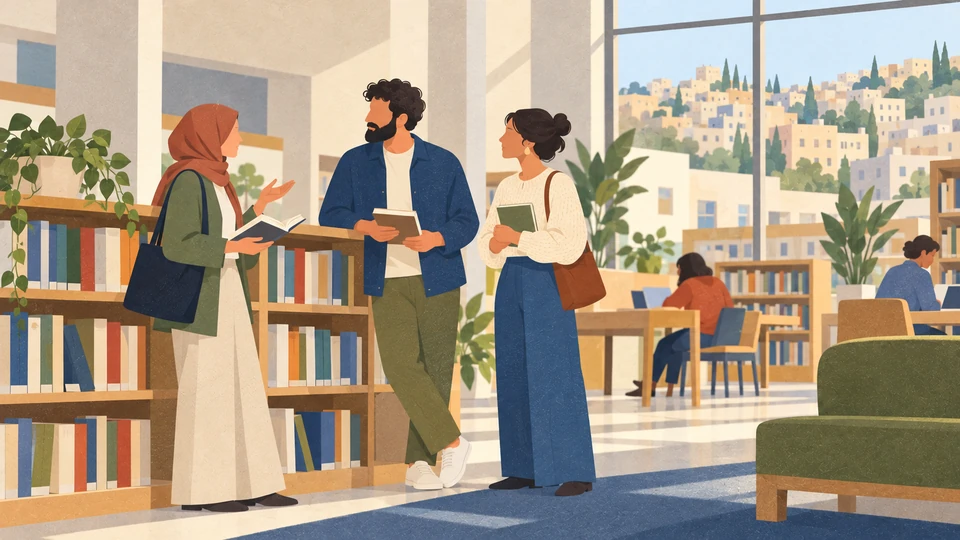
Reading is also a social activity in present-day communities. In May 2026, Abdul Hameed Shoman Library in Amman described clubs devoted to Arabic and international literature, Jordanian books and the humanities. One club explores works set in Amman; another focuses on Naguib Mahfouz’s novels. These are specific opportunities to discuss characters, ideas and places with other readers. Alongside the foundation’s library spaces in Jordan, they show Arabic culture being sustained through ordinary borrowing, interpretation and conversation, with room for different literary interests.
Sources
- Karin C. Ryding; Department of Arabic and Islamic Studies, Georgetown University. Learning Arabic as a Foreign Language. https://arabic.georgetown.edu/afl/
- Ahmad Al-Jallad; in Christopher Lucas and Stefano Manfredi (eds.), Arabic and contact-induced change, Language Science Press, pp. 37–55. Pre-Islamic Arabic (2020). https://pure.rug.nl/ws/portalfiles/portal/180928009/235_Book_Manuscript_1830_1_10_20200515.pdf
- Houda Bouamor, Nizar Habash, Mohammad Salameh, Wajdi Zaghouani, Owen Rambow, Dana Abdulrahim, Ossama Obeid, Salam Khalifa, Fadhl Eryani, Alexander Erdmann and Kemal Oflazer; European Language Resources Association. The MADAR Arabic Dialect Corpus and Lexicon. https://aclanthology.org/L18-1535.pdf
- NYU Press / Library of Arabic Literature. Library of Arabic Literature. https://nyupress.org/library-of-arabic-literature/
- New York University Libraries / Arabic Collections Online. Arabic Collections Online. https://aco.dlib.nyu.edu/
- Kees Versteegh; in The Cambridge History of Linguistics, Cambridge University Press. The Arabic Linguistic Tradition (2023-07-20). https://www.cambridge.org/core/books/abs/cambridge-history-of-linguistics/arabic-linguistic-tradition/0673036D0233A43ADBB0F8772C81C4AE
- Abdul Hameed Shoman Foundation. Abdul Hameed Shoman Foundation. > The Library > Main library > About the Library. https://shoman.org/en/library
- Abdul Hameed Shoman Foundation. Reading Clubs: A Space for Culture and Dialogue (2026-05-16). https://shoman.org/en/Latest-News/ArticleID/4180/reading-clubs-at-shoman-library-promote-culture-and-dialogue