Languages & Culture
Bengali
Bengali, also called Bangla, has a life on both sides of the Bangladesh–India border and far beyond it. It is an Indo-Aryan language within the Indo-Iranian branch of Indo-European. Its major communities include Bangladesh and the Indian states of West Bengal and Tripura, as well as parts of Assam. Diaspora settings such as London and New York add further contexts for its use. These places share a language while differing in local speech, reading traditions and the other languages people use around it.
Bangla developed through earlier eastern Indo-Aryan speech forms, including stages associated with Magadhi Prakrit. Describing it simply as modern Sanskrit would miss that intervening history. The poems collected as the Charyapada are important early literary evidence, although their language also shares features with other eastern linguistic traditions. Medieval writing subsequently encompassed narrative poetry, religious lyrics and translations. Contact contributed vocabulary from Persian and Arabic, while Sanskrit and, later, English also supplied words. This layered history helps explain why family relationship and vocabulary source are different questions.
Different ways of writing
The Bengali script belongs to the historical Brahmi tradition and is written from left to right. Within that script, readers encounter differences of register as well as differences between authors. The older formal written style usually called sadhu uses forms of verbs and pronouns that differ from the shorter forms associated with chalita, the colloquial written style. The twentieth century saw the latter gain a much wider literary presence. For a learner moving between an older work and contemporary prose, an unfamiliar form may therefore reflect the text’s register and period rather than an entirely new everyday word.
Language, remembrance and books
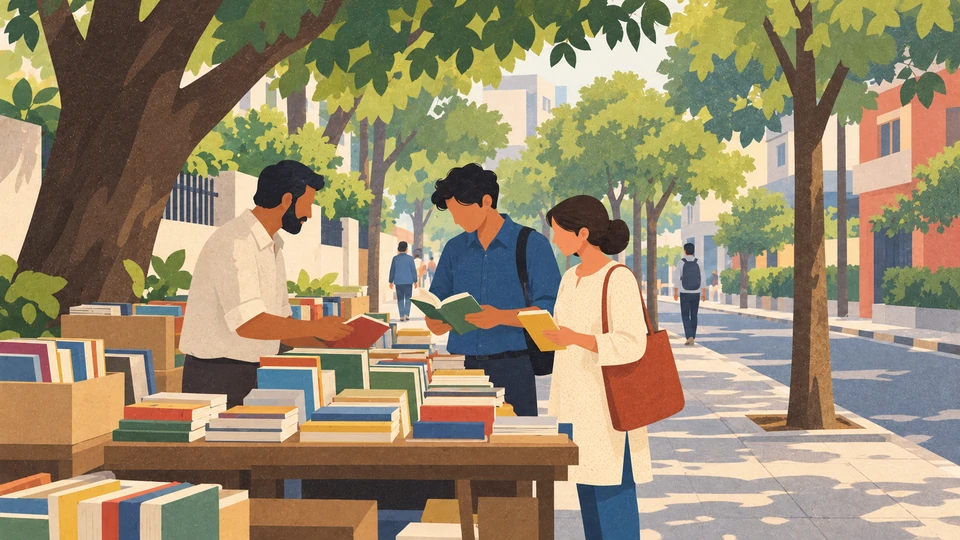
In Bangladesh, public remembrance of language is connected to 21 February 1952, when people lost their lives in the campaign for recognition of Bangla in what was then East Pakistan. The Amar Ekushey Book Fair, organised by Bangla Academy in Dhaka, commemorates that sacrifice. The Bangladesh Tourism Board describes books across genres and subjects at venues including the academy grounds and Suhrawardy Udyan. The fair brings the history of language rights into a setting where readers can also choose a new book. It links remembrance to the ongoing production and circulation of writing.
That historical association has an international dimension. Bangladesh initiated the proposal for International Mother Language Day; UNESCO approved it in 1999, and the observance has taken place worldwide since 2000 on 21 February. The day extends attention to many languages and communities. For readers approaching Bengali, it offers a way to understand how a particular history of language recognition became part of a wider conversation about learning, cultural transmission and linguistic diversity.
From historical scholarship to digital evidence
The study of Bengali also has a substantial documentary history. Suniti Kumar Chatterji’s The Origin and Development of the Bengali Language appeared in 1926. Mohammad Daniul Huq’s scholarly reference account describes its attention to sound history and word structure, using both description and comparison. This kind of research asks how earlier evidence helps explain later forms. It remains useful to distinguish that historical question from a different one: how people write and speak in particular communities today.
Present-day digital projects make large bodies of writing searchable.
- Bangladesh’s official corpus platform describes collections of running text, grammatical annotation and Romanized Bangla, alongside tools for examining words in context.
- It distinguishes a manually constructed “gold” treebank from a “silver” resource generated automatically.
Those labels describe how the research material was prepared, rather than social grades of Bengali. The distinction matters when using a corpus: an automatically assigned grammatical label is a result to evaluate, while the original text remains evidence requiring context.
Regional language work supplies another perspective. The creators of BanglaRegionalTextCorpus, in their November 2025 dataset description, document material from Rangpur, Barisal, Narail and Khulna, with Standard Bangla and English translations. They report collecting examples through community interaction, field recordings and online material, followed by validation from native speakers. This is a defined research sample, not a complete map of Bengali or a ruling on every neighbouring language boundary. It nevertheless demonstrates why regional usage deserves direct attention alongside the written standard. Different evidence—from a historical poem to a local recording—answers different questions about the language.
Sources
- Columbia University Language Resource Center. Bengali. https://lrc.columbia.edu/languages/bengali
- Mohammad Daniul Huq and Pabitra Sarkar; Banglapedia, Asiatic Society of Bangladesh. Bangla Language. https://en.banglapedia.org/index.php/Bangla_Language
- UNESCO. International Mother Language Day. https://www.unesco.org/en/days/mother-language
- Bangladesh Tourism Board; Ministry of Civil Aviation and Tourism, Government of Bangladesh. Amar Ekushey Book Fair. https://beautifulbangladesh.gov.bd/district-event/dhaka/events/32
- Mohammad Daniul Huq; Banglapedia, Asiatic Society of Bangladesh. Origin and Development of the Bengali Language, The. https://en.banglapedia.org/index.php/Origin_and_Development_of_the_Bengali_Language,_The
- EBLICT project, Bangladesh Computer Council (BCC), ICT Division; institutional credit in page footer. Bangla Syntactic Treebank Corpus with Processing Pipeline and Distribution Platform. https://corpus.bangla.gov.bd/
- Contributors displayed as Umme Ayman ayman; Zannatul Mawa Koli Koli; Md. Tofael Ahmed; institutions listed as Daffodil International University and Comilla University. BanglaRegionalTextCorpus: A Curated Dataset for Four Regional Bangla Dialects. https://data.mendeley.com/datasets/92r62h4k5k/2