Language & culture
Blackfoot: A Language Across Four Nations
Language at a glance
- Speakers in Canada
- 6,685 · 2021
Conversational ability; people in private households.
- Local names
- Niitsí’powahsin · Siksiká
Niitsitapi refers collectively to the people.
- Communities
- Southern Alberta · northern Montana
Four distinct Blackfoot Confederacy Nations.
- Family
- Algonquian
Related to Cree and Ojibwe.
- Writing
- Roman alphabet · 13 symbols
Kainai Transition Centre; glottal stop included.
- Varieties
- Four community varieties
Frantz’s spelling in grammars and dictionaries.
Who speaks Blackfoot, and what do they call it?
Blackfoot is spoken by four distinct Nations of the Blackfoot Confederacy: Siksika, Kainai, Northern Piikani and Amskapi Piikani, in southern Alberta and northern Montana.
Language names include Niitsí’powahsin, meaning real or original language, and Siksiká, which can also name the Siksika variety. The wider collective name for the people, Niitsitapi, means Real People.
How many people speak Blackfoot worldwide?
Canada’s 2021 census counted 6,685 people in private households who reported conversational ability in Blackfoot, including first- and additional-language speakers. A dependable worldwide total remains unverified.
Where did Blackfoot come from, and who spoke it in the past?
Blackfoot is an Algonquian language. Its speakers’ historical territory extended across parts of present-day Alberta, Saskatchewan, Montana and Idaho, beyond today’s reserves and reservation.
The fur trader James Isham recorded ten Blackfoot numerals in 1743. Later visitors, missionaries and linguists compiled word lists and dictionaries.
Which Blackfoot words might an English speaker already recognise?
The cat word poos, also recorded as ohpoos, is generally traced to English puss, borrowed into Blackfoot. Its ultimate origin remains uncertain: similar cat words occur in several Indigenous languages, and a possible Dutch connection has also been proposed.
How does Blackfoot vary from region to region?
The four Nations have recognisable varieties, with differences in pronunciation and vocabulary. Speakers generally understand one another. For example, áípakkohtamm can mean a tractor in Kainai and a motorcycle in Northern Piikani.
What is Standard Blackfoot, and where is it used?
Reference grammars and dictionaries use Donald Frantz’s standardized Roman spelling. Local teaching also reflects community speech: the Glenbow Blackfoot project draws many words from Kainai speakers.
Which alphabet does Blackfoot use, and what might surprise an English speaker?
The Blackfoot Roman alphabet taught by the Kainai Transition Centre has 13 symbols: twelve Roman letters and a glottal-stop sign, marking a brief closure in the throat. Its vowel letters are a, i and o. Doubled letters mark longer sounds; an acute accent can mark high pitch.
Does Blackfoot have grammatical gender?
Blackfoot has animate and inanimate noun classes. People and animals are grammatically animate, but so are knives and blankets.
How do you say hello, thank you and goodbye in Blackfoot?
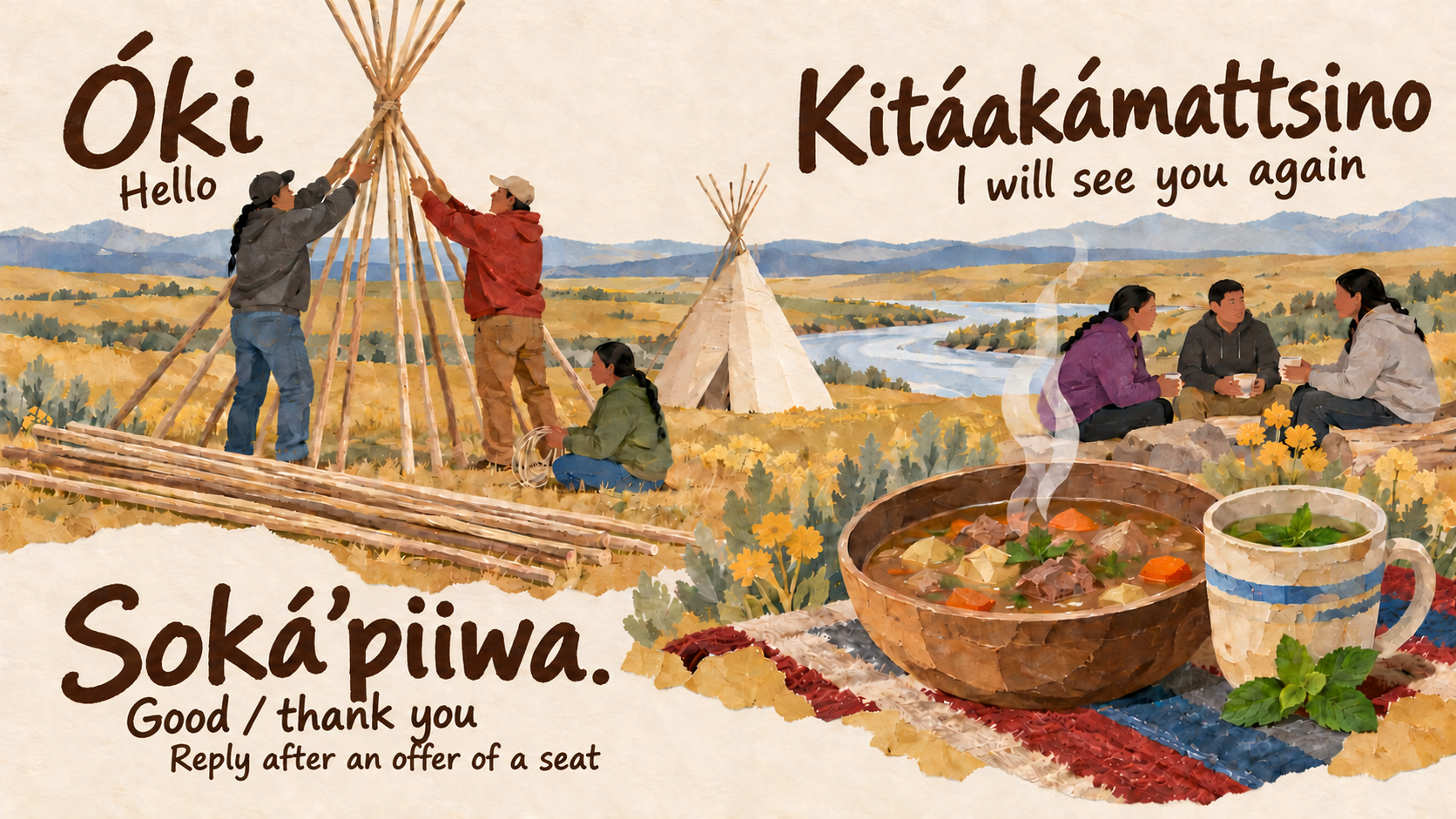
Kainai community teaching uses:
- Óki — Hello.
- Soká’piiwa. — Thank you / good; an appreciative reply in an office exchange after an offer of a seat and a short wait.
- Kitáakámattsino — I will see you again.
What are some memorable Blackfoot sayings?
- Aa, kakayo'kaat means “Yes, keep sleeping”, an expression used when someone sleeps too late.
- Omahkinnayo'kaa, literally “He sleeps like an old man”, describes someone sleeping without clothing.
What everyday customs might surprise a visitor?
In the Kainai account of social visiting, people sit together over meat soup or mint tea and share stories.
Which Blackfoot-language song and film offer a cultural introduction?
The lullaby ponoka, performed by Susie White Calf, addresses an elk eating swamp grass. Mizuki Miyashita recorded it in Browning, Montana, in 2007; the University of Montana offers the recording.
Sooyii, directed by Krisztian Kery, follows a young Pikuni epidemic survivor who meets a Shoshone woman fleeing captivity. This fictional drama uses Blackfoot and Shoshone, with English subtitles. Jesse DesRosier was its language and dialect coach and also appears in the film.
What is available for someone curious about the language now?
The Galt Museum offers a downloadable Blackfoot language book in screen and print formats, plus flashcards. It covers language fundamentals, introductions and learning through relationships with the land. Kainai Transition Centre’s online lessons cover visiting, work and travel.
Natosapi–Old Sun Community College’s Siksika Knowledge certificate and diploma include introductory and conversational Siksika with history and cultural studies. Its current course sequence runs from 2025 to 2027.
Fun Facts
- Month names follow the seasons. Matsiyikkapisaki’soom, April’s Frog Moon, recalls frogs sounding in the meadows. Other month names refer to July’s ripe blueberries and December’s long nights.
- A name for television, Aisaiksit’to, describes a person coming into view.
Sources
- Siksika Nation. About. n.d. https://siksikanation.com/about/
- Blackfoot Crossing Historical Park. Stories of the Siksika. First printing, March 2020. https://blackfootconfederacy.ca/wp-content/uploads/2024/04/History-book-layout-V2a.pdf
- Natalie Weber and coauthors. Blackfoot Words: a database of Blackfoot lexical forms. Language Resources and Evaluation 57, 1207–1262. 31 March 2023. https://link.springer.com/article/10.1007/s10579-022-09631-2
- Statistics Canada and Office of the Commissioner of Indigenous Languages. Indigenous Language Families: Algonquian languages. 31 March 2025; corrected 2 September 2025. https://www150.statcan.gc.ca/n1/pub/41-20-0002/412000022025002-eng.htm
- Julius Delaney, Galt Museum & Archives. Blackfoot Alphabet and History. 10 March 2021. https://www.galtmuseum.com/blackfoot-1/blackfoot-alphabet-and-history
- Kainai Transition Centre Society. Module 1 Lesson 1: Greetings. n.d. https://learnblackfoot.ca/mod1les1.htm
- Julius Delaney, Galt Museum & Archives. Nature, Weather and Time. 8 March 2021. https://www.galtmuseum.com/blackfoot-1/nature-weather-time
- Julius Delaney, Galt Museum & Archives. Animals and Stories. 9 March 2021. https://www.galtmuseum.com/blackfoot-1/animals-and-stories
- Kainai Transition Centre Society. Welcome to the Blackfoot Language. n.d. https://learnblackfoot.ca/
- Natosapi–Old Sun Community College. Siksika Knowledge Certificate & Diploma Program. n.d.; current page includes the 2025–2027 sequence. https://oldsuncommunitycollege.ca/siksika-knowledge/
- Galt Museum & Archives. Blackfoot Language Workbooks. n.d. https://www.galtmuseum.com/blackfoot-language-workbook
- Julius Delaney, Galt Museum & Archives. Homes and Transportation. 4 March 2021. https://www.galtmuseum.com/blackfoot-1/homes
- Kainai Transition Centre Society. Did You Know? n.d. https://learnblackfoot.ca/dyk.htm
- Ryan Denzer-King. Neologisms in Indigenous Languages of North America. Santa Barbara Papers in Linguistics 19, 25–39. 2008. https://www.linguistics.ucsb.edu/sites/default/files/sitefiles/research/papers/19/Denzer-King_vol19.pdf
- Kyumin Kim. Oblique nominals, a verbal affix and late merge. Linguistics 58(6), 1737–1773. 2020. doi:10.1515/ling-2020-0179. https://www.researchgate.net/publication/347574305_Oblique_nominals_a_verbal_affix_and_late_merge
- Glenbow Museum and Blackfoot community contributors. Blackfoot Language, Niitsitapiisini: Our Way of Life, Teacher Toolkit. n.d. https://www.glenbow.org/blackfoot/teacher_toolkit/english/culture/language_Print.htm
- Blackfoot Lab, Yale University. Blackfoot Words. n.d. https://www.blackfootwords.com/
- Kainai Transition Centre Society. Module 4 Lesson 10: Review, Workplace Conversation Comprehension. n.d. https://learnblackfoot.ca/mod4les10.htm
- Mizuki Miyashita, University of Montana. The Five Blackfoot Lullabies. n.d.; recordings made in 2007. https://www.umt.edu/indigenous-language-linguistics-applied-science/research1/lullabies.php
- Mizuki Miyashita. Five Blackfoot Lullabies. Proceedings of the American Philosophical Society 155(3), 276–293. 2011. https://www.academia.edu/12399478/2011_Five_Blackfoot_Lullabies
- Smithsonian Mother Tongue Film Festival. 2022 Festival Program: Sooyii Screening and Conversation. 2022. https://mothertongue.si.edu/2022-program.html?v=2025.05.02
- University of Lethbridge Library, Blackfoot Digital Library. Blackfoot-English Phrases, record 120. n.d. Accessed 23 October 2026. https://www.ulethbridge.ca/lib/bdl/index.php?sort=Blackfoot&id=120
- University of Lethbridge Library, Blackfoot Digital Library. Blackfoot-English Phrases, record 119. n.d. Accessed 23 October 2026. https://www.ulethbridge.ca/lib/bdl/index.php?sort=Blackfoot&id=119
Start learning today
Explore these books to keep learning.