Blackfoot Beyond the Word Óki
 OkiHelloKaitama’tsinSee you laterSokapiAll is well
Language at a glance
- Speakers in Canada · 2021
- 6,685
Self-reported conversational ability in private households, including later learners. Does not cover Montana. Census table published in 2025.
- Regions
- Southern Alberta · Northern Montana
Canada and the United States.
- Language family
- Algonquian
- Writing system
- Latin alphabet
Some orthographies use accents and apostrophes for sound distinctions.
A Blackfoot conversation can begin with the brief greeting Óki. Elsewhere in the language, a single word can describe a whole shopping trip, while names for months call attention to birds, berries, and changing weather. Blackfoot belongs to communities on both sides of the Canada–United States border, with their own voices and local ways of speaking.
Is Siksiká the language, the Nation, or both?
Siksiká can name Blackfoot as a language, but Siksika Nation is one particular Nation within the Blackfoot Confederacy. The other three are Kainai, Northern Piikani, and Amskapi Piikani, or the Blackfeet Nation in Montana. Siksika Nation itself is east of Calgary in Alberta.
The wider Blackfoot-speaking people also use the collective name Niitsitapi. Their language belongs to the Algonquian family, and its principal communities are in southern Alberta and northern Montana. Each of the four Nations has an associated dialect. A name for the language itself is Niitsí’powahsin, meaning real, true, or original language.
How many people speak Blackfoot?
Canada’s 2021 census recorded 6,685 people in private households who reported being able to hold a conversation in Blackfoot, according to a Statistics Canada table published in 2025. This measure includes people who learned it as an additional language. It covers Canada, so speakers in Montana are outside that figure.
What is noticeable on the written page?
Modern Blackfoot materials often use a Latin alphabet with marks that carry information about the sound. An apostrophe can represent a brief closure in the throat, and an acute accent indicates a prominent pitch. Those small marks are part of the spelling.
Some words also carry a surprising amount of meaning. áakotoowahsoohpommaawa expresses that someone will go grocery shopping. The English version spreads the action and its timing over several words; Blackfoot can put them together in one.
How do conversations begin and end?
Everyday Blackfoot expressions include:
- Óki — hello.
- Tsá niitá'piiwa? — how are you?
- Kitáakámattsino — I will see you again.
How do Blackfoot month names reflect the seasons?
The Blackfoot calendar vocabulary presented by the Galt Museum’s language contributors follows events in the surrounding world. April is associated with frogs, July with ripening blueberries, and December with long nights. These names connect a month to something a person can hear, gather, or experience outdoors.
The connection becomes especially clear in Matsiyikkapisaki’soom, the name given for April, or frog moon. The accompanying account links the season with frogs sounding in the meadows.
What does an everyday social visit look like?
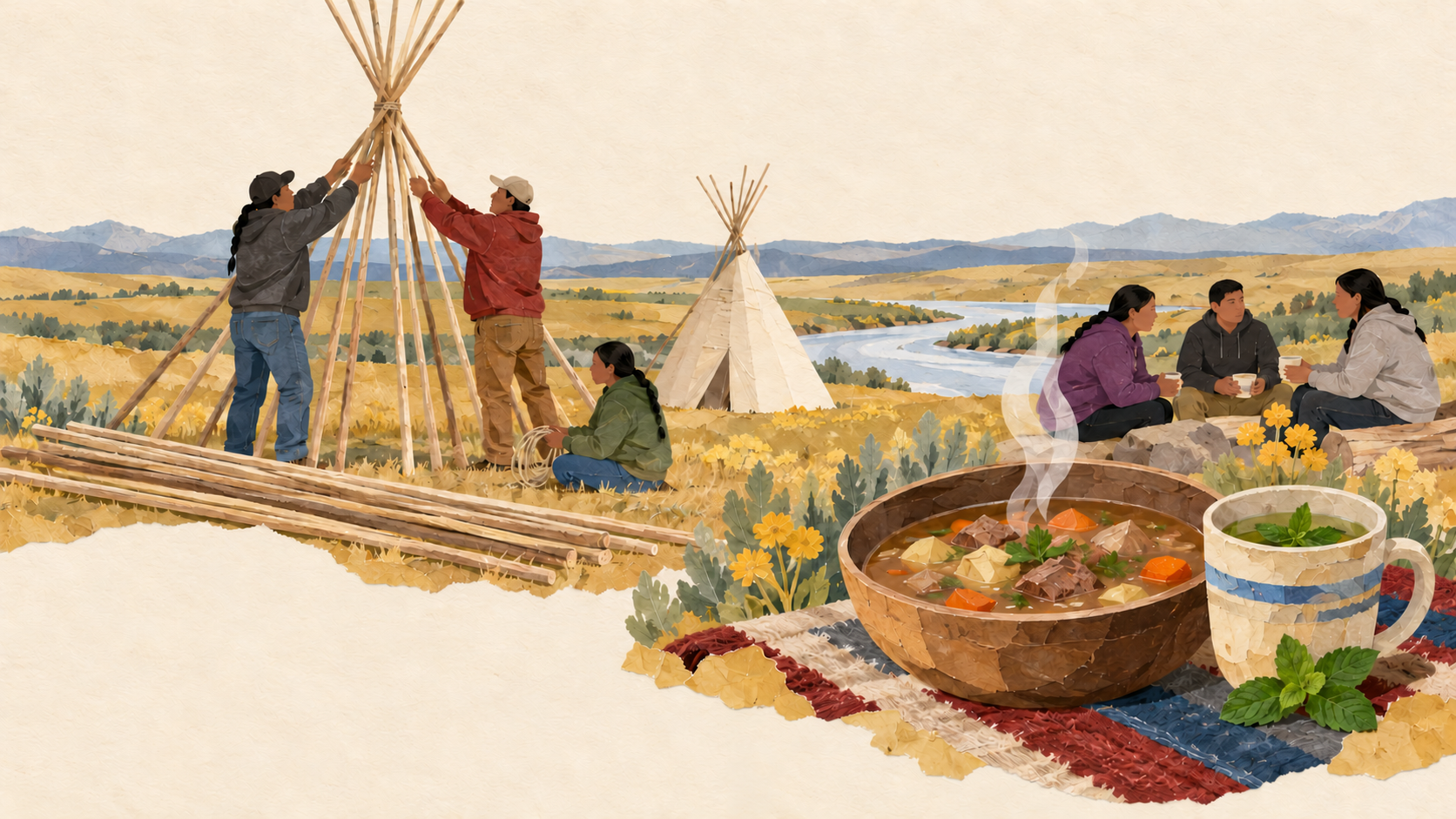
In the Kainai Transition Centre’s account of Blackfoot social life, conversation and storytelling accompany visits over meat soup or mint tea. Singing and dancing also remain part of social gatherings, but the everyday picture includes the quieter pleasure of a shared drink and a story.
Is there a Blackfoot story about ordinary life?
Clifford Crane Bear’s Isttstsáápikimmiksi, presented as Barbed Wires, recalls childhood trips with his grandfather to collect and sell discarded fencing. A neighbour wants the wire removed because it could injure his horses. The small errand becomes a story involving a wagon, a five-dollar payment, and the police.
Recorded in 2017, it appears in the Blackfoot oral-stories collection in the Siksika dialect, with Crane Bear’s English translation. Years after the trip, Crane Bear passes the spot where they were told to leave the wire and finds it still there.
Where is Blackfoot being taught now?
At Natosapi–Old Sun Community College, the Siksika Knowledge programme combines language with Siksika history, land, and cultural knowledge. Its courses include introductory and conversational language, giving adults a route into sustained study within a Siksika institution.
The Galt Museum’s Niisit’powahsin Blackfoot Language Book offers another entry point. Its second edition credits language consultants Julius Delayney, Blaise Russell, Wilma Spearchief, and Camina Weasel Mocassin. It combines language introductions with land-based material. Kainai’s recorded conversation lessons and the Siksika story archive add opportunities to hear named speakers alongside written words.
Fun Facts
- An extra consonant can change the action completely. In examples recorded from Beatrice Bullshields, áípotaawa means that he gets beaten up, while áípottaawa means that he is flying. The longer t matters.
- A television can be named for what appears on it. The word Aisaiksit’to is explained in the Galt language materials as describing a person coming into view.
Sources
- Siksika Nation; About; n.d.; https://siksikanation.com/about/
- Blackfoot Crossing Historical Park; Stories of the Siksika; March 2020 (first printing); https://blackfootconfederacy.ca/wp-content/uploads/2024/04/History-book-layout-V2a.pdf
- Natalie Weber, Tyler Brown, Joshua Celli, McKenzie Denham, Hailey Dykstra, Rodrigo Hernandez-Merlin, Evan Hochstein, Pinyu Hwang, Nico Kidd, Diana Kulmizev, Hannah Morrison, Matty Norris, and Lena Venkatraman; Blackfoot Words: a database of Blackfoot lexical forms; 31 March 2023; https://link.springer.com/article/10.1007/s10579-022-09631-2
- Statistics Canada and Office of the Commissioner of Indigenous Languages; Indigenous Language Families: Algonquian languages; 31 March 2025; corrected 2 September 2025; https://www150.statcan.gc.ca/n1/pub/41-20-0002/412000022025002-eng.htm
- Julius Delaney, Galt Museum & Archives; Blackfoot Alphabet and History; 10 March 2021; https://www.galtmuseum.com/blackfoot-1/blackfoot-alphabet-and-history
- Kainai Transition Centre Society; Module 1 Lesson 1: Greetings; n.d.; https://learnblackfoot.ca/mod1les1.htm
- Julius Delaney, Galt Museum & Archives; Nature, Weather and Time; 8 March 2021; https://www.galtmuseum.com/blackfoot-1/nature-weather-time
- Julius Delaney, Galt Museum & Archives; Animals and Stories; 9 March 2021; https://www.galtmuseum.com/blackfoot-1/animals-and-stories
- Kainai Transition Centre Society; Welcome to the Blackfoot Language; n.d.; https://learnblackfoot.ca/
- Clifford Crane Bear (storyteller and English translator); Heather Bliss (collector and editor); Isttstsáápikimmiksi / Barbed Wires; 19 September 2017 (recording); https://stories.blackfoot.atlas-ling.ca/Stories/view/5a442e53-8fbc-47a9-bda9-434368c1ad6a.json
- Natosapi–Old Sun Community College; Siksika Knowledge Certificate & Diploma Program; n.d.; https://oldsuncommunitycollege.ca/siksika-knowledge/
- Natosapi–Old Sun Community College; About; n.d.; https://oldsuncommunitycollege.ca/about/
- Galt Museum & Archives; Blackfoot Language Workbooks / Niisit’powahsin Blackfoot Language Book, second edition; n.d.; https://www.galtmuseum.com/blackfoot-language-workbook
- Julius Delaney, Galt Museum & Archives; Homes and Transportation; 4 March 2021; https://www.galtmuseum.com/blackfoot-1/homes