Languages & Culture
Brazilian Portuguese
Brazilian Portuguese names the many forms of Portuguese used in Brazil, including regional speech, social varieties and the conventions of formal writing. Portuguese belongs to the Romance family. The Brazilian label identifies a major national setting within that language, rather than one uniform accent or a language with an unrelated origin. Research on Brazil deliberately investigates differences between places and speakers: the national frame is a starting point for understanding that diversity, not a substitute for it.
A language reshaped in the Americas
Portuguese developed from Latin in the Iberian Peninsula and reached Brazil through Portuguese colonial expansion. Its Brazilian history then unfolded through contact with Indigenous languages and the languages of Africans brought under slavery. The Museu da Língua Portuguesa's historical exhibition connects these encounters with the formation of Portuguese in Brazil. The process involved coercion as well as cultural creativity: eighteenth-century colonial policy sought to suppress Indigenous general languages and impose Portuguese.
A history of Portuguese is therefore also a history of unequal access to public authority, schooling and writing. The museum traces the continuing effects of Indigenous and African speech on Brazilian Portuguese while observing that Nheengatu, an Amazonian general language, is still spoken. Recognising those contributions must leave room for the languages themselves and their living users. They are not simply ingredients that disappeared into a national language.
Hearing differences within Brazil
The Atlas Linguístico do Brasil, or ALiB, provides an empirical way to explore variation. In their 2012 account, Suzana Alice Cardoso and Jacyra Andrade Mota explain how its interviews and mapping examine pronunciation, grammar, vocabulary and intonation across locations. Its design also considers age, gender and education. A map of where a form occurs can consequently be read alongside information about who used it. The project explicitly connects this evidence with teaching that helps students learn socially valued forms without disparaging their home varieties. Regional differences are patterns to investigate, rather than errors to rank.
Historical research asks a different question: how did these ways of speaking and writing develop? The Projeto Para a História do Português Brasileiro grew to national scale in 1997 from work initially focused on São Paulo. The University of São Paulo's CEDOCH documentation describes written corpora and comparison materials that include correspondence and newspaper genres. Such records give researchers evidence of language across time. They also require attention to the circumstances of writing: a private letter and a newspaper advertisement were produced for different readers and purposes, and neither is a transparent recording of ordinary conversation.
Spontaneous speech can instead be studied through recordings. At the Federal University of Minas Gerais, C-ORAL-BRASIL, coordinated by Tommaso Raso and Heliana Mello, documents speech in varied situations. Its first corpus, published in 2012, includes dialogues, conversations and monologues, with recordings aligned to transcriptions. The project identifies Minas Gerais as its principal regional base. That qualification is valuable: even a carefully designed collection gives a situated sample, not the voices of an entire country. Hearing a conversation also reveals timing and intonation that a printed transcription alone cannot convey.
Poetry between the page and the voice
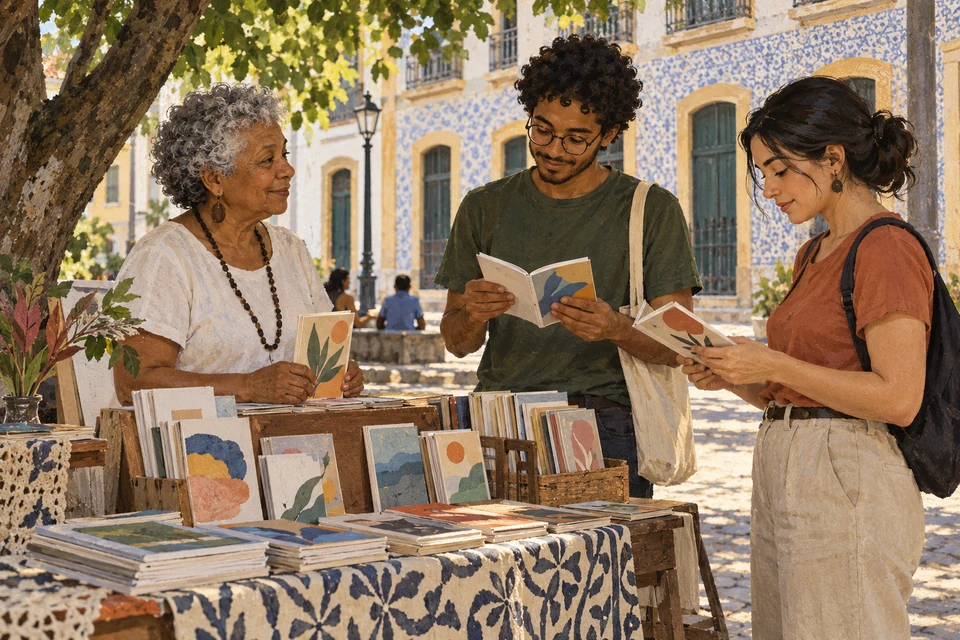
Cordel joins printed poetry with oral performance. The University of São Paulo's Institute of Brazilian Studies preserves booklets alongside photographs, sound recordings and woodcuts. Its collection account places booklet circulation especially in northeastern Brazil and describes authors selling and reciting their work in public squares. These forms allow a poem to meet readers and listeners in different ways. They also give researchers several kinds of evidence: the printed object, the sound of performance and records of how works were collected.
Writing in 2019, Paulo Teixeira Iumatti documented cordel's recognition as Brazilian cultural heritage on 19 September 2018. His institute hosted a mobilisation meeting during the registration process and developed a cordel portal with IPHAN as part of safeguarding work. His introduction also draws attention to the relationship between collections, poets and collectors, including questions about intellectual property when material is made available digitally. Preservation consequently involves decisions about access and the interests of the people whose work is collected. Cordel offers one specific view of Brazilian linguistic creativity, connecting poetic language, public circulation and continuing research.
Sources
- Center for Language Technology, Indiana University. Portuguese. https://celt.indiana.edu/portal/Portuguese/index.html
- Museu da Língua Portuguesa. Português do Brasil. https://acervo.museudalinguaportuguesa.org.br/exposicoes/portugues-do-brasil
- Suzana Alice Cardoso and Jacyra Andrade Mota; Alfa: Revista de Linguística 56(3). Projeto Atlas Linguístico do Brasil: antecedentes e estágio atual (2012). https://www.scielo.br/j/alfa/a/v3JHS56nn7zfC4RHRK6GYgD/?lang=pt
- Ataliba T. de Castilho; CEDOCH, Faculdade de Filosofia, Letras e Ciências Humanas, Universidade de São Paulo. Produção científica do Projeto Para a História do Português Brasileiro. https://cedoch.fflch.usp.br/producao-cientifica-do-projeto-para-historia-do-portugues-brasileiro
- C-ORAL-BRASIL, Universidade Federal de Minas Gerais; coordinators Tommaso Raso and Heliana Mello. Informações sobre o projeto. https://c-oral-brasil.org/projeto.php
- UNESCO World Heritage Centre. Historic Centre of São Luís. https://whc.unesco.org/en/list/821/
- Paulo Teixeira Iumatti; Revista do Instituto de Estudos Brasileiros, Universidade de São Paulo. Cordel e patrimônio. https://www.scielo.br/j/rieb/a/CSpKK9BFjjDc9fgBqGBFPfs/?format=html&lang=pt
- Instituto de Estudos Brasileiros, Universidade de São Paulo; site byline difusieb. Literatura Popular – Cordel (2016-07-06). https://www.ieb.usp.br/literatura-popular-cordel/