Languages & Culture
Breton
Breton connects Brittany with the Celtic languages of Britain. It belongs to the Celtic branch of the Indo-European family and is particularly close to Welsh and Cornish. Its history includes the settlement of people from Britain in Armorica during the early Middle Ages, especially the fifth and sixth centuries. That connection helps explain why a Celtic language is spoken in this part of northwestern France. Breton has its own linguistic history and grammar; treating it as French with regional vocabulary would miss the language itself.
A regional language with several centres
The traditional Breton-speaking heartland lies in western Brittany. Four dialect groupings are conventionally named after Cornouaille, Léon, Trégor and Vannes, although the Public Office for the Breton Language cautions against imagining sharp boundaries between them. Written usage, education and broadcasting also connect people across local differences. The language therefore cannot be represented adequately by a single village voice, or by assuming that every Breton speaker learned it in the same way.
The geography of learning is wider than that traditional heartland. A dated illustration comes from the office’s September 2025 education update, which recorded new bilingual provision in Rennes and Nantes as well as locations farther west. Such openings document opportunities to learn Breton; they do not by themselves measure how often it is used outside school. Distinguishing educational provision from daily language use is essential when discussing the language’s future.
Making room for everyday Breton
Education has become central to transmission.
- The first Diwan school opened in 1977, and the network now includes primary and secondary establishments.
- Diwan describes its schools as secular, free and open to everyone, with families participating in the associations that run them.
These are institutions for learning through Breton, with a goal of active bilingualism in Breton and French.
Diwan’s explanation of immersion extends beyond classroom lessons: play, meals and informal exchanges are part of the language environment. The organisation also describes a serious break in family transmission and a predominantly French-speaking surrounding society. Its account makes clear why a school can be important without making the challenge disappear. Parents who already speak Breton and parents learning it themselves can both contribute to children’s opportunities to use it. This is continuing language work involving families and institutions, not evidence that transmission has become secure.
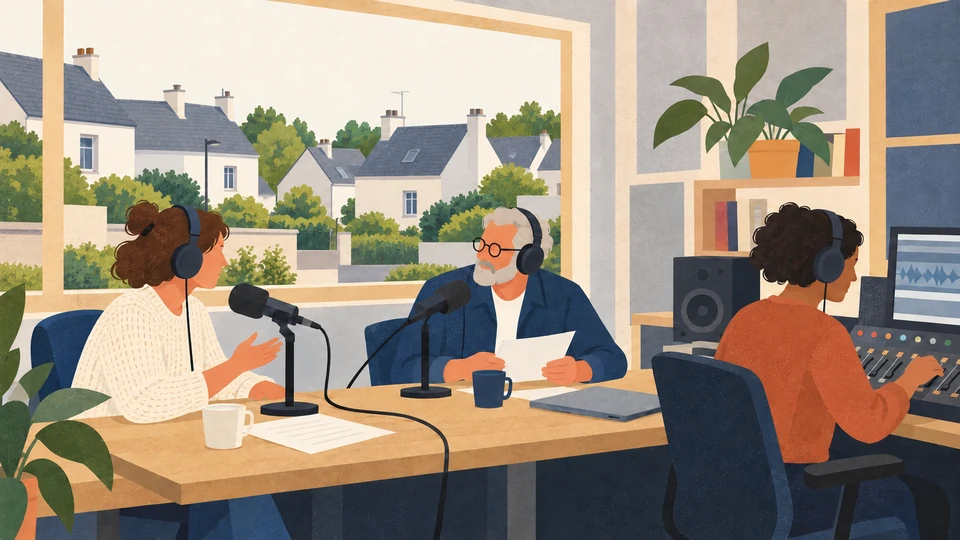
Broadcasting provides another setting. Radio Kerne has broadcast in Breton in Finistère since 1998. Its programming includes news, reporting, documentaries and music, and it exchanges or coproduces programmes with partner stations. The station’s description of community participation includes making programmes, helping with technical tasks and suggesting interview subjects. Such work gives Breton a role in reporting and discussing contemporary life.
The programme Rodeier offers a specific example: its stated purpose is to meet local Breton speakers and let them talk about their occupations, their places and their lives. That editorial choice matters. It places speakers’ experiences at the centre of the programme, allowing the language to carry accounts of work and daily concerns as well as discussion about Breton itself.
Records that can be used again
Documentation also makes variation and history accessible. The public Meurgorf historical dictionary brings together lexical evidence from Middle Breton to the present, including historical and dialect forms. Its dated examples provide source references and preserve original spelling alongside modernised versions where needed. A learner or researcher can therefore ask where a usage appears and how it has changed, instead of treating every dictionary form as equally current. The project continues to add material.
Dastum’s oral-heritage archive adds another kind of evidence: sound recordings, manuscripts and photographs concerning songs, instrumental music, tales, legends and personal testimony. Its public selections describe musicians and singers returning to archival material, including recordings of kan ha diskan singing. These holdings concern Brittany broadly and should not all be assumed to be in Breton. Together with contemporary radio and educational work, they offer several routes into the language’s surroundings: listening to remembered experience, investigating written evidence and making new conversation possible.
Sources
- Office Public de la Langue Bretonne. A few information for english people - Office Public de la Langue Bretonne. https://www.fr.brezhoneg.bzh/136-a-few-information-for-english-people.htm
- Diwan. Diwan - Diwan en quelques mots. https://www.diwan.bzh/fr/diwan-en-bref
- Diwan. Diwan - L’immersion à Diwan. https://www.diwan.bzh/fr/immersion
- Office Public de la Langue Bretonne. Enseignement bilingue : rentrée 2025 (2025-09-12). https://www.fr.brezhoneg.bzh/evenement/2369/50-actualite.htm
- Office Public de la Langue Bretonne. En savoir plus − Portail numérique de la langue bretonne. https://niverel.brezhoneg.bzh/fr/meurgorf/about
- Dastum. Dastumedia - Dastum. https://www.dastum.bzh/dastumedia/
- Radio Kerne. L’association | Radio Kerne. https://radiokerne.bzh/fr/kevredigezh
- Radio Kerne. Rodeier | Radio Kerne. https://radiokerne.bzh/fr/programs/609/
- Dastum. Qu'est-ce que Dastumedia ?. https://www.dastum.bzh/dastumedia/quest-ce-que-dastumedia/
- Dastum. Ar verjelenn (Manu Kerjean et Lomig Doniou). https://www.dastum.bzh/objet-multimedia/ar-verjelenn-manu-kerjean-et-lomig-doniou/
- Nolùen Le Buhé; Dastum. Le coup de cœur de Nolùen Le Buhé. https://www.dastum.bzh/objet-multimedia/le-coup-de-coeur-de-noluen-le-buhe/