Languages & Culture
Burmese
Burmese is a language of Myanmar and of communities living beyond its borders, including Thailand, Malaysia and Australia. The University Languages Portal Australia places it in the Lolo-Burmese branch of the Sino-Tibetan family. In Myanmar it is used both as a first language and by people who have another first language. Consequently, knowing that someone is from Myanmar does not identify their mother tongue: the country is home to many other languages. “Burmese” in this article refers to the language, rather than to a single ethnic identity or every language spoken in the country.
Writing, speech and the distance between them
Burmese is written from left to right in a script with rounded letterforms. It is also tonal: a change in pitch can contribute to a difference in word meaning. That makes listening an essential part of learning words, alongside recognising their written forms. An English spelling approximation cannot by itself communicate everything a learner needs to hear.
The distinction between colloquial and literary Burmese adds another dimension. Northern Illinois University’s SEAsite describes colloquial and written forms, but stresses that their boundary is blurred: both appear in print and broadcast media. A learner should therefore avoid assuming that everything printed follows one register, or that every spoken setting uses another. In a 2020 interview, instructor Kenneth Wong described beginning with colloquial Burmese and introducing more literary usage through short stories and poems at intermediate level. His account illustrates a teaching sequence, rather than a fixed rule dividing all Burmese communication.
An earlier multilingual world is visible in the Myazedi inscription at Bagan. UNESCO’s Memory of the World record describes this twelfth-century stone inscription in four languages: Pyu, Mon, Burmese and Pali. The object puts Burmese writing alongside other regional and religious traditions. It is evidence of an established written language in that period, rather than a date when people first began speaking it. Reading the four-language context also prevents a history of Burmese from becoming a history in which neighbouring languages disappear.
Conversation around a tea table
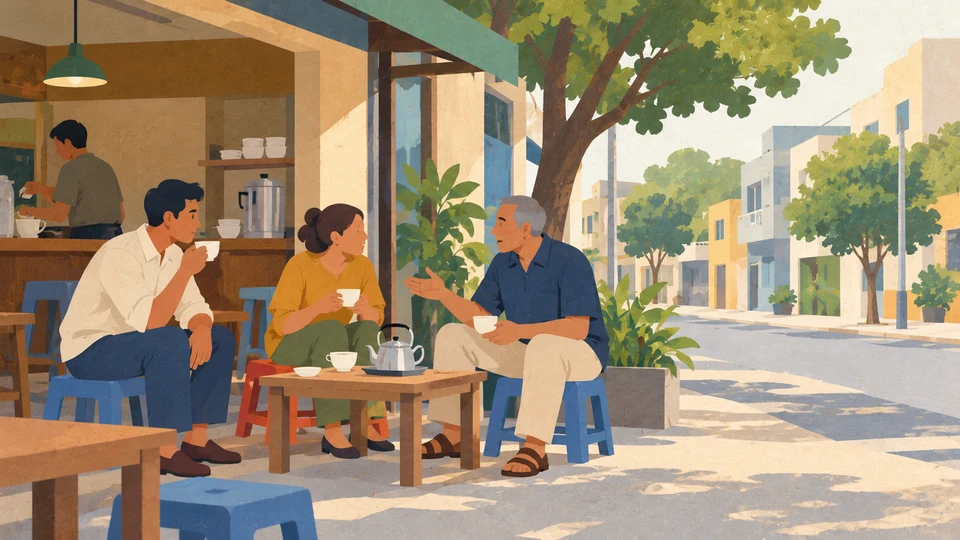
Tea shops provide one everyday setting for social exchange. In their 2024 scholarly review, Zaw Lin and Joseph J. Molnar describe establishments where people share food, news and conversation, including in Yangon neighbourhoods. Small tables and stools bring customers into a shared space. Their discussion also identifies limits to participation: tea-shop social life has often been dominated by men, and women’s access and roles vary. This is a useful cultural example precisely when it is kept specific. It does not mean that everyone in Myanmar frequents tea shops, or that everyone seated together necessarily shares a first language.
Preserving texts and widening opportunities to learn
The Myanmar Manuscript Digital Library, hosted by the University of Toronto, makes material from libraries in Myanmar available online. The project includes work by Myanmar and international scholars, librarians and local volunteers. At the U Pho Thi Library in Thaton, the account describes attention to physical preservation, photography and checking the order of manuscript leaves. Those details matter: an image collection becomes more useful when a reader can follow a text in its intended sequence. Digital access depends on practical care for the physical objects as well as on software.
The collections also require linguistic care. Project director William Pruitt explains that they include Pali, Burmese and Mon texts, including Pali passages accompanied by word-by-word translations and explanations. “A manuscript from Myanmar” is therefore not a sufficient description of its language. Preserving those distinctions helps researchers understand the relationships among religious study, translation and local literary knowledge. The project’s aims include making manuscript photographs freely available to scholars and training people in Myanmar to care for and digitise the material.
Language education also draws on living community knowledge.
- Wong’s 2020 account describes children from the One Myanmar Community Center conversing with university learners online, bringing different generations into the same lesson.
- In 2023, Arizona State University announced a collaborative project to develop an open educational textbook for intermediate Burmese, led by Chan Lwin with instructors from other universities.
These documented initiatives address different needs: opportunities to interact with speakers and sustained material for progressing beyond introductory study.
Sources
- University Languages Portal Australia; project of Australian National University, Macquarie University and University of Melbourne. Burmese. https://ulpa.eresearch.unimelb.edu.au/languages/individual/burmese
- Northern Illinois University, Center for Southeast Asian Studies. SEAsite. https://www.niu.edu/clas/cseas/resources/seasite.shtml
- Kitty Hu; UCLA Center for Southeast Asian Studies, interview with Kenneth Wong. From YouTube to a hybrid classroom – Burmese language learning (2020-05-04). https://international.ucla.edu/cseas/article/219290
- UNESCO, Memory of the World; nomination submitted by Myanmar. Myazedi Quadrilingual Stone Inscription. https://www.unesco.org/en/memory-world/myazedi-quadrilingual-stone-inscription
- Zaw Lin and Joseph J. Molnar; Societies14(8),154. Tea Shops in Myanmar: Micro-Institutional Functions for Rural Migrants and Women (2024-08-14). https://pdfs.semanticscholar.org/face/ad13b712f78800c35fd65d7822c241594b24.pdf
- Myanmar Manuscript Digital Library; hosted by University of Toronto and supported by Robarts Library. Welcome to the Myanmar Manuscript Digital Library. https://myanmarmanuscripts.org/
- Myanmar Manuscript Digital Library. Libraries. https://myanmarmanuscripts.org/libraries/
- William Pruitt; Myanmar Manuscript Digital Library. The Project to Digitize Manuscripts in Myanmar. https://myanmarmanuscripts.org/the-project-to-digitize-manuscripts-in-myanmar/
- Chan Lwin; Arizona State University, ASU News. ASU center leading project to develop materials for Burmese language instruction (2023-12-07). https://news.asu.edu/20231207-asu-center-leading-new-project-develop-new-materials-burmese-language-instruction
- Yamin Aye and Yè Wint Htut; University of Yangon Research Journal11(1),pp.437–446; MERAL repository. Distribution Pattern of Tea Shops in Dagon Myothit (North) Township. https://meral.edu.mm/records/9373