Languages & Culture
Canadian French
Canadian French is a broad geographical label for varieties of French used in Canada. It should not be treated as the name of a separate language, a single accent, or an exact synonym for Quebec French. French belongs to the Romance group within Indo-European. Within Canada, histories of settlement, movement and contact have produced different regional traditions, while people also shift their speech according to setting and audience. A useful introduction therefore asks both where French is used and what kind of communication is taking place.
More than one regional history
Two important historical groupings are Laurentian French and Acadian French. The Canadian Language Museum's educational account traces Laurentian French from the St Lawrence valley westward across Canada. It places Acadian French across the Maritime provinces, particularly in New Brunswick. These broad connections help explain why Canadian French cannot be reduced to Quebec alone. They are not an exhaustive map of every community, and people living in the same city need not share an identical family language history. Regional labels provide an introduction to variation rather than a complete account of an individual's speech.
French took root through European colonization of territories already inhabited by Indigenous peoples. The seventeenth-century settlers came from different parts of France and brought varied linguistic backgrounds. The forms that developed in North America reflected interaction among those speakers as well as later change. André Thibault’s historical account for Usito explains that nineteenth-century scholars traced many regional words to earlier French or to the speech of particular French provinces. A feature unfamiliar in present-day France may consequently have a documented history rather than being a recent mistake.
Contemporary francophone Canada also includes people who arrived through later migration. The Fédération des communautés francophones et acadienne du Canada describes immigration and diversity as priorities for francophone and Acadian communities, with work on settlement, inclusion and connections among organisations. Its account places Quebec, Acadia and francophone communities in other provinces and territories within a shared Canadian francophonie. This perspective makes room for heritage speakers, newcomers and people who build French into their lives through education or community participation. It does not make ancestry a condition of belonging.
What dictionaries can reveal
Thibault’s Usito essay traces a shift in lexicography from collecting allegedly faulty expressions toward documenting how words were actually used. He identifies Oscar Dunn’s 1880 Glossaire franco-canadien as an important descriptive work. Later dictionaries and linguistic atlases assembled larger bodies of regional evidence. The difference in purpose matters: a guide telling readers what to avoid and a historical dictionary tracing a word through dated evidence answer different questions. Neither should be mistaken for a complete transcript of everyday conversation.
For that, researchers need recordings and careful transcriptions. The Corpus de français parlé au Québec, directed by Gaétane Dostie, contains informal conversations among people who know one another. Its recordings were made in several Quebec regions between 2006 and 2013, with a final recording from 2019. Participants conversed in familiar places, often someone’s living room or kitchen. This design captures a different situation from a formal interview in which a stranger asks prepared questions. The corpus has a defined regional and social setting; it does not represent all Canadian French.
Its transcriptions also record more than words. Pauses, laughter, intonation and accompanying gestures help show how an exchange unfolds. A nod or a sigh can affect how a turn is understood, while informal speech may develop through interruptions, restarts and shared knowledge. Recording these dimensions allows linguists to study conversation as coordinated activity. It also explains why written sentences alone cannot reproduce all the information participants use when speaking face to face.
French beyond the page
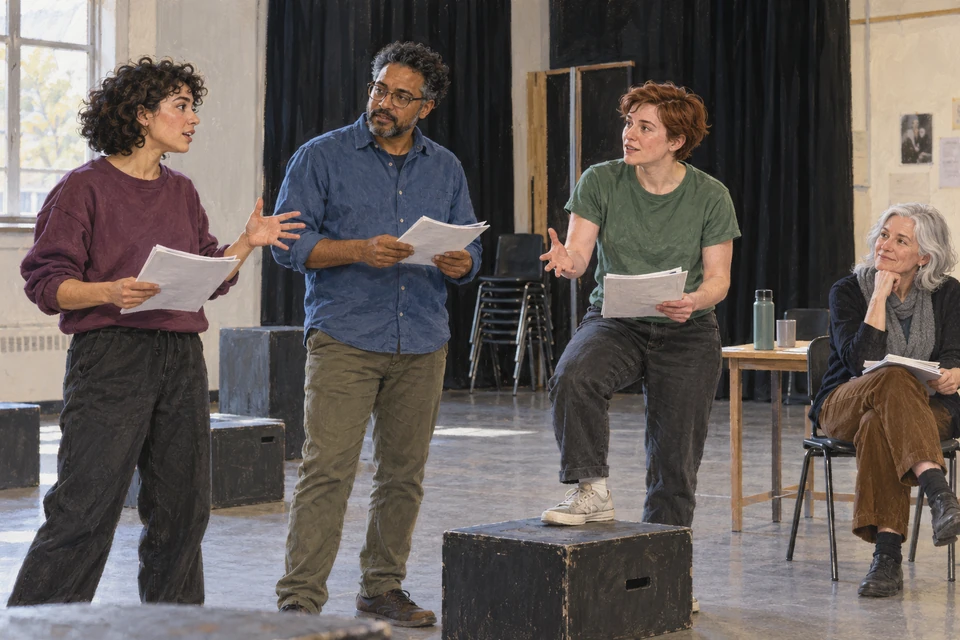
Theatre offers another setting in which language becomes collective activity. In Saint-Boniface, Manitoba, Théâtre Cercle Molière traces its foundation to 1925. Its institutional history describes performances of Quebec and Canadian plays, tours in western Canada and continuing work with younger people and amateur and professional artists. This is a specific example of francophone cultural life outside Quebec, rather than a claim that one company speaks for every community.
The company’s present mission emphasises bringing people together through stories, artistic development and collaboration with schools and community organisations. A rehearsal asks participants to listen, interpret and make choices together; an audience encounters spoken language shaped for performance. Alongside dictionaries and recorded conversations, such work shows several ways French is sustained in Canada: as everyday interaction, an object of research and a means of creating something with other people.
Sources
- Catherine Walter, in Learner English, edited by Michael Swan and Bernard Smith; Cambridge University Press, pp. 52–72. French speakers. https://www.cambridge.org/core/books/abs/learner-english/french-speakers/D4E43A2A790501FB468A2960596DC9DE
- Aménagement linguistique dans le monde, hosted by CEFAN, Université Laval. Histoire du français au Québec: colonie du Canada. https://www.axl.cefan.ulaval.ca/francophonie/HISTfrQC_s1_Nlle-France.htm
- André Thibault; Usito, Université de Sherbrooke; author affiliation displayed as Paris-Sorbonne. La lexicographie du français québécois. https://usito.usherbrooke.ca/articles/th%C3%A9matiques/thibault_1
- Fédération des communautés francophones et acadienne du Canada (FCFA). Ce que nous faisons. https://fcfa.ca/ce-que-nous-faisons/
- Gaétane Dostie, director; Fonds de données linguistiques du Québec, CRIFUQ, Université de Sherbrooke. Corpus de français parlé au Québec (CFPQ). https://fdlq.recherche.usherbrooke.ca/corpus/corpus-francais-parle-au-quebec-cfpq.html
- Théâtre Cercle Molière. La compagnie. https://www.cerclemoliere.com/a-propos/compagnie
- Katharine Snider McNair, Canadian Language Museum; hosted by the Language Portal of Canada. French in Canada: Some interesting facts you may not know. https://our-languages.canada.ca/en/blogue-blog/francais-canada-french-eng