Language & culture
Central Alaskan Yup’ik: A Language of Southwestern Alaska
Language at a glance
- Speakers in Alaska
- 2,500–7,500
2024 estimate · highly proficient Yugtun/Cugtun users.
- Local names
- Yugtun · Cup’ik · Cup’ig
Names reflect regional speech communities.
- Communities
- Southwestern Alaska
Coastal villages and Yukon–Kuskokwim river communities.
- Language family
- Inuit–Yupik–Unangan
Part of the Yupik branch.
- Writing
- 18 basic letters
Latin alphabet · ANLC orthography · combinations counted separately.
- Regional varieties
- Five main groupings
Including General Central Yup’ik and Nunivak.
Who speaks Central Alaskan Yup’ik, and what do they call it?
Central Alaskan Yup’ik, also called Yugtun, is spoken in southwestern Alaska: around Norton Sound and Bristol Bay and along the Yukon and Kuskokwim rivers. Its speakers include Elders, families and adult learners. It is distinct from Siberian Yupik and Sugpiaq, or Alutiiq.
How many people speak Central Alaskan Yup’ik in Alaska?
A 2024 Alaska estimate lists 2,500–7,500 highly proficient Yugtun/Cugtun speakers, with 100–300 highly proficient second-language speakers counted separately. It also lists 5–25 highly proficient Nunivak Cup’ig speakers. A worldwide total remains uncertain.
Where did Central Alaskan Yup’ik come from, and who spoke it in the past?
Central Alaskan Yup’ik belongs to the Yupik branch of Inuit–Yupik–Unangan. Its spoken history predates the first known word list: James King recorded words at Norton Sound during Cook’s 1778 expedition. Russian travellers and missionaries later produced further lists and texts.
Missionary writing and personal letters preceded modern school materials. Coastal and river communities continue to speak the language today.
Which Central Alaskan Yup’ik words might an English speaker already recognise?
Kuspuk, a light hooded garment in Alaskan English, comes from Yup’ik qaspeq. It can be a parka cover, jacket or dress.
English kayak comes from Inuit. Yup’ik has the corresponding word qayaq.
How does Central Alaskan Yup’ik vary from region to region?
The main groupings are General Central Yup’ik, Norton Sound, Hooper Bay–Chevak, Nunivak and Egegik. General Central Yup’ik covers much of the Yukon–Kuskokwim and Bristol Bay region. Chevak uses the local name Cup’ik; Nunivak Island uses Cup’ig.
Which written form of Central Alaskan Yup’ik is used in education?
The University of Alaska Fairbanks’ modern orthography, developed in the 1960s with Yup’ik speakers, is used in dictionaries and teaching materials. It accommodates regional pronunciation. The university’s orthography course teaches this shared spelling to people who already speak the language, drawing on their dialect differences.
Which alphabet does Central Alaskan Yup’ik use, and what might surprise an English speaker?
Modern Alaska Native Language Center orthography uses 18 basic Latin letters. Combinations such as ng and ll, and added marks, are counted separately.
The apostrophe in Yup’ik marks a long p sound, rather than missing letters as in English contractions.
Does Central Alaskan Yup’ik have grammatical gender?
No. Nouns are not divided into masculine and feminine grammatical classes.
How do you say hello, thank you and goodbye in Central Alaskan Yup’ik?
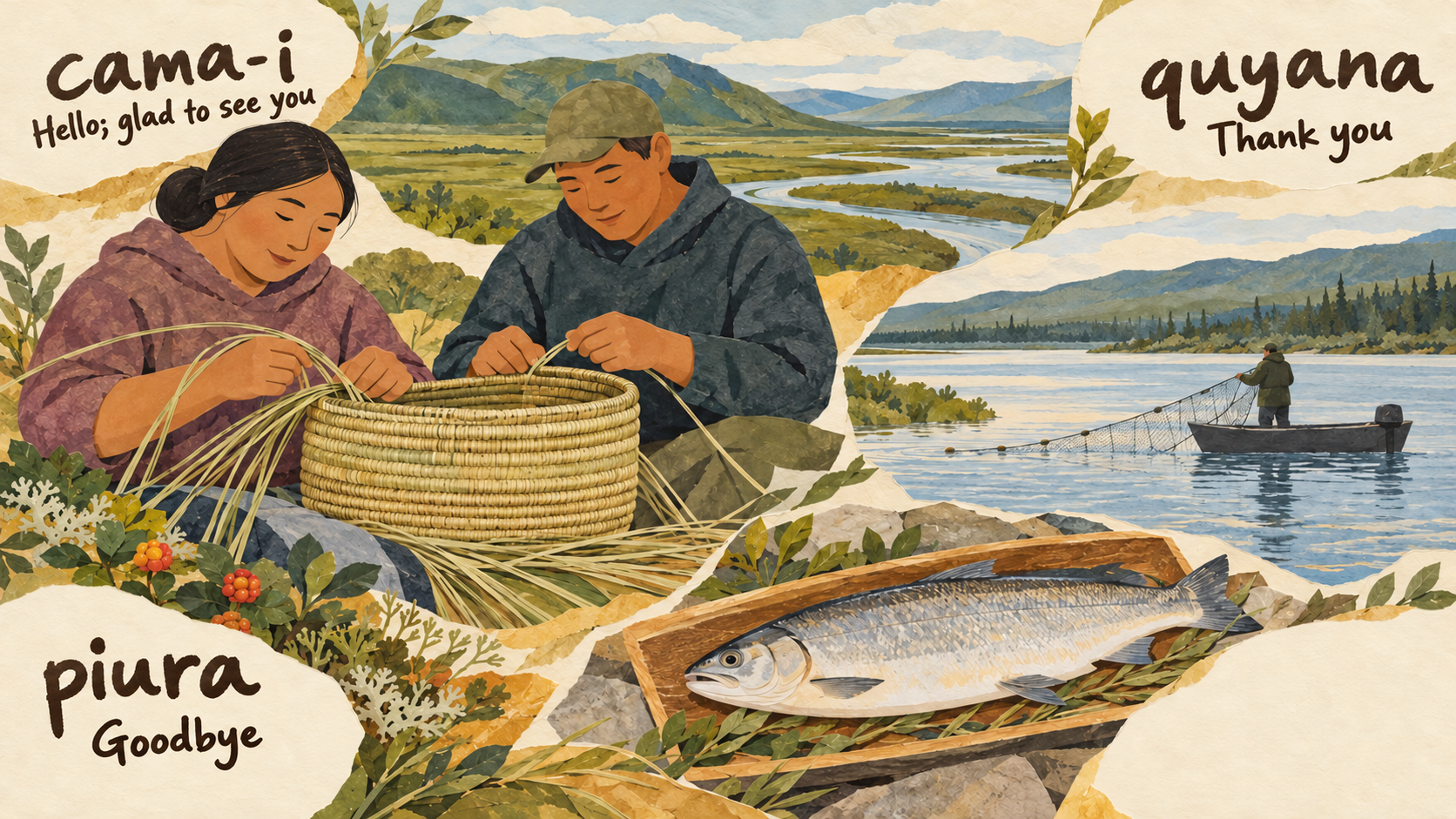
- cama-i — hello, with the sense of being glad to see someone.
- quyana — thank you.
- piura — goodbye.
What are some memorable Central Alaskan Yup’ik sayings?
Qanruyutet are Elders’ words of guidance:
- Ciutek-gguq iinguuk — “Ears, they say, are eyes.” This saying accompanies oral teachings, linking careful listening with understanding.
- Upterrlainarluta — “Always be alert and ready.” Elder John Smith recalled this seal-hunting advice as his uncles watched the wind, tides and ice.
What everyday customs might surprise a visitor?
Sharing a catch can extend beyond the household. Tuvqakiyaraq concerns sharing gathered or caught food. In a 2022 account of the Calista region, cultural advisor Mark John described hunters’ and fishers’ families providing for Elders, widows and people with disabilities after meeting their own needs.
Which Central Alaskan Yup’ik-language song and film offer a cultural introduction?
“Ak’a Tamaani” by John Angaiak opens the Yup’ik side of his 1971 album I’m Lost in the City. The Nightmute singer combines guitar with songwriting about Indigenous life and change. The album also has an English-language side.
Uksuum Cauyai: The Drums of Winter (1988), directed by Sarah Elder and Leonard Kamerling, follows Emmonak’s ceremonial songs and dances. Elders explain the movements’ meanings.
What is available for someone curious about the language now?
- Anna Jacobson’s Yup’ik Stories Read Aloud offers six audio recordings on the University Press of Colorado’s open site. Its separately sold booklet has Yup’ik transcriptions and interlinear English translations.
- The Yup’ik Atlas maps place names, stories and videos from the Bering Sea coast and Yukon–Kuskokwim Delta. It requires JavaScript.
- UAF’s Elementary Central Yup’ik I is a five-credit fall course listed for 2026–2027, open to speakers and nonspeakers.
Fun Facts
- Caayuq and saayuq, words for tea, are Russian borrowings: contact history survives in an everyday drink’s name.
- A quliraq is a traditional story; a qanemciq recounts something experienced. English story can cover both, while Yup’ik distinguishes the kinds of telling.
Sources
- Alaska Native Language Center, University of Alaska Fairbanks. Languages — Central Yup’ik. n.d.
https://www.uaf.edu/anlc/languages-move/centralakyupik.php - Alaska Native Language Archive, University of Alaska Fairbanks. Overview of Comparative Inuit-Yupik-Unangan. n.d.
https://www.uaf.edu/anla/collections/cea/about/ - Alaska Native Language Archive, University of Alaska Fairbanks. Guide to the Central Alaskan Yup’ik Collection. n.d.
https://www.uaf.edu/anla/collections/cayupik/ - David Hirning, interviewer; University of Washington. Preserving Endangered Languages. 2023-10.
https://www.compling.uw.edu/careers/alumni-stories/lonny-alaskuk-strunk - Calista Education and Culture. Yup’ik Atlas: Mapping Our Stories and Place Names. n.d.
https://www.calistaeducation.org/yupik-atlas-1 - Mark John, cultural advisor; Calista Education and Culture; published by Calista Corporation. Yup’ik Teaching Moment: Tuvqakiyaraq. 2022-03/2022-04.
https://www.calistacorp.com/news/yupik-teaching-moment-tuvqakiyaraq/ - Anna Jacobson; Alaska Native Language Center; University Press of Colorado Open Books. Yup’ik Stories Read Aloud / Yugcetun Qulirat Naaqumalriit Erinairissuutmun. 1998 (book); online audio collection, n.d.
https://read.upcolorado.com/projects/yup-ik-stories-read-aloud-yugcetun-qulirat-naaqumalriit-erinairissuutmun - Steven A. Jacobson; Alaska Native Language Center, University of Alaska Fairbanks. Yup’ik Eskimo Dictionary, second edition, volume 2. 2012.
https://beringstraits.com/wp-content/uploads/2024/01/Yupik_Eskimo_Dictonary_Vol_2.pdf - Alaska Native Language Preservation and Advisory Council. AYARUQ: 2024 Action Plan for Alaska Native Languages. 2024-01-01.
https://education.alaska.gov/anlpac/AYARUQ%20Final%20Draft%202024.pdf - Alaska Department of Education and Early Development; Council for Alaska Native Languages. Languages. n.d.
https://education.alaska.gov/canl/Languages - Steven A. Jacobson; Alaska Native Language Center, University of Alaska Fairbanks. Yup’ik Eskimo Dictionary, second edition, volume 1. 2012.
https://www.alaskafarmersmarketstoolkit.org/wp-content/uploads/2022/05/Yupik_Eskimo_Dictionary_Vol_1.pdf - Greville G. Corbett; WALS Online, edited by Matthew S. Dryer and Martin Haspelmath. Yup’ik (Central): Number of Genders. n.d.
https://wals.info/valuesets/30A-ypk - Merriam-Webster. Kayak: definition and etymology. n.d.
https://www.merriam-webster.com/dictionary/kayak - Dictionary.com Unabridged, based on the Random House Unabridged Dictionary. Kuspuk: definition and etymology. n.d.
https://www.dictionary.com/browse/kuspuk - John Smith and Sean Gleason; Text and Performance Quarterly. “Knowledge is like food”: qanruyutet on change and subsistence from John Smith. 2021-05-07.
https://www.researchgate.net/publication/351418322_Knowledge_is_like_food_qanruyutet_on_change_and_subsistence_from_John_Smith - John Angaiak; artist/label Bandcamp release page. I’m Lost in the City. 1971 (original album); 2016-05-20 (reissue listing).
https://johnangaiak.bandcamp.com/album/i-m-lost-in-the-city - University of Alaska Museum of the North, Film Center. The Drums of Winter. n.d.
https://www.uaf.edu/museum/collections/docfilm/policies/drums_of_winter/ - Visual Anthropology of the North, UiT The Arctic University of Norway; Alaska Ethnographic Film Archive. Uksuum Cauyai: The Drums of Winter. n.d.
https://site.uit.no/visantofnorth/p032/ - University of Alaska Fairbanks. Yup’ik (YUP): 2026–2027 catalogue. 2026–2027 catalogue edition.
https://catalog.uaf.edu/courses/yup/ - Anna Jacobson; Alaska Native Language Center; University Press of Colorado. Yup’ik Stories Read Aloud: book listing. 1998-03.
https://www.upcolorado.com/alaska-native-language-center/yupik-stories-read-aloud - University of Alaska Museum of the North. Film Center — Alaska Center for Documentary Film. n.d.
https://www.uaf.edu/museum/collections/docfilm/ - Theresa Bakker; University of Alaska Fairbanks News / Museum of the North. Art and film featured at museum’s First Friday. 2017-11-27.
https://www.uaf.edu/news/archives/news-archives-2010-2021/community-invited-to-first-friday-at-uamn.php
Start learning today
Explore these books to keep learning.