Central Alaskan Yup’ik: Words for Rivers, Stories and Sharing
 cama-iHello; glad to see youquyanaThank youpiuraGoodbye
Language at a glance
- Highly proficient speakers
- Approx. 2,500–7,500
Alaska · AYARUQ 2024 report estimate.
- Region
- Southwestern Alaska
Norton Sound, Bristol Bay, Yukon–Kuskokwim communities and Nunivak Island.
- Language family
- Inuit–Yupik–Unangan
Yupik branch.
- Writing system
- Latin script
Modern Central Alaskan Yup’ik orthography.
The estimate covers Yugtun/Cugtun (Yup’ik/Cup’ik). Nunivak Cup’ig and proficient second-language speakers are tabulated separately. 2024 is the report year, rather than a new census.
Which Yup’ik are we talking about?
Central Alaskan Yup’ik is spoken in southwestern Alaska, along the coast around Norton Sound and Bristol Bay and inland along the region’s rivers. Its relatives belong to the Inuit–Yupik–Unangan family. The broader Yupik group contains several languages; Central Alaskan Yup’ik is one of them, alongside relatives such as Siberian Yupik and Alutiiq.
Local names also reveal differences within Central Alaskan Yup’ik. In Chevak, the language is called Cup’ik; on Nunivak Island, Cup’ig. General Central Yup’ik is the main dialect grouping, alongside Norton Sound, Hooper Bay–Chevak, Nunivak and Egegik.
How do you say hello, thank you and goodbye in Central Alaskan Yup’ik?
Three short expressions provide a glimpse of ordinary conversation:
- cama-i — hello, with the sense of being glad to see someone.
- quyana — thank you.
- piura — goodbye.
How do places keep their stories?
The Yup’ik Atlas brings together place names and accounts shared by Elders and communities around the Bering Sea coast and Yukon–Kuskokwim Delta. Its map reaches beyond settlements to places such as sandbars, ponds and channels beneath the water. Camp locations and river features appear alongside memories and teachings associated with them.
Calista Education and Culture developed the atlas with the Exchange for Local Observations and Knowledge of the Arctic. The project includes stories and videos as well as names.
What does sharing a catch mean?
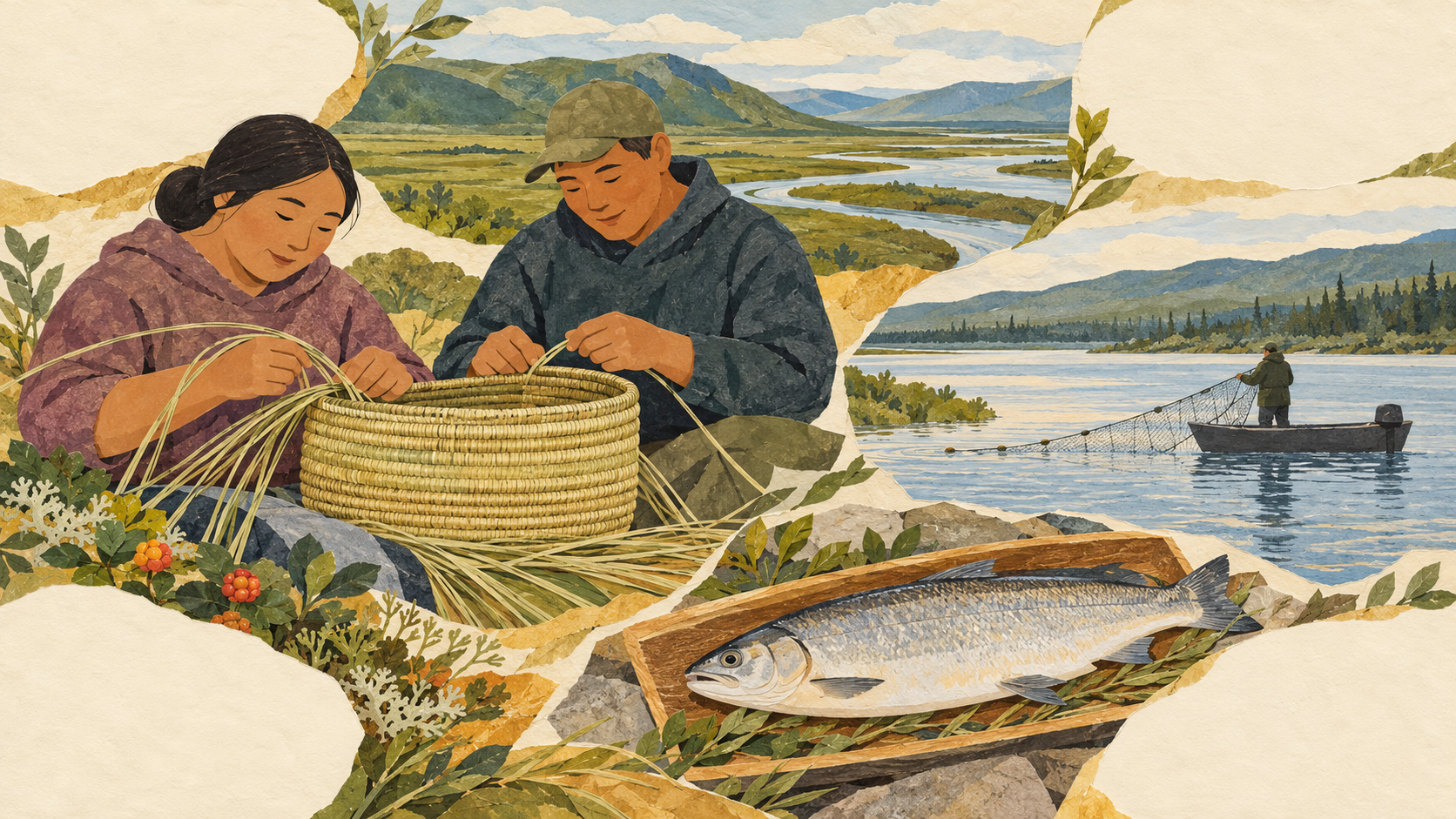
Tuvqakiyaraq concerns sharing what one has gathered or caught. In a 2022 teaching shared by Calista Education and Culture, cultural advisor Mark John describes families whose many hunters and fishers could provide generously. Once their own needs were met, they supplied people unable to hunt or fish for themselves, including Elders, widows and people with disabilities.
The teaching connects this practical help with gratitude and the hope of future abundance.
Which stories can you hear in Yup’ik?
Anna Jacobson’s Yup’ik Stories Read Aloud pairs six recordings in her own language with written Yup’ik and English translations. Five are traditional tales from southwestern Alaska. The sixth, Kiagmi Neqlivik, or Fishcamp in Summer, concerns family life at a Kuskokwim River fish camp.
The accompanying text places translations alongside the Yup’ik wording, allowing the printed and spoken versions to be followed together. The publisher’s open collection includes the recordings themselves.
Yup’ik also has words for different kinds of telling. A quliraq can be a traditional story; a qanemciq can be an account of something experienced. Both may become story in English, but the Yup’ik terms give a more specific sense of what is being related.
How did Yup’ik reach books and screens?
Earlier writing included missionary texts and personal letters. In the 1960s, Irene Reed and colleagues at the University of Alaska Fairbanks developed the modern writing system. Bilingual school programs followed in the early 1970s, and the university’s archive now documents primers, children’s stories, teaching materials and literary works.
Digital work has also come from Yup’ik developers. Lonny Alaskuk Strunk, from Quinhagak, created software that analyzes how Yup’ik words are assembled. His work became part of an online dictionary with a word-building feature. He worked with fellow Yup’ik developer Christopher Egalaaq Liu on language resources for communities.
That design responds to a distinctive feature of Yup’ik: a word can combine numerous meaningful parts. An ordinary list of separate English-style dictionary entries would miss many of the forms a reader encounters. The analyzer helps connect those longer forms with their component meanings.
Fun Facts
- The apostrophe in Yup’ik marks a long p sound: even the language’s name contains a clue to its pronunciation.
- Caayuq and saayuq, words for tea, are Russian borrowings. Steven Jacobson’s dictionary traces them to the Russian word for the drink, recording a small piece of contact history in everyday vocabulary.
Sources
- Alaska Native Language Center, University of Alaska Fairbanks. Languages — Central Yup’ik. n.d.. https://www.uaf.edu/anlc/languages-move/centralakyupik.php
- Alaska Native Language Archive, University of Alaska Fairbanks. Overview of Comparative Inuit-Yupik-Unangan. n.d.. https://www.uaf.edu/anla/collections/cea/about/
- Alaska Native Language Archive, University of Alaska Fairbanks. Guide to the Central Alaskan Yup’ik Collection. n.d.. https://www.uaf.edu/anla/collections/cayupik/
- David Hirning, interviewer; University of Washington. Preserving Endangered Languages. 2023-10. https://www.compling.uw.edu/careers/alumni-stories/lonny-alaskuk-strunk
- Calista Education and Culture. Yup’ik Atlas: Mapping Our Stories and Place Names. n.d.. https://www.calistaeducation.org/yupik-atlas-1
- Mark John, cultural advisor; Calista Education and Culture; published by Calista Corporation. Yup’ik Teaching Moment: Tuvqakiyaraq. 2022-03/2022-04. https://www.calistacorp.com/news/yupik-teaching-moment-tuvqakiyaraq/
- Anna Jacobson; Alaska Native Language Center; University Press of Colorado Open Books. Yup’ik Stories Read Aloud / Yugcetun Qulirat Naaqumalriit Erinairissuutmun. n.d.. https://read.upcolorado.com/projects/yup-ik-stories-read-aloud-yugcetun-qulirat-naaqumalriit-erinairissuutmun
- Steven A. Jacobson; Alaska Native Language Center, University of Alaska Fairbanks. Yup’ik Eskimo Dictionary, second edition, volume 2. 2012. https://beringstraits.com/wp-content/uploads/2024/01/Yupik_Eskimo_Dictonary_Vol_2.pdf
- Alaska Native Language Preservation and Advisory Council. AYARUQ: 2024 Action Plan for Alaska Native Languages. 2024-01-01. https://education.alaska.gov/anlpac/AYARUQ%20Final%20Draft%202024.pdf
- Alaska Department of Education and Early Development; Council for Alaska Native Languages. Languages. n.d.. https://education.alaska.gov/canl/Languages