Language & culture
Cherokee: Words, Writing and Voices Today
Language at a glance
- Speakers
- About 1,500 first-language speakers
Cherokee Nation only; October 2024 estimate.
- Local name
- ᏣᎳᎩ · Tsalagi
Language and people share this name.
- Communities
- Oklahoma · North Carolina
Cherokee Nation, United Keetoowah Band and Eastern Band.
- Family
- Southern Iroquoian
The branch’s only surviving language.
- Writing
- Cherokee syllabary · 85 ordinary signs
86 including historical Ᏽ (mv).
- Varieties
- Overhill · Middle (Kituwah)
Local speech and spellings also vary.
Who speaks Cherokee, and what do they call it?
Cherokee communities include the Cherokee Nation and United Keetoowah Band of Cherokee Indians in Oklahoma, and the Eastern Band of Cherokee Indians in North Carolina. Speakers include people raised with Cherokee and those learning through immersion or other teaching programs. ᏣᎳᎩ, also written Tsalagi, names both the language and the people.
How many people speak Cherokee worldwide?
Cherokee Nation’s February 2025 report estimated about 1,500 first-language speakers for October 2024. This Cherokee Nation figure is not a worldwide total.
Where did Cherokee come from, and who spoke it in the past?
Cherokee is the only surviving language of the Southern branch of the Iroquoian family. Its southeastern homelands include parts of present-day North Carolina, Tennessee, Georgia, South Carolina and Alabama. Some Cherokee people moved west before the forced removal of 1838; that removal separated many families from their eastern homelands. Later boarding schools punished children for speaking Cherokee and disrupted its transmission between generations.
Written records of Cherokee predate its own script. Luigi Castiglioni’s 1790 travel account included a vocabulary of nearly 170 words. Sequoyah completed the syllabary in 1821, and the bilingual Cherokee Phoenix began publication in 1828.
Which Cherokee words might an English speaker already recognise?
English speakers may recognise coffee in Oklahoma Cherokee khaáhwi and watch in waáci. Both are borrowings from English, adapted to Cherokee sounds.
How does Cherokee vary from region to region?
Historically, Cherokee had Overhill, Underhill and Middle (Kituwah) dialects. Underhill became dormant by the early twentieth century; Overhill and Middle continued. Middle is associated with North Carolina’s Qualla Boundary, Western Cherokee with northeastern Oklahoma. Within Oklahoma, United Keetoowah Band communities have local differences as well.
How is written Cherokee shared across communities and schools?
The three tribes cooperate through the Cherokee Language Consortium on new vocabulary and teaching materials. Fluent speakers and second-language learners take part in this work. They share a syllabary, although spelling varies.
Which writing system does Cherokee use, and what might surprise an English speaker?
Cherokee uses a syllabary, whose signs generally represent syllables rather than individual consonants and vowels. The ordinary teaching inventory has 85 signs, or 86 including historical Ᏽ (mv).
Familiar-looking shapes can sound unexpected: Ꭰ has the value a, despite resembling a Latin capital D. Cherokee also has lowercase forms.
Does Cherokee have grammatical gender?
Cherokee has no masculine–feminine distinction like he and she, but some verb forms distinguish animate from inanimate objects.
How do you say hello, thank you and goodbye in Cherokee?
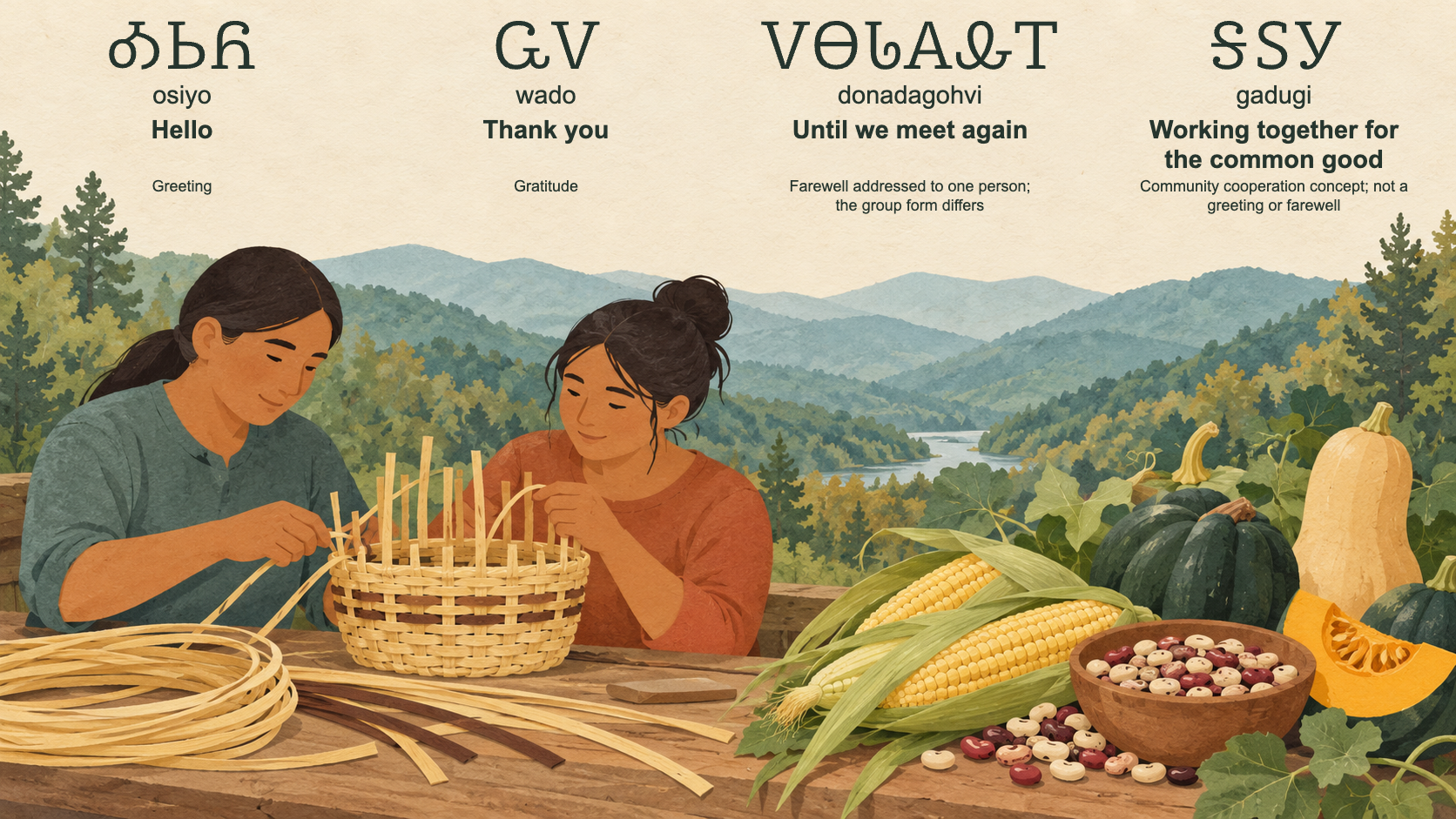
Cherokee Nation usage includes:
- ᎣᏏᏲ (osiyo) — Hello. Greeting.
- ᏩᏙ (wado) — Thank you. Gratitude.
- ᏙᎾᏓᎪᎲᎢ (donadagohvi) — Until we meet again. Farewell addressed to one person; the group form differs.
- ᎦᏚᎩ (gadugi) — Working together for the common good. Community cooperation concept; not a greeting or farewell.
- ᎥᎥ (Vv) — Yes. Affirmative reply.
- ᎥᏝ (Vtla) — No. Negative reply.
The farewell addresses one person; a different form is used for a group.
What are some memorable Cherokee sayings?
- ᏂᏓᏙᏓᏈᏒ, ᏣᎳᎩ ᎢᏥᏬᏂᏍᎨᏍᏗ. — “Speak Cherokee every day.” This was dictionary maker and teacher Durbin Feeling’s maxim.
- ᎡᎵᏊ ᎢᎬᏱᏊ ᎠᏆᏁᎵᏔᏅ ᏯᏂᎦᏛᎦ — “I think I’ll find it on the first try.” Feeling, Joseph Erb and fellow translators developed it for Google’s lucky-search option.
What everyday customs might surprise a visitor?
ᎦᏚᎩ, or gadugi, means cooperating for the community’s benefit. In 2023, Cherokee families needed help with firewood, minor house repairs, lawn care and storm cleanup. Cherokee Nation’s Gadugi Corps connects volunteers with projects, including help for elders.
Which Cherokee-language song and film offer a cultural introduction?
Agalisiga “Chuj” Mackey sings Tsitsutsa Tsigesv (“When I Was a Boy”) in Cherokee. The country recording draws on childhood memories of a creek and changing seasons. Mackey is from Kenwood, Oklahoma; the song appears on his 2024 album Nasgino Inage Nidayulenvi (“It Started in the Woods”).
The film ᏓᏗᏬᏂᏏ, We Will Speak (2023), directed by Schon Duncan and Michael McDermit, follows efforts to keep the language in use across all three Cherokee tribes. Cherokee and English are spoken, with English subtitles.
What is available for someone curious about the language now?
Cherokee Nation offers free PDFs of Durbin Feeling’s Cherokee Reader, Book One and Learning to Use the Cherokee Verb, by Feeling and colleagues. The latter explains verb forms through examples. The 2024 Consortium Word List adds vocabulary developed through the Cherokee Language Consortium.
Fun Facts
- A banknote and loose change can call for different verbs. Paper bills take the possession pattern for flexible objects; coins take a different pattern.
- One word can specify exactly who is going. ᎢᏁᎦ means “we (you and I) are going.” It includes the listener and refers to two people.
Sources
- Brian Hsu and Benjamin Frey. Word order in Cherokee: Information structure, thematic structure, and variability. Language 100(3), 2024.
https://www.lsadc.org/Files/Language/Language%202024/100.3_e02Hsu&Frey.pdf - United Keetoowah Band of Cherokee Indians in Oklahoma. About Us. No date.
https://www.ukb-nsn.gov/about-us - Cherokee Nation. Biennial Report on the State of Cherokee Language. February 10, 2025; language assessment dated October 2024.
https://www.cherokee.org/media/13znqfcu/biennial-report-on-the-state-of-cherokee-language-2025_final.pdf - Durbin Feeling, Joshua Webster, Craig Kopris, Charles van Tuyl and Shoshone Odess. Learning to Use the Cherokee Verb. Cherokee Nation. No publication date; official download added April 16, 2024.
https://language.cherokee.gov/media/vnihnhms/learning-to-use-the-cherokee-verb.pdf - Cherokee Nation and RSU Public TV. Cherokee 1 on RSU TV: course catalogue. No date.
https://learn.cherokee.org/course/index.php?categoryid=7 - Cherokee Nation. Cherokee Nation Citizens At-Large. No date.
https://cherokeesatlarge.org/ - Cherokee Nation. Popular Annual Financial Report for fiscal year ended September 30, 2019. 2020. Final-page memorial.
https://www.cherokee.org/media/gaahnswb/pafr-fy19-final-v-2.pdf - Cherokee Nation Gadugi Task Force. Final Report to Principal Chief Chuck Hoskin, Jr., from the Task Force on Volunteer & National Service. October 6, 2023.
https://www.cherokee.org/media/gxunryks/taskforce_gadugicorp_20231006.pdf - William Pulte and Durbin Feeling. Outline of Cherokee Grammar. Cherokee Nation of Oklahoma, 1975.
https://cherokeenationdictionary.net/pdf/cherokee_grammar_df.pdf - Cherokee Nation. Cherokee Nation Dictionary: Speakers. No date.
https://cherokeenationdictionary.net/speakers.html - Joseph Erb, Joanna Hearne and Mark Palmer, with Durbin Feeling. Origin Stories in the Genealogy of Cherokee Language Technology. b2o, July 2018.
https://www.boundary2.org/2018/07/hearne/ - Unicode Consortium. The Unicode Standard, Version 18.0, Chapter 20: Americas, section 20.1 Cherokee. 2026.
https://unicode.org/versions/Unicode18.0.0/core-spec/chapter-20/ - Unicode Consortium. The Unicode Standard, Version 18.0: Cherokee, U+13A0–U+13FF character chart. 2026.
https://www.unicode.org/charts/PDF/U13A0.pdf - Hiroto Uchihara. Tone and Accent in Oklahoma Cherokee. Doctoral dissertation, University at Buffalo, State University of New York, 2013.
https://arts-sciences.buffalo.edu/content/dam/arts-sciences/linguistics/AlumniDissertations/Uchihara%20dissertation.pdf - Cherokee Nation. Cherokee Language Consortium. Updated October 6, 2026.
https://language.cherokee.gov/language-programs/cherokee-language-consortium/ - Cherokee Nation. Teaching Materials. Updated August 13, 2026.
https://language.cherokee.gov/learning-materials/teaching-materials/ - Cherokee Language Consortium / Cherokee Nation. Consortium Word List. Updated September 16, 2024; official download posted October 24, 2024.
https://language.cherokee.gov/media/vdiic5hr/2024consortium.pdf - Agalisiga Mackey and Horton Records. Nasgino Inage Nidayulenvi (It Started in the Woods): album, track list and credits. Released October 18, 2024.
https://hortonrecords.bandcamp.com/album/nasgino-inage-nidayulenvi-it-started-in-the-woods - Ayesha Rascoe and Ryan Benk. Agalisiga Mackey reflects on writing songs in his native Cherokee language. NPR interview, published by KOSU, June 23, 2024.
https://www.kosu.org/music/2024-06-23/agalisiga-mackey-reflects-on-writing-songs-in-his-native-cherokee-language - Schon Duncan and Michael McDermit / Blurry Pictures. ᏓᏗᏬᏂᏏ (We Will Speak): production details and press kit. Film released 2023; press kit undated.
https://www.buncombecounty.org/common/library/We%20Will%20Speak%20Details.pdf - Evolution Publishing. American Indian Languages: Castiglioni’s Vocabulary of Cherokee, by Luigi Castiglioni (1790), American Language Reprint Series 33. Catalogue entry for the 2009 edition; page undated.
https://www.arxbooks.com/evolpub/ECBookstore/IndianLangs.html - Western Carolina University, Hunter Library. Cherokee Traditions: Language & Literature. No date.
https://www.wcu.edu/library/DigitalCollections/CherokeeTraditions/Language/ - Durbin Feeling. Cherokee Reader, Book One. Cherokee Language Curriculum Project, Cherokee Nation, 1993.
https://language.cherokee.gov/media/ti2etezo/cherokee_reader.pdf - Cherokee Nation. Gadugi Corps. Updated October 9, 2026.
https://cherokee.gov/departments/gadugi-corps/ - Brian Daffron, interviewing Dr. Candessa Tehee. 10 Things You Should Know About Cherokee Nation. Indian Country Today, January 8, 2015; page also displays November 28, 2025.
https://ictnews.org/archive/10-things-you-should-know-about-cherokee-nation/ - Cherokee Nation Education Services. We Are Learning Cherokee, Level 1. ©2018. pp.75–77. https://cherokeenationdictionary.net/pdf/cherokee_grammar.pdf
- Mike ᎩᏳᎦ White. Verb Parts. Digital Archive of Indigenous Language Persistence, Northeastern University Library. Page updated May11,2026. https://dailp.northeastern.edu/cwkw/verb-parts/
Start learning today
Explore these books to keep learning.