Languages & Culture
Cherokee
Cherokee belongs to the southern branch of the Iroquoian language family. Its historical homeland is in the southern Appalachians, while language work today connects communities in North Carolina and Oklahoma. The Cherokee Nation, United Keetoowah Band of Cherokee Indians and Eastern Band of Cherokee Indians are distinct tribal communities whose speakers collaborate through a language consortium. A broad introduction must leave room for their different histories and ways of speaking.
The familiar division into Eastern and Western Cherokee is useful, but it does not describe every local difference. The United Keetoowah Band explicitly identifies variation within its own communities. Its account also explains that some ancestors moved west before the forced removal known as the Trail of Tears, while others were subsequently compelled to leave. The Band is based in Tahlequah, Oklahoma. Those distinct experiences matter when identifying the community behind a recording, teaching resource or historical document.
A writing tradition and an interrupted inheritance
Sequoyah completed the Cherokee syllabary in 1821. The United Keetoowah Band describes its dissemination as a major transformation in Cherokee literacy. Writing did not insulate spoken transmission from the pressures of assimilation and boarding schools, however. The Band’s account identifies those pressures as causes of language loss. Cherokee language history therefore includes both deliberate intellectual innovation and institutions that disrupted children’s connections with speakers.
Archives preserve some of the resulting variety of written and recorded language. The University of Oklahoma’s Sam Noble Museum lists a notebook of Bellefonte Indian Baptist Church Sunday-school records from 1962–63, alongside a 2010 audio item titled Baby bear. These catalogue descriptions show how documentation can encompass ordinary recordkeeping as well as storytelling. They also provide a practical reminder to distinguish an archive’s description from the recording or manuscript itself: consulting a catalogue does not mean hearing the speakers or reading their complete text.
Listening to how sentences work
Cherokee also rewards attention beyond the shapes of its written characters. A 2024 study by Brian Hsu and Benjamin Frey examined word order in spoken narratives. It found that ordering preferences respond to several interacting factors, including whether a person or thing has already been introduced and the role it plays in an event. Flexible order follows patterns that speakers understand. Frey, an Eastern Band citizen, describes his involvement in language reclamation, and the authors connect their research with the development of teaching materials. This is scholarship directed toward understanding speakers’ choices in context.
Learning across generations
In Oklahoma, the Cherokee Nation’s Master Apprentice Program pairs novice adults with fluent speakers in a full-time, two-year immersion commitment. Its public description identifies Tahlequah and Kenwood locations and an aim of preparing new teachers. Community events, cultural activities and volunteering form part of its approach. This makes language learning a substantial relationship and responsibility, extending beyond a short introductory course.
Other routes accommodate different circumstances. The Nation describes immersion education for children and teenagers in Tahlequah, community classes, online instruction and self-directed study. Its Language Hub gathers stories, lessons and recordings. Together, these options recognise that children beginning their education, adults preparing to teach and people studying around other commitments need different kinds of access. The existence of a resource does not establish how much an individual learner understands; proficiency develops through sustained participation.
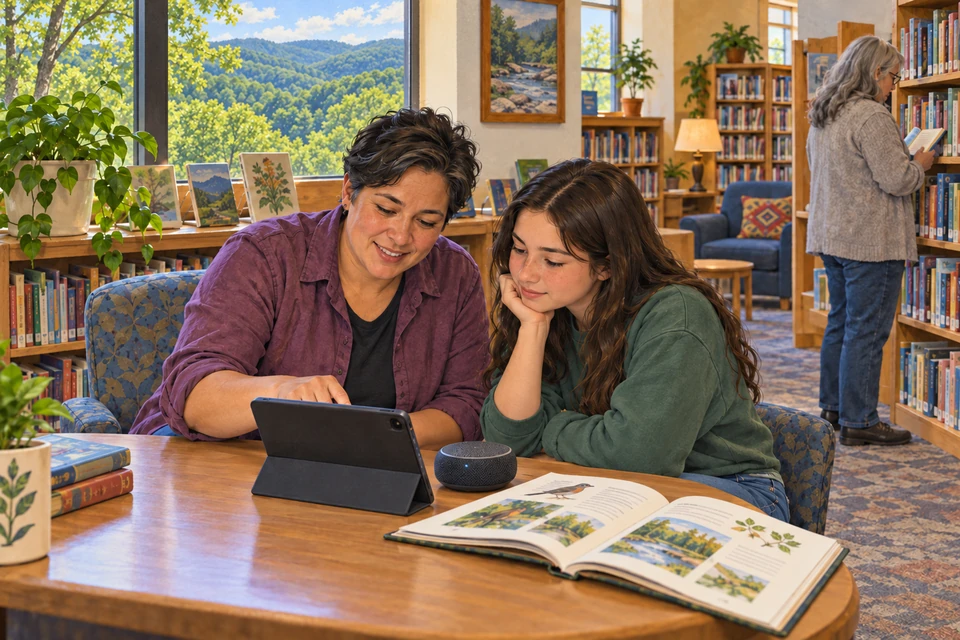
The Eastern Band’s 2025 annual report supplies a separate, concrete picture. New Kituwah Academy provides immersion education, with language classes also reported for staff and parents. The Kituwah Preservation and Education Program supports adult learning and translates community materials. The Qualla Public Library includes Cherokee classes among its literacy and computer services. These are connected places where language can enter a family’s week through children’s schooling, adult study and shared public resources.
Collaboration across communities also involves making language usable for new purposes. The Cherokee Language Consortium brings together fluent speakers and second-language learners appointed by the three tribes, alongside university partners, to develop words and curriculum. That work gives contemporary speakers an active role in shaping instruction. For a newcomer, identifying who produced a resource and which community it serves is a useful first step toward learning from that continuing work.
Sources
- Sam Noble Oklahoma Museum of Natural History, University of Oklahoma. Cherokee Language. https://samnoblemuseum.ou.edu/collections-and-research/native-american-languages/map-of-oklahoma-languages/cherokee-language/
- United Keetoowah Band of Cherokee Indians. About Us | United Keetoowah Band | Tahlequah. https://www.ukb-nsn.gov/about-us
- Cherokee Nation Language Department. Cherokee Nation: Cherokee Language Consortium. https://language.cherokee.gov/language-programs/cherokee-language-consortium/
- Brian Hsu and Benjamin Frey; Language, volume 100, number 3. Word order in Cherokee: Information structure, thematic structure, and variability (2024). https://www.lsadc.org/Files/Language/Language%202024/100.3_e02Hsu&Frey.pdf
- Cherokee Nation Language Department. Cherokee Nation: Cherokee Language Master Apprentice Program. https://language.cherokee.gov/language-programs/cherokee-language-master-apprentice-program/
- Cherokee Nation. Cherokee Nation: Learning the Cherokee language. https://www.cherokee.gov/life-events/learning-the-cherokee-language/
- Eastern Band of Cherokee Indians, Division of Community, Education & Recreation Services. 2025 Division of Community, Education & Recreation Services (CERS). https://www.ebci.gov/wp-content/uploads/2026/03/Community-Education-Recreation-Annual-Report-2025.pdf
- Cherokee Preservation Foundation. Cherokee Language. https://cherokeepreservation.org/cherokee-language/