Languages & Culture
Chilean Spanish
Chilean Spanish encompasses the regional and social forms of Spanish used in Chile. Spanish is a Romance language with historical roots in Castile, and the Chilean varieties belong within that wider language. Their history includes colonial settlement, contact with Indigenous languages, the development of schools and print, and continuing debate about how people should speak. The national label is useful, but it does not identify one accent shared by everyone from the north to the far south.
Who gets to define good speech?
During the colonial period, Spanish in Chile developed distinctive vocabulary, pronunciation and grammatical patterns. Memoria Chilena, the National Library’s historical resource, identifies contact with Mapuche and Quechua languages as particularly important to vocabulary. In the nineteenth century, printing, public education and new institutions helped establish a standard for public communication. Andrés Bello’s 1847 grammar was influential in that process. The history of everyday speech and the history of rules about speech are therefore closely connected, although they are different objects of study.
Attitudes themselves can be investigated. In a 2012 study, Darío Rojas Gallardo examined how participants from Santiago evaluated speech associated with different parts of Chile. They tended to favour the capital and central zone, while evaluations of southern speech varied with the dimension being assessed and the participants’ social grouping. These findings concern perceptions within a particular study. They do not establish that central Chilean speech is linguistically superior, or tell us what every Chilean thinks. They show how familiar ways of speaking can become standards against which people judge others.
Forms of address offer a more immediate example of the relationship between grammar and social life. Chilean usage includes systems traditionally called tuteo, ustedeo and voseo: different patterns for addressing one person. Pronoun choice and verb form need to be considered separately. A 2024 study by Nicole Riveros-Diegues and Frank Honores-Barrios discusses verbal voseo in informal interaction and television, alongside the social judgments attached to it. Their pedagogical argument is that students can learn to understand context and variation while developing greater control of their own language use. A form heard among friends should therefore be learned with its social setting, rather than treated as an interchangeable replacement in every conversation.
Finding language in historical records
Historical scholarship increasingly brings dispersed printed material into searchable collections. Claudio Garrido Sepúlveda and Catalina Insausti Muñoz’s 2026 description of the Corpus Diacrónico del Español de Chile, or CoDiECh, explains its focus on literary and nonliterary national print, principally from the nineteenth and twentieth centuries. Its design considers chronology, geography and different kinds of discourse. The researchers also identify the need to add material that improves the balance between periods.
For a reader, this opens questions that a list of slang cannot answer. When does a word appear in the surviving record? Does it occur in fiction, journalism or another kind of writing? How does its use change? The collection is evidence of printed language, so an absence from it cannot prove that nobody spoke a word. Its value lies in making particular kinds of historical evidence easier to examine and compare.
Poetry on a single sheet
The Lira Popular offers a vivid example of print’s social reach. These loose sheets circulated in Chilean towns and cities in the late nineteenth and early twentieth centuries. Poets used verse to comment on public events, including disasters, elections and crime, alongside religious and other traditional themes. Headlines and engravings helped give the sheets their visual character. Poets also sold their work in streets, markets and railway stations, connecting writing with the places where workers and travellers met. The collections preserve a public conversation that extended beyond prestigious literary publishing.
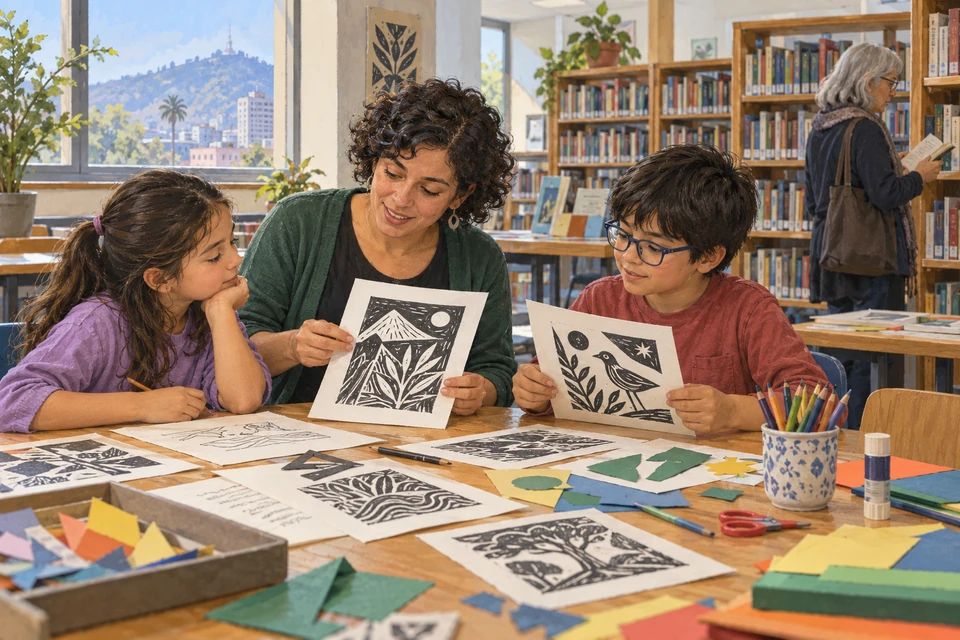
That material continues to find new readers. In its May 2025 account of Chile para Niños, the National Library describes adapted historical documents, downloadable activities and an anthology of the Lira Popular for children. It also reports workshops at the library and online training for teachers. A historical sheet can thus become the starting point for reading, discussion or a child’s own investigation of local history. The encounter links language with a concrete activity: noticing how earlier writers addressed their audiences, then finding words for experiences that matter now.
Sources
- Center for Language Technology, Indiana University. Spanish. https://celt.indiana.edu/portal/Spanish/index.html
- Memoria Chilena, Biblioteca Nacional de Chile. La lengua española en Chile. https://www.memoriachilena.gob.cl/602/w3-article-3525.html
- Darío Rojas Gallardo; Boletín de Filología, Universidad de Chile. Percepción y valoración de variedades geográficas del español de Chile entre hispanohablantes santiaguinos. https://boletinfilologia.uchile.cl/index.php/BDF/article/view/22668
- Nicole Riveros-Diegues and Frank Honores-Barrios, Universidad de Antofagasta; Revista de estudios y experiencias en educación. Promoción de la conciencia lingüística desde el currículo de lengua y literatura: reflexiones pedagógicas sobre el voseo como variedad dialectal. https://www.scielo.cl/scielo.php?pid=S0718-51622024000300278&script=sci_arttext
- Claudio Garrido Sepúlveda and Catalina Insausti Muñoz; Onomázein. El Corpus Diacrónico del Español de Chile (CoDiECh). https://onomazein.letras.uc.cl/index.php/onom/article/view/109589
- Memoria Chilena, Biblioteca Nacional de Chile. Lira Popular (1866-1930). https://www.memoriachilena.gob.cl/602/w3-article-723.html
- Biblioteca Nacional de Chile. Chile para Niños cumple 20 años llevando el patrimonio cultural de Chile a las infancias (2025-05-08). https://www.bibliotecanacional.gob.cl/noticias/chile-para-ninos-cumple-20-anos-llevando-el-patrimonio-cultural-de-chile-las-infancias