Languages & Culture
Colombian Spanish
Colombian Spanish is best understood through its places and speakers: it comprises varieties of Spanish associated with Colombia, rather than a single national accent. Spanish belongs to the Romance languages and developed historically in Castile. Within Colombia, its regional forms are part of a multilingual country. The Ministry of Culture’s account of language heritage explicitly distinguishes regional Spanish from Indigenous and creole languages. A study of Colombian Spanish therefore needs room for diversity within Spanish while recognising that other Colombian languages have their own histories and communities.
Colonial history in a multilingual setting
Spanish spread through conquest and colonial settlement in territories already inhabited by peoples with varied languages. Historian Juan F. Cobo Betancourt’s study of the New Kingdom of Granada follows these encounters in the northern Andes. Its geographical focus includes what are now Cundinamarca and Boyacá, rather than all present-day Colombia. His account shows that colonial authorities argued over whether religious instruction should impose Castilian or use Indigenous languages. Local linguistic diversity and Indigenous action complicated those plans. The development of Spanish in Colombia cannot be reduced to the smooth replacement of one language by another.
What a regional word tells us
Regional vocabulary is one way to explore the resulting variety, but a dictionary needs more than a collection of amusing expressions. In a 2020 interview, lexicographer Nancy Rozo explained the descriptive approach of the Instituto Caro y Cuervo’s Diccionario de colombianismos. The work brings together vocabulary from different Colombian regions and marks usage where necessary, including informal, derogatory or vulgar senses. Such labels help readers understand where and how a word may be used. Inclusion in a dictionary does not mean that every Colombian uses a term, or that it suits every occasion.
Rozo also describes evidence that helps lexicographers assess whether a term has become established: continued use in different contexts and, where possible, written records in literature or the press. This draws attention to the people and situations behind an entry. A learner can ask who uses a word, what it conveys in that setting, and whether its meaning changes between groups. Regional dictionaries become more useful when those contextual questions accompany the search for a definition.
Listening across places and generations
The Atlas Lingüístico-Etnográfico de Colombia, usually shortened to ALEC, approached variation through field research. Published between 1981 and 1983, it mapped differences in vocabulary and pronunciation. Its recordings also preserved narratives, songs and descriptions of activities such as farming, fishing, housing and family life. These are dated records of particular communities and encounters; they are not a census of contemporary speech.
Urban research supplies a different perspective. The Español Hablado en Bogotá project gathered recordings across Bogotá neighbourhoods between 1990 and 1992, considering speakers with different educational backgrounds. Ruth Rubio and Julio Bernal’s 2019 account explains how this material, the ALEC recordings and another Bogotá collection were brought into the institute’s oral-corpus project. Preserving the original sampling information matters: a rural interview and an urban conversation answer different questions. The recordings can support study of intonation, interruptions and the way speakers take turns, as well as vocabulary.
Neighbourhood stories as shared work
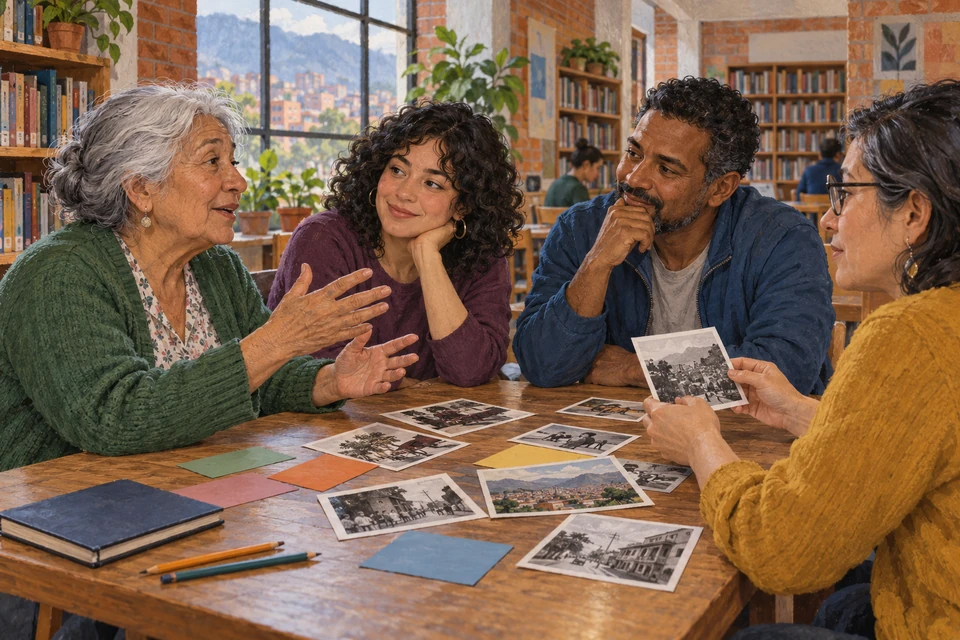
Conversation also has a place in contemporary cultural projects. In its November 2024 report, Bogotá’s public-library network BibloRed describes work with community libraries on neighbourhood and rural memory. Participants helped create Entre barrios y montañas, a game bringing local stories into activities that could travel between spaces in the city. The project included communities in Caracolí, Altamira and Chuniza and produced written, video and podcast documentation. This is a specific example of people making shared records of their surroundings, rather than a claim that one activity represents the whole country.
The connection with language is practical. Recounting a remembered journey, explaining a familiar place or responding to a neighbour gives words a speaker, a purpose and an audience. BibloRed places reading, writing and oral exchange together in its community work. Alongside the institute’s historical recordings, this offers a way to approach Colombian Spanish through attentive listening: to differences between places, to the circumstances of an exchange and to the stories people choose to tell.
Sources
- Center for Language Technology, Indiana University. Spanish. https://celt.indiana.edu/portal/Spanish/index.html
- Ministerio de Cultura de Colombia. Lenguas y tradición oral. https://patrimonio.mincultura.gov.co/Paginas/Lenguas-y-tradici%C3%B3n-oral.aspx
- Juan F. Cobo Betancourt; Cambridge University Press. Introduction, in The Coming of the Kingdom: The Muisca, Catholic Reform, and Spanish Colonialism in the New Kingdom of Granada. https://www.cambridge.org/core/books/coming-of-the-kingdom/introduction/0B5C8D3A4E7D9AAE87D759ACD1B58C8F
- Richard Hernández interviewing lexicographer Nancy Rozo; Radio Nacional de Colombia. Colombianismos: expresiones que reflejan nuestra diversidad (2020-04-23). https://www.radionacional.co/cultura/tradiciones/colombianismos-expresiones-que-reflejan-nuestra-diversidad
- Ruth Rubio and Julio Bernal, Instituto Caro y Cuervo; Lexis. Corpus Oral del Instituto Caro y Cuervo: reestructuración, diseño y construcción. https://www.scielo.org.pe/scielo.php?pid=S0254-92392019000100006&script=sci_arttext
- BibloRed, Red Distrital de Bibliotecas Públicas de Bogotá. 2.400 personas participaron en los proyectos para el fortalecimiento de las bibliotecas comunitarias de Bogotá (2024-11-26). https://www.biblored.gov.co/noticias/laboratorios-proyectos-bibliotecarios-comunes-biblored