Languages & Culture
Croatian
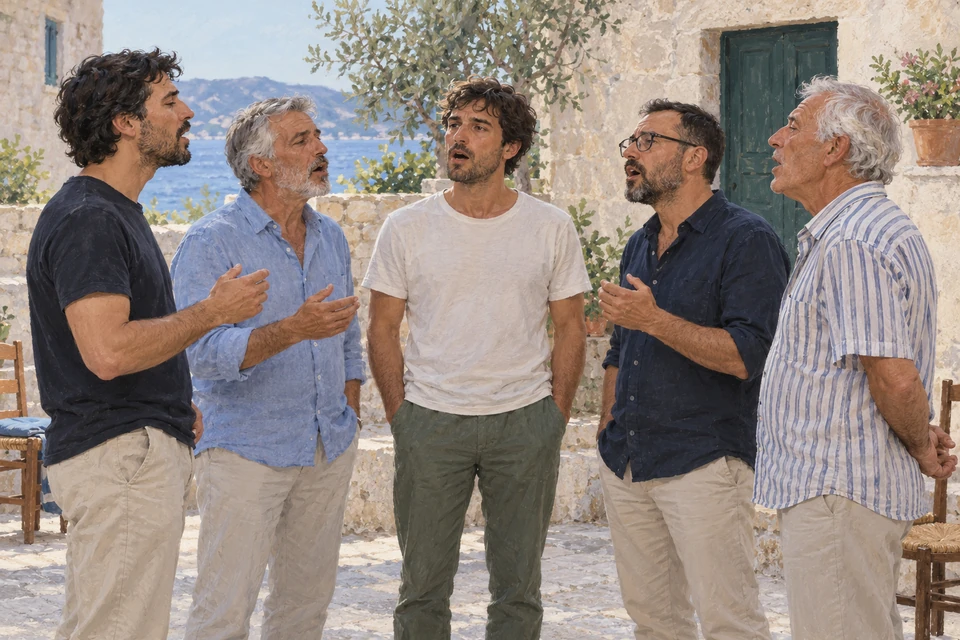
Croatian connects a public standard with a varied landscape of local speech. It belongs to the South Slavic branch of Indo-European and is the official language of Croatia. It is also closely related to Bosnian and Serbian, which UCLA studies together in its language programme. Describing Croatian as a distinct standard acknowledges its institutions, literature and speakers' chosen name; it does not mean that the neighbouring standards developed as unrelated languages. The older umbrella term Serbo-Croatian remains part of scholarship, alongside terminology that names the standards separately.
Croatian-speaking communities extend beyond Croatia. The Miroslav Krleža Institute of Lexicography identifies communities in Bosnia and Herzegovina, neighbouring countries, Austria's Burgenland and Italy's Molise, as well as emigrant communities farther afield. Those communities have different relationships to local speech, formal Croatian and other languages; a single national accent cannot represent them all.
A standard among regional voices
The traditional Croatian dialectological framework distinguishes Čakavian, Kajkavian and Štokavian. Čakavian varieties occur across much of Istria, many Adriatic islands and parts of the coast and interior; Kajkavian is associated especially with northwestern Croatia. Each grouping contains further dialects and local forms. Even the question-word forms behind their names are not an infallible test of an individual speaker's variety. The Institute of Croatian Language's educational account describes exceptions and overlapping features, making the familiar three-part map a starting point rather than a complete description.
The contemporary standard draws chiefly on New Štokavian with Ijekavian pronunciation and uses the Latin alphabet. Its nineteenth-century formation also incorporated lexical contributions from Čakavian and Kajkavian, while Ljudevit Gaj's spelling reforms helped establish a common written practice. Standardization selected from this existing linguistic landscape, while speakers and writers continued to draw on regional traditions.
For a learner, grammar provides another route into the language. Standard Croatian distinguishes seven noun cases, which help signal relationships within a sentence, and adjectives agree with nouns in grammatical gender, number and case. Verbs distinguish perfective and imperfective aspect. Word order has flexibility, yet short unstressed words follow their own placement rules. These interacting patterns reward attention to whole sentences as well as vocabulary; memorising a noun's dictionary form gives only part of its grammatical behaviour.
Old writing in a digital setting
Croatian written history includes more scripts than the Latin alphabet encountered today. The Glagolitic Baška Tablet, dated around 1100, records a donation and church construction. Script, liturgical language and local speech need careful distinction when interpreting such a medieval record, which cannot directly represent contemporary conversation.
The National and University Library in Zagreb makes this heritage easier to examine through its Croatian Glagolitic digitization project. Its account describes collaboration with other heritage institutions, digital copies of books and manuscripts, and accompanying scholarly studies. The portal supports viewing originals alongside available transcriptions, comments or translations. Digitization protects fragile originals while giving researchers and readers a way to inspect written evidence that would otherwise require visits to dispersed collections.
Contemporary reference work addresses different needs. Mrežnik, the Croatian Web Dictionary, was designed as a searchable monolingual resource informed by text corpora. Its project description discusses how actual usage, recurring word combinations and contextual examples inform dictionary entries. The public interface provides separate routes for general users, younger schoolchildren and people learning Croatian as an additional language. It remains labelled a demonstration version, so its availability should not be confused with a claim that the entire planned dictionary is finished.
Language shared in song
In Dalmatia, klapa singing offers a specific example of words carried through collective performance. The regional UNESCO heritage centre describes unaccompanied multipart singing, with singers standing close together in a semicircle and listening for a blended sound. Songs address love, situations in everyday life and the surrounding environment. Transmission includes learning orally from experienced singers, while modern groups also learn through recordings and performances. Younger and older practitioners participate.
Klapa is one regional practice, not a definition of every Croatian speaker. The same caution applies to dialects: the Institute's account describes Čakavian in everyday communication, local publishing, radio and theatre. Encountering such work alongside the standard reveals how a language can sustain shared public forms while local communities continue to create in their own voices.
Sources
- Department of Slavic, East European & Eurasian Languages & Cultures, University of California, Los Angeles. Background Information (Croatian). https://slavic.ucla.edu/languages/bcs/croatian-background-info/
- The Miroslav Krleža Institute of Lexicography. Language — Croatia.eu: land and people. https://croatie.eu/index.php/en/home-en/culture/language
- Institut za hrvatski jezik i jezikoslovlje (name displayed on the JEZIK.HRvatski portal). Hrvatska narječja. https://jezik.hr/hrvatska-narjecja.html
- National and University Library in Zagreb. About the project — Glagolitic.eu. https://glagolitic.eu/?project=l
- Institut za hrvatski jezik; project leader Lana Hudeček. Hrvatski mrežni rječnik (MREŽNIK). https://ihjj.hr/projekt/hrvatski-mrezni-rjecnik-mreznik/70/
- Institut za hrvatski jezik. Hrvatski mrežni rječnik – Mrežnik. https://rjecnik.hr/mreznik/
- Regional Centre for the Safeguarding of the Intangible Cultural Heritage in South-Eastern Europe under the auspices of UNESCO. Хърватия – EN; section: Klapa multipart singing of Dalmatia, southern Croatia. https://www.unesco-centerbg.org/en/inscribed-elements-en/croatia-en/