Languages & Culture
Crow
Crow is a Siouan language associated especially with the Crow Reservation in southeastern Montana. The Crow Language Consortium uses the name Apsáalooke for the language it works to sustain. Its public description begins with schools, educators and community cooperation: people making resources and supporting one another’s teaching. That is an appropriate starting point for understanding a language whose speakers and learners are shaping its future in homes, classrooms and public institutions.
Histories carried in speech and writing
A tribal-history timeline published through Montana’s Office of Public Instruction relates ancestral movement from Great Lakes country toward the Big Horn region. It presents this history through community traditions and earlier tribal-history work. The timeline’s introduction stresses that historical knowledge also remains in living oral narratives. Such accounts should be read with their sources and cultural setting in view; a simplified date for a language’s “birth” would convey little of that history.
The written linguistic record has its own history. Reviewing Randolph Graczyk’s A Grammar of Crow in 2009, Crow speaker Rose Chesarek described an older handwritten copy of a missionary grammar on her desk. She compared that late-nineteenth-century work with Graczyk’s extended description. Published in 2007, his grammar examines sounds, word formation and sentence structure, including how clauses connect. The comparison shows why a new reference work can matter to a community while also belonging to a much longer documentary record.
Building room for daily use
The Crow Language Consortium describes a partnership involving the Crow Nation, Little Big Horn College, St. Charles Mission School and the Language Conservancy. Its work includes materials, multimedia resources and teacher development with Crow speakers. This arrangement brings different kinds of expertise together: knowledge of the language, experience teaching children and adults, and the practical work of producing resources that people can use repeatedly. It also makes clear that language revitalization involves continuing community organisation.
A 2019 Federal Reserve Bank of Minneapolis report documented one approach at Little Big Horn College’s Chickadee Lodge Immersion School. Children learned mathematics, science and art through Crow, and the programme included family language-learning evenings. These are dated examples, rather than a claim about the school’s current schedule. Their significance lies in the range of activities: using Crow to explore an ordinary school subject gives children reasons to listen and respond throughout a lesson. Family participation creates another setting for shared learning.
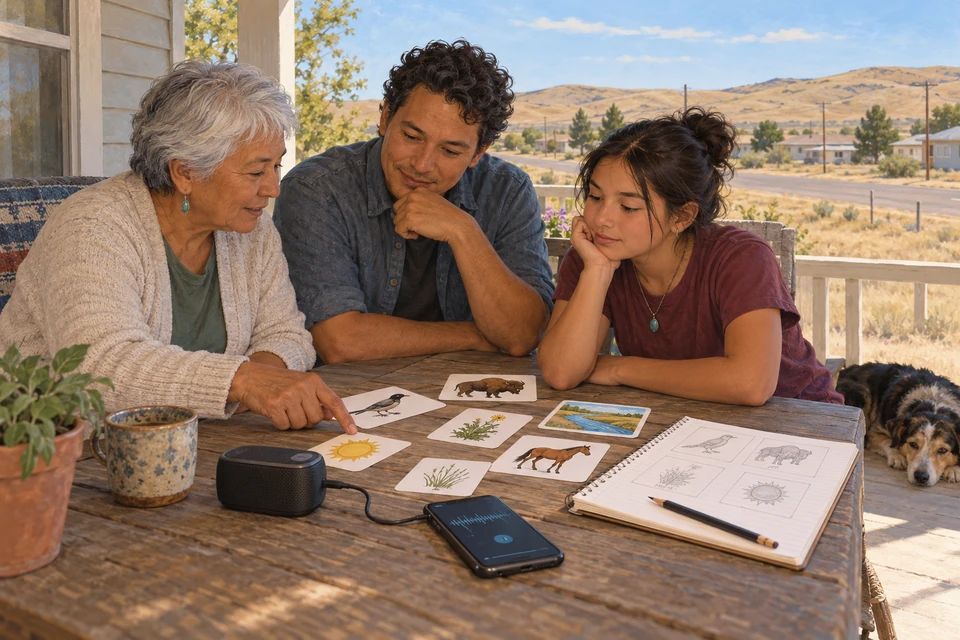
Everyday relationships are also visible in the consortium’s learning catalogue. English titles of its illustrated storybooks include Grandma Comes to Visit and Big Brother, Little Brother. Other materials address weather and food. These themes place language in recognisable interactions rather than reserving it for a formal presentation about heritage. The catalogue also describes community-recorded audio and resources intended for classrooms, homes and family learning.
From a remembered word to a useful resource
Dictionary making depends on more than collecting isolated English equivalents. The same 2019 report describes a 2018 workshop where Crow speakers discussed topics in small groups, wrote words down and recorded them. Participants contributed familiar words and words remembered from earlier conversations with grandparents. That account locates documentation in social memory and in speakers’ decisions about what to contribute. It does not establish a current dictionary size, which is why no word total is offered here.
The public online dictionary now presents English and Crow lookup options, together with topics such as seasons, occupations and cooking utensils. Its interface also links to pronunciation and morphology guides. A learner encountering these resources can therefore look beyond a translation toward sound and word structure. The consortium additionally describes the Ammiláau learning platform as combining recorded language, images and dialogues with activities for different learning settings.
Little Big Horn College’s public Crow Studies listing places conversation courses alongside phonology, morphology, oral literature and teaching methods. The 2025 Siouan and Caddoan Languages Conference programme, hosted at the college, similarly paired community language initiatives with research on grammar and the documentation of connected speech. These records show education and scholarship meeting in a Crow institution. They also suggest a useful direction for further study: follow the people and programmes that connect careful description with opportunities to speak, listen and teach.
Sources
- Crow Language Consortium. Crow Language Consortium – Working to Revitalize the Crow Language. https://crowlanguage.org/
- Randolph Graczyk; University of Nebraska Press. A Grammar of Crow. https://www.nebraskapress.unl.edu/nebraska/9780803221963/a-grammar-of-crow/
- Crow Tribe; Montana Office of Public Instruction. Crow Reservation Timeline (2017). https://opi.mt.gov/Portals/182/Page%20Files/Indian%20Education/Social%20Studies/K-12%20Resources/Crow%20Timeline.pdf
- Rose Chesarek; Great Plains Research 19.1, page 141; University of Nebraska–Lincoln repository. Book Review: A Grammar of Crow: Apsáalooke Aliláau By Randolph Graczyk. https://digitalcommons.unl.edu/greatplainsresearch/1004/
- Casey Lozar; Federal Reserve Bank of Minneapolis. Crow community wakes up its language. https://www.minneapolisfed.org/article/2019/32-crow-community-wakes-up-its-language
- Crow Language Consortium. Language Learning Materials – Crow Language Consortium. https://crowlanguage.org/language-learning-materials/
- Crow Language Consortium. Crow Dictionary. https://dictionary.crowlanguage.org/
- Little Big Horn College, Crow Studies. Courses in this Department - Main View | Main Page | Portal | JICS. https://cloudram.lbhc.edu/ICS/Academics/CS/Main_Page.jnz
- Conference organizers Edwin Ko and Tim McCleary. 45th Annual Siouan & Caddoan Languages Conference. https://eddersko.com/sclc45/