Languages & Culture
Cuban Spanish
Cuban Spanish encompasses varieties of Spanish associated with Cuba and Cuban communities abroad. Spanish belongs to the Romance branch of the Indo-European family and developed from Latin. Within Spanish, Cuban varieties form part of the Caribbean dialect area, sharing features of pronunciation, grammar and vocabulary with neighbouring varieties while having their own histories. The national label does not imply either an independent language or one uniform way of speaking. Research on communities in Cuba and on Miami Cubans also makes clear that the field extends beyond a single island setting.
A history of contact and unequal encounters
Spanish became established in Cuba through conquest and colonisation beginning in the early sixteenth century. Sergio Osmundo Valdés Bernal, of the Academia Cubana de la Lengua, describes Indigenous Caribbean and Mesoamerican contributions to its vocabulary, including the roles of commerce and forced displacement. Dalila Fasla Fernández’s study of Cuban vocabulary also examines African-language, English and French contributions. Her historical account places African language contact within the enslavement and transportation of people to Cuba, and discusses later movement from neighbouring Caribbean islands. These histories cannot be reduced to a list of ingredients in a supposedly uniform national speech.
Fasla’s lexical analysis adds a useful distinction: a borrowed word can become part of Spanish word formation and acquire meanings shaped by its new setting. Its use may also differ by region or situation. Knowing a word’s remote origin therefore does not, by itself, tell a learner who uses it today or in what circumstances. Historical etymology and present usage answer related but different questions.
Mapping differences instead of assuming an island-wide norm
Elisa García González, of Cuba’s Instituto de Literatura y Lingüística, describes a long effort to document variation across western, central and eastern Cuba. The Atlas Lingüístico de Cuba grew from fieldwork that considered rural and urban locations, mountain, plain and coastal settings, and speakers of different ages and educational backgrounds. Its questions addressed vocabulary, pronunciation and grammar, as well as intonation and gestures. This design matters because a familiar Havana voice cannot automatically represent every community in the country.
The atlas was completed in 2013, and its lexical material subsequently supported the Diccionario Geolectal de Cuba, completed in 2019. García González explains that the dictionary aimed to counter the disproportionate attention earlier dictionaries had given western Cuba. Its evidence belongs to the late twentieth-century survey period; the date of completion does not make every recorded usage a measurement of speech today. Keeping the fieldwork dates visible allows readers to use the work as a substantial historical record of regional variation.
The PRESEEA-La Habana project provides a complementary social perspective. Marisela del Carmen Pérez Rodríguez describes recorded interviews with Havana-born participants selected across age, sex and educational categories. The conversations were partly guided, with the recorder visible, and most took place at the University of Havana. The resulting corpus has supported research on subjects including pronoun choices and ways of managing discourse. It supplies evidence that can be compared with other Spanish-speaking cities, while its interview conditions remain part of interpreting that evidence.
What speakers believe about speech
Social judgments are another research subject. In a 2014 study, Gabriela G. Alfaraz revisited Miami Cubans’ perceptions of regional Spanish, including speech associated with the island and their own Miami community. The study examined how evaluations related to political ideology and beliefs about race and poverty. Such judgments reveal social relationships; they do not provide an objective ranking of languages or speakers. Asking what people associate with an accent is a different investigation from measuring the accent’s linguistic features.
Words practised in performance
Punto cubano offers a specific example of verbal artistry. Musicologist Amaya Carricaburu Collantes describes a tradition combining music with the décima, a rhymed stanza of ten eight-syllable lines. Improvisation works within this demanding form. Her account for Cuba’s music research centre explains that knowledge passes through families and communities, and that a practice historically associated with rural life also occurs in urban settings. It is one cultural tradition, rather than a description of every Cuban’s interests or everyday speech.
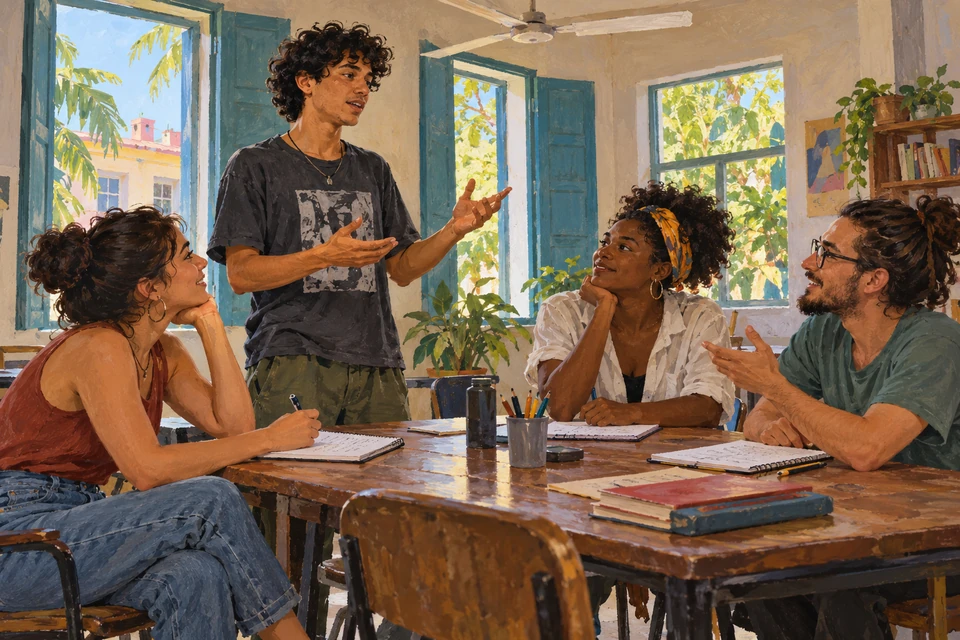
Carricaburu’s fieldwork in Mayabeque also documents children’s workshops in improvised poetry and musical accompaniment. Their participants learn through interaction with teachers and fellow learners. Her study challenges assumptions that practitioners must be elderly, live in the countryside or dress in a prescribed style. These workshops make the cultural detail tangible: working with rhyme and rhythm involves learning, rehearsal and exchange between generations, alongside the excitement of composing in the moment.
Sources
- Arqus European University Alliance; announcement of Roxana Sobrino, University of Bergen, at University of Granada. Two face-to-face lectures on the Spanish language in Latin America (2021-12-14). https://arqus-alliance.eu/event/two-face-to-face-lectures-on-the-spanish-language-in-latin-america/
- Irvine Valley College, Spanish programme. All About the Spanish Language. https://www.ivc.edu/dept/llr/spanish/about
- Dalila Fasla Fernández; Universidad de La Rioja; Cuadernos de Investigación Filológica 33–34, pp.73–96. El español hablado en Cuba: préstamos vigentes, lexicogénesis y variación lingüística. https://publicaciones.unirioja.es/ojs/index.php/cif/article/download/1487/1390/1407
- Elisa García González; Instituto de Literatura y Lingüística; Signos Lingüísticos 18(35), pp.184–200. Variabilidad del español de Cuba: el Atlas Lingüístico de Cuba (ALCu) Y el Diccionario Geolectal de Cuba (DIGECu). https://signoslinguisticos.izt.uam.mx/index.php/SL/article/download/374/332/
- Marisela del Carmen Pérez Rodríguez; Universidad de Oviedo; Signos Lingüísticos 18(36), pp.172–186. El Proyecto para el estudio sociolingüístico del español de España y de América, PRESEEA La Habana. Balance y perspectivas. https://signoslinguisticos.izt.uam.mx/index.php/SL/article/download/381/338/
- Gabriela G. Alfaraz; Michigan State University; Journal of Linguistic Geography 2(2), pp.74–86. Dialect perceptions in real time: A restudy of Miami-Cuban perceptions. https://www.cambridge.org/core/journals/journal-of-linguistic-geography/article/abs/dialect-perceptions-in-real-time-a-restudy-of-miamicuban-perceptions/C4FC6F4146B3841E92C3B19419D70461
- Amaya Carricaburu Collantes; Centro de Investigación y Desarrollo de la Música Cubana; Popular Music Research Today 3(2), pp.23–39. El punto cubano como práctica cultural. Claves para su comprensión en la región occidental de Cuba (2021). https://revistas.usal.es/uno/index.php/pmrt/article/download/26369/27085/100958
- Amaya Carricaburu Collantes; CIDMUC, Del canto y el tiempo. Punto Cubano, Patrimonio Inmaterial de la Humanidad. https://cidmucmusicacubana.wordpress.com/2018/07/06/punto-cubano-patrimonio-inmaterial-de-la-humanidad/
- Sergio Osmundo Valdés Bernal; Academia Cubana de la Lengua; IX Congreso Internacional de la Lengua Española, Cádiz. El aporte de las lenguas caribeñas y mesoamericanas a la modalidad cubana de la lengua española. https://www.rae.es/sites/default/files/2024-09/Cronica%20de%20la%20lengua%20espanola%202023_2024_web.pdf