Languages & Culture
Czech
Czech is a West Slavic language rooted in Central Europe. Its geographical story includes Bohemia, Moravia and Czech Silesia, while its social life encompasses regional conversation, public writing and bilingual families abroad. Understanding Czech involves attending to these different settings: a historical manuscript, a local conversation and a modern reference work each reveal something different about the language.
The Czech School Without Borders in London offers one concrete example of the language's life outside Czechia. Its own account describes education in Czech language, history and geography for Czech-English bilingual children in the United Kingdom. Parents participate in the organisation, and arts activities accompany language learning. This is a setting in which literacy and cultural connections are cultivated through families and community institutions.
How written Czech expanded
Charles University's historical overview places the emergence of continuous Czech texts around the middle of the thirteenth century. Earlier evidence includes individual Czech words, glosses and inscriptions within a wider multilingual written culture. Spelling developed through several conventions. Fourteenth-century writers used combinations of letters to represent sounds; an early fifteenth-century reform associated with Jan Hus's circle developed diacritical marks for consonant distinctions and vowel length. Adoption was gradual, and scribes continued to mix conventions. The familiar appearance of Czech writing has a history of experimentation behind it.
The nineteenth-century national revival brought another deliberate expansion of written expression. Linguist Olga Martincová's study of Josef Jungmann explains how his generation sought vocabulary for scientific and literary work. Sources included older literature, regional speech, other Slavic languages and newly formed words. Jungmann's five-volume Czech-German dictionary, published in the 1830s, gathered evidence from many contributors. Some proposed terms lasted; others disappeared. This history shows standard-language development as a collective process involving choices, borrowing and subsequent usage.
Reading a map of living speech
“Common Czech”, or obecná čeština, needs careful explanation. Marie Krčmová's scholarly account shows that the term has several uses. Dialectological discussions connect it with a variety developed from the dialects of Bohemia; other discussions emphasise spontaneous private or less formal communication. These perspectives overlap, but their boundaries are debated. Treating Common Czech as the speech of every Czech speaker would conceal regional differences and the interaction between standard and nonstandard forms.
The Czech Linguistic Atlas provides a way to examine that variation. Researchers from the Czech Language Institute conducted its extensive fieldwork between 1964 and 1976 in Bohemia, Moravia and the relevant part of Silesia. Its maps and commentaries document vocabulary, grammatical forms and other regional patterns, including urban speech. The dates matter: the atlas preserves a systematically collected historical record against which later usage can be considered. A map records the circumstances of its research as well as the distribution of a linguistic feature.
Different evidence comes from the Czech National Corpus, founded in 1994. Charles University describes electronic collections covering contemporary written and spoken Czech, historical Czech and other languages. Its associated corpus-linguistics centre also develops tools that make such collections searchable. These resources let researchers investigate recurring words and structures across texts rather than rely entirely on individual impressions. Historical dictionaries, regional maps and electronic corpora therefore answer complementary questions about how people have used Czech.
Voices on a small stage
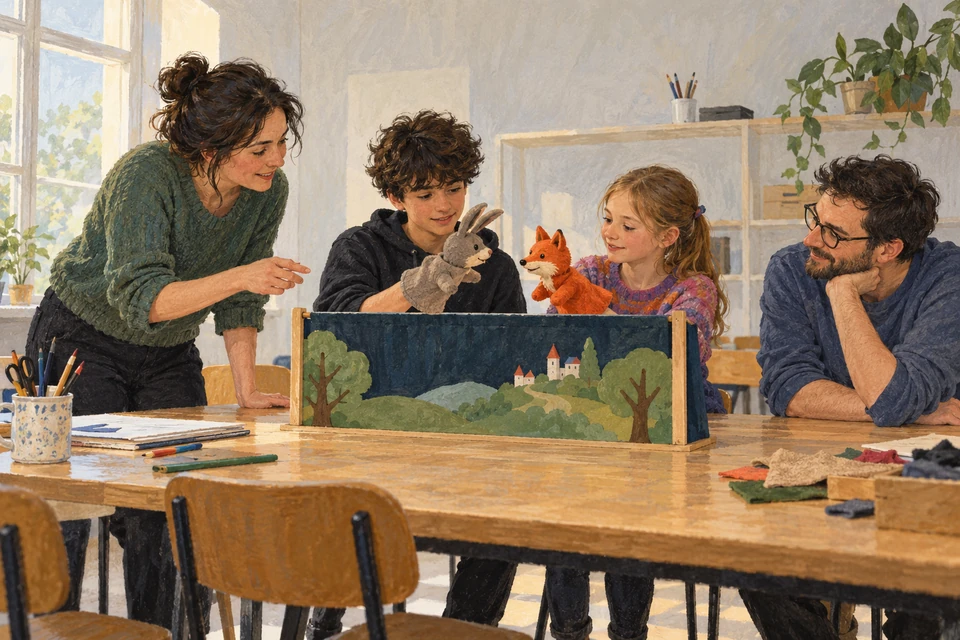
Puppetry offers a distinctive meeting of language, storytelling and practical craft. UNESCO's archival description treats puppetry in Czechia and Slovakia as a shared cultural practice connected with theatre and literature. It describes puppets commonly made from wood, several ways of animating them, and transmission through performing communities, families, organisations and arts schools. Its significance includes creative participation and the communication of ideas and values.
The Museum of Puppetry Culture in Chrudim gives this tradition a contemporary educational form. Its Podoby loutek programme introduces different puppet types, lets participants handle and operate them, and then asks groups to improvise short scenes. It is offered for children, adults and groups with specific needs. The museum explicitly identifies language and communication among its educational areas. Preparing a character's words and responding to another performer make speech part of a cooperative activity, with room for both planned stories and spontaneous invention.
Sources
- Department of Languages and Literature, Faculty of Humanities, Charles University; no individual byline displayed. Czech — Medieval languages and literatures. https://medlit.fhs.cuni.cz/language/czech/
- Czech School Without Borders, London. About Us — Czech School Without Borders, London. https://www.czechschool.org.uk/about-us-2/
- Olga Martincová; Český jazyk a literatura 74(1), 10–16; journal hosted by Palacký University Olomouc. Zásluha Josefa Jungmanna na rozvoji české slovní zásoby: (K 250. výročí Josefa Jungmanna). https://journals.upol.cz/CJL/article/view/265
- Marie Krčmová; in Petr Karlík, Marek Nekula and Jana Pleskalová (eds.), CzechEncy – Nový encyklopedický slovník češtiny; Masaryk University. OBECNÁ ČEŠTINA. https://www.czechency.org/slovnik/OBECN%C3%81%20%C4%8CE%C5%A0TINA
- Czech Language Institute, Czech Academy of Sciences. Český jazykový atlas (Czech Linguistic Atlas). https://ujc.cas.cz/en/elektronicke-slovniky-a-zdroje/czech-linguistic-atlas/
- Charles University; Research Support Office listed as responsible for site content. The Czech National Corpus: research infrastructure for empirical language-oriented inquiry. https://cuni.cz/UKEN-504.html
- Czech National Corpus / Charles University, Faculty of Arts. CorpLingCz — Czech CLARIN Knowledge Centre for Corpus Linguistics. https://www.korpus.cz/clarin/corplingcz
- UNESCO Multimedia Archives; documentary publishers: The National Information and Consulting Centre for Culture, Czech Republic, and Slovak Intangible Cultural Heritage Centre. Slovakia and Czech Puppetry. https://www.unesco.org/archives/multimedia/document-4352
- Muzeum loutkářských kultur v Chrudimi / Museum of Puppetry Culture in Chrudim. Podoby loutek. https://www.puppets.cz/programy-pro-skoly-programy-pro-ms-a-i-stupen-zs/podoby-loutek