Language & culture
Dakota: A Language of Minnesota and Beyond
Language at a glance
- Speaker estimate
- About 1,530 conversational speakers
Canada, 2021 census; includes additional-language speakers.
- Local names
- Dakhóta iápi
Dakhóta names both regional groupings.
- Communities
- US · Canada
Minnesota, Dakotas, Nebraska; Manitoba and Saskatchewan.
- Language family
- Siouan
Part of the Dakota–Lakota group.
- Writing
- 33 letters
Latin-based alphabet taught by Dakhóta Iápi Okhódakičhiye.
- Regional varieties
- Eastern · Western
Standard Dakota Orthography is used in education.
Who speaks Dakota, and what do they call it?
Dakota is spoken in communities in Minnesota, North Dakota, South Dakota, Nebraska and Canada. In Minnesota, Prairie Island and the Shakopee Mdewakanton Sioux Community maintain language programs. Dakhóta iápi is a name used by Dakota language organizations; Dakhóta is the people’s self-name.
How many people speak Dakota worldwide?
Canada’s 2021 census reported about 1,530 people able to hold a conversation in Dakota, including additional-language speakers. A comparable worldwide total remains uncertain.
Where did Dakota come from, and who spoke it in the past?
Dakota belongs to the Siouan family and the closely related Dakota–Lakota group. Minnesota is an ancestral homeland: Dakota communities lived around its rivers and lakes long before the fur-trade encounters of the early nineteenth century. Forced exile after the U.S.–Dakota War of 1862 dispersed many people, although some remained.
Missionary work on an alphabet began with Samuel and Gideon Pond in summer 1834. Stephen Return Riggs’s Grammar and Dictionary of the Dakota Language followed in 1852, published by the Smithsonian.
Which Dakota words might an English speaker already recognise?
Tipi, also written tepee, entered English from Dakota. Its Dakota source is connected with a verb meaning to dwell.
How does Dakota vary from region to region?
Eastern Dakota is associated with Santee-Sisseton communities, and Western Dakota with Yankton-Yanktonai. Both use Dakhóta; Nakota is associated with Assiniboine and Stoney.
What is Standard Dakota, and where is it used?
Standard Dakota Orthography is used in educational materials, including the Why Treaties Matter curriculum. Other teaching resources use different conventions.
Which alphabet does Dakota use, and what might surprise an English speaker?
Dakota uses Latin-based alphabets adapted to its sounds. Dakhóta Iápi Okhódakičhiye teaches a 33-letter alphabet, running from A to Ž, in its alphabet colouring book. The Metropolitan State course archive uses a different convention, with dotted consonants and ƞ after a vowel to show nasalization.
Does Dakota have grammatical gender?
Dakota has no masculine–feminine agreement.
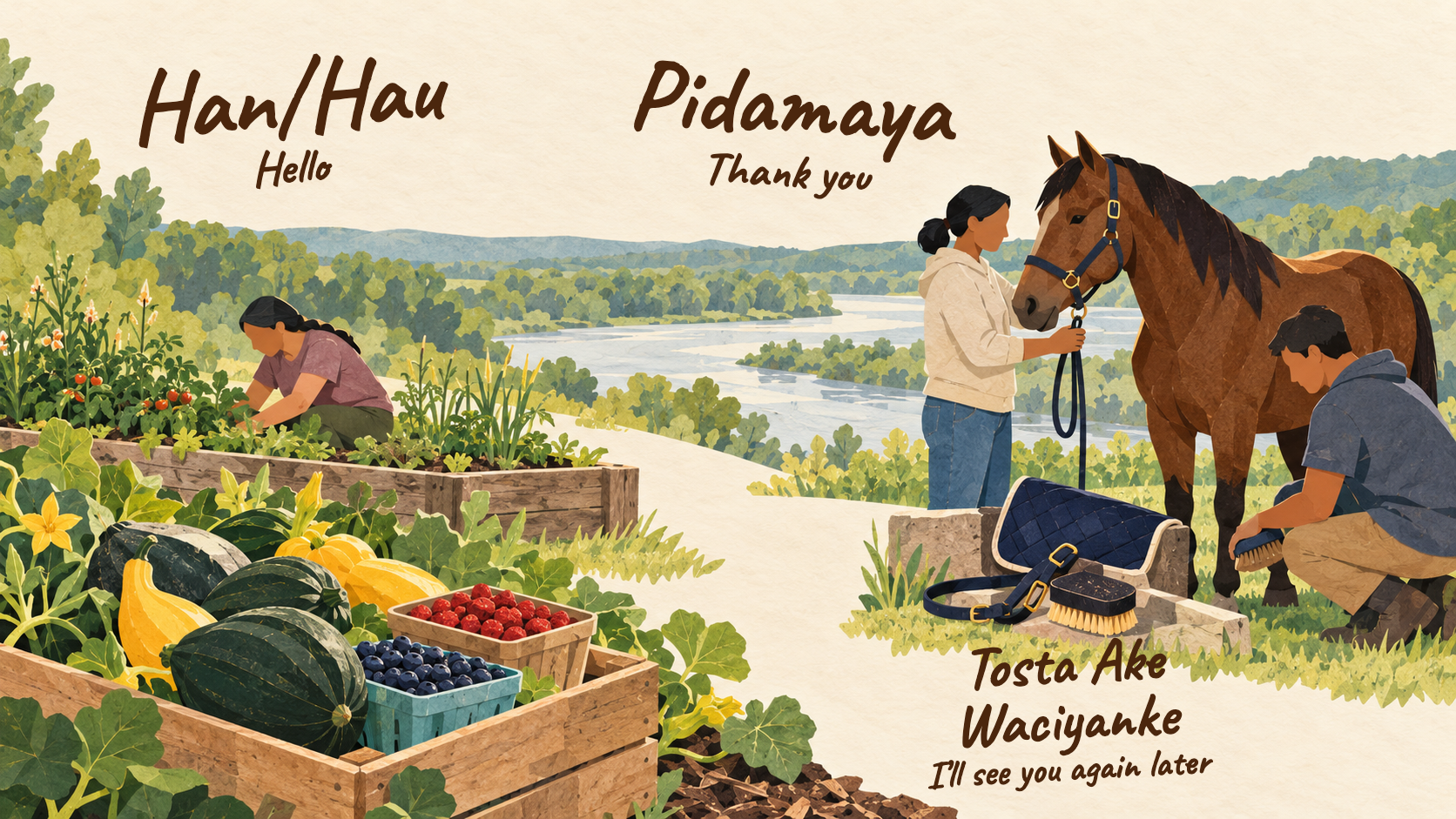
How do you say hello, thank you and goodbye in Dakota?
At Prairie Island, everyday exchanges include:
- Han/Hau — hello.
- Pidamaya — thank you.
- Tosta Ake Waciyanke — I’ll see you again later.
What are some memorable Dakota sayings?
- Mitakuye owas’iƞ — all my relations.
- Mni Wiconi — water is life.
Erin Genia’s five concrete trail stencils at Bdote reflect Mitakuye Oyasin. In her 2021 statement, the Sisseton-Wahpeton Oyate/Odawa artist describes people, animals, plants, water and earth as interconnected relatives, to be treated with respect and reciprocity.
What everyday customs might surprise a visitor?
Dakota educator Ramona Kitto Stately describes birth-order names: Chaské for a first-born son and Winúna for a first-born daughter. A child may later receive a personal name.
Which Dakota-language song and film offer a cultural introduction?
Wakantanka Taku Nitawa, credited to Joseph R. Renville in 1842, introduces Dakota Christian hymn singing. It is set to the Dakota melody known as LACQUIPARLE; The New Century Hymnal prints Dakota words with an English paraphrase.
The 2022 opera film Mináǧi kiŋ dowáŋ: A Zitkála-Šá Opera was directed by Sequoia Hauck, with Lyz Jaakola as composer and Hannah Johnson as librettist. Almost a third of its libretto is translated and sung in Dakota; the film also uses English. Its 2022 Saint Paul screenings included captions and translations. It tells the story of the Indigenous writer and activist Zitkála-Šá.
What is available for someone curious about the language now?
The Minnesota Historical Society’s archived Beginning Dakota companion website remains publicly accessible, with lesson recordings by Clifford Canku and Sandee Geshick. Dakhóta Iápi Okhódakičhiye offers Speak Dakota textbooks and audio CDs. It has also produced a Dakota Audio Journal featuring elders’ life stories and songs.
For poetry, Gwen Nell Westerman’s Follow the Blackbirds (2013) uses Dakota and English to explore family, community, the Great Plains and the pull of home. The publisher offers print and electronic editions.
Fun Facts
- One word can include exactly two people. uŋkásni says that you and I are well.
- Minnehaha describes moving water. Its Dakota components refer to water and curling, together meaning waterfall. The familiar “laughing waters” translation is mistaken.
Sources
- Minnesota Historical Society; Dakota People; n.d. https://www.mnhs.org/fortsnelling/learn/native-americans/dakota-people
- Prairie Island Indian Community; Dakota Language; n.d. https://prairieisland.org/who-we-are/our-culture/dakota-language
- Shakopee Mdewakanton Sioux Community; Dakota Language; n.d. https://shakopeedakota.org/culture-history/dakota-language/
- Dakhóta Iápi Okhódakičhiye; About DIO; n.d. https://dakhota.org/about-dio/
- Regina Pustet; Lakota Texts: Narratives of Lakota Life and Culture in the Twentieth Century; University of Nebraska Press and American Indian Studies Research Institute; 2021. Publisher preview. https://api.pageplace.de/preview/DT0400.9781496226426_A49427232/preview-9781496226426_A49427232.pdf
- Statistics Canada and the Office of the Commissioner of Indigenous Languages; Familles de langues autochtones : langues siouennes; March 31, 2025; 2021 census data. https://www150.statcan.gc.ca/n1/pub/41-20-0002/412000022025006-fra.htm
- Statistics Canada; Knowledge of languages by generation status, mother tongue, age and gender: Canada, provinces and territories and economic regions; Table 98-10-0619-01; December 4, 2024; 2021 census data. https://www150.statcan.gc.ca/t1/tbl1/en/tv.action?pid=9810061901
- Dakhóta Iápi Okhódakičhiye; Status of Dakota Language; n.d. https://dakhota.org/status-of-dakota-language/
- Smithsonian Institution Archives; Smithsonian Publishes “Grammar and Dictionary of the Dakota Language”; May 15, 1852 event; catalogue n.d. https://siarchives.si.edu/collections/siris_sic_13199
- Minnesota Historical Society, including curator Ethel B. Virtue’s essay; Pond Family: An Inventory of Their Papers at the Minnesota Historical Society; n.d. https://storage.googleapis.com/mnhs-finding-aids-public/library/findaids/00717.html
- Merriam-Webster; Tepee; n.d. https://www.merriam-webster.com/dictionary/tepee
- Jan Ullrich; Modification, Secondary Predication and Multi-Verb Constructions in Lakota; doctoral dissertation, Heinrich Heine University Düsseldorf; 2018. https://rrg.caset.buffalo.edu/rrg/Ullrich.pdf
- Minnesota Indian Affairs Council and Minnesota Humanities Center; Why Treaties Matter: A Deep Connection to Place, including “A Dakota Narrative” by Ramona Kitto Stately; n.d. https://treatiesmatter.org/exhibit/wp-content/uploads/2017/09/A-Deep-Connection-to-Place.pdf
- Metropolitan State University Dakota language project; Dakota Alphabet; 2013 course resource. https://dakota.metrostate.edu/alphabet.php.html
- Dakhóta Iápi Okhódakičhiye; Dakota Alphabet Coloring Book; n.d. https://dakhota.org/product/dakota-alphabet-coloring-book/
- Patricia A. Shaw; Theoretical Issues in Dakota Phonology and Morphology; 1980, Routledge reprint 2019. Publisher preview. https://api.pageplace.de/preview/DT0400.9780429881831_A34990402/preview-9780429881831_A34990402.pdf
- Dakota Wicohan; Dakota Language Lessons; n.d. https://dakotawicohan.org/wp-content/uploads/2017/10/Dakota-Language-in-MSM.pdf
- Minnesota Historical Society, Historic Fort Snelling; Trails, including Erin Genia’s artist statement under “Plant and Animal Nations”; statement 2021; page n.d. https://www.mnhs.org/fortsnelling/activities/trails
- Hymnary.org; The New Century Hymnal, hymn 3, Wakantanka Taku Nitawa; hymnal 1995; online entry n.d. https://hymnary.org/hymn/NCH1995/3
- An Opera Theatre; Mináǧi kiŋ dowáŋ: A Zitkála-Šá Opera; 2022 production; page n.d. https://anoperatheatre.org/-zitkla-sa
- An Opera Theatre, Minnesota Access Alliance calendar; Mináǧi kiŋ dowáŋ: A Zitkála-Šá Opera; October 21–23, 2022 screenings. https://calendar.mnaccess.org/events/mina%C7%A7i-kin-dowan-a-zitkala-sa-opera-2/
- Minnesota Historical Society; Beginning Dakota companion website; archived December 2020. https://mnhs.gitlab.io/archive/beginning-dakota/beginningdakota.org/index.html
- Cherlon Ussery, Carleton College; Pronouns in Dakota: A Brief Look; Ling222, Fall 2016. https://carleton-wp-production.s3.amazonaws.com/uploads/sites/630/2021/03/7._Dakota_Pronouns.2.pdf
- Minneapolis Park and Recreation Board; Minnehaha Falls Background Info and Full History; n.d. https://www.minneapolisparks.org/wp-content/uploads/2024/07/Minnehaha-Concepts-for-project-page.pdf
- Prairie Island Indian Community; Decolonizing Our Palate; n.d. https://prairieisland.org/who-we-are/our-land/food-sovereignty
- Gwen Nell Westerman, Michigan State University Press; Follow the Blackbirds; August 1, 2013; publisher catalogue n.d. https://msupress.org/9781611860924/follow-the-blackbirds/
- Dakhóta Iápi Okhódakičhiye; Speak Dakota teaching materials and shop; n.d. https://dakhota.org/
- Lower Sioux Indian Community; Our Language; n.d. https://lscwoo.com/our-story/our-language/
Start learning today
Explore these books to keep learning.