Languages & Culture
Dakhótiyapi (The Dakota Language)
Dakota language learning connects homes, schools and communities across the United States and Canada. Its Minnesota homeland remains central: the University of Minnesota's Dakota Language Program explains how place names preserve relationships between land, language and ways of life. Dakota also belongs to a larger linguistic family, Siouan, whose historical relationships scholars investigate through comparisons among languages. Community relationships and linguistic family trees illuminate different parts of its story.
Names, relationships and writing
Classification requires care. Rory Larson's account of Siouan historical linguistics places Santee-Sisseton, Yankton-Yanktonai, Lakota, Assiniboine and Stoney within the broader Dakotan branch. Such scholarship sometimes uses “dialect” where community institutions use “language.” The broad branch name does not make all its members interchangeable. This article follows Dakota community programmes and distinguishes their work from Lakota language work; it does not treat every resource described as “Sioux” as a Dakota teaching resource.
Writing conventions also deserve attention. The Shakopee Mdewakanton Sioux Community provides a keyboard specifically for its own Dakota orthography. Dakhóta Iápi Okhódakičhiye, a community organisation, publishes learning materials with Dakota spellings visible in its titles and name. For someone beginning study, the practical question is which community's teachers and materials they are following. A keyboard or dictionary needs to match that learning context; visible differences in spelling should prompt investigation rather than automatic correction.
Recovering opportunities to speak
The need for revitalization has a documented political history. Shakopee's own account describes federal assimilation policies and boarding schools where children were punished for speaking their language. It also describes the fear and shame that continued afterward. The same account reports renewed family transmission and presents language restoration as an active community responsibility. These experiences explain why providing a class involves more than distributing vocabulary: learners also need places where speaking is supported and welcomed.
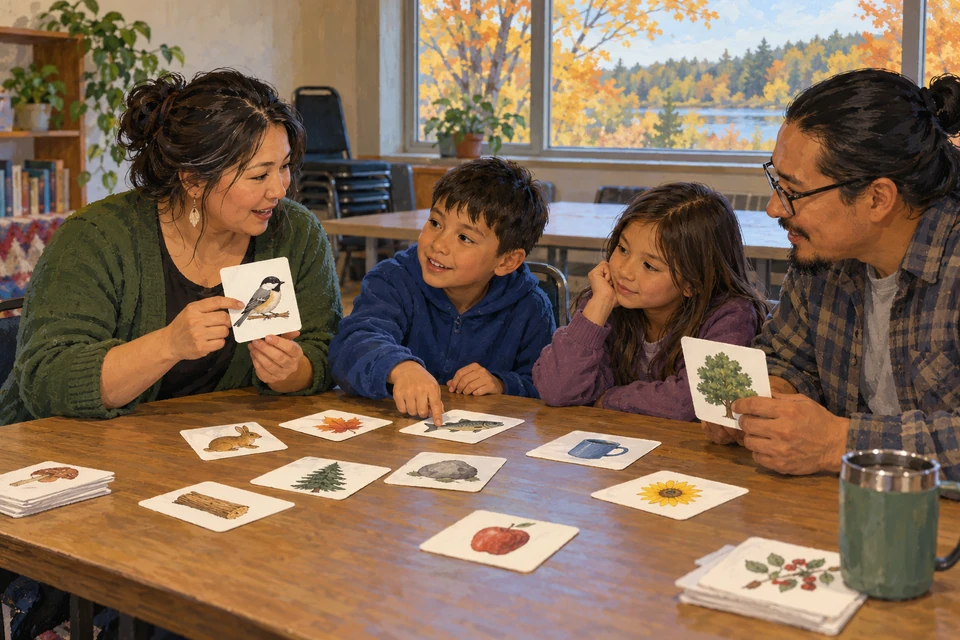
Founded in 2014, Dakhóta Iápi Okhódakičhiye is an organisation of Dakota community members, learners and speakers that develops materials for homes, classrooms and community settings. Its programme description includes family immersion camps, a summer institute and language tables, with activity around Minneapolis and Saint Paul. Its learning materials reach communities across several US states and Manitoba and Saskatchewan. An audio journal preserves speakers' accounts of their lives, placing extended voices and experiences alongside textbooks.
At Shakopee in Minnesota, the language team describes weekly classes, beginners' family nights, youth camps and translation work for tribal departments. Language also enters cultural-centre tours and public interpretation. The community began its Dakota Language Bowl in 2023, bringing together teams from tribes and schools across the Upper Midwest and Canada. These settings connect learning with family participation, friendly competition and the practical business of a contemporary tribal government.
Training teachers supports this wider activity. The University of Minnesota links its teaching certificate to immersion instruction and offers classroom practica in Minneapolis schools. Sisseton Wahpeton College's Dakota Studies programme combines language learning with Dakota history, oral traditions and tribal government. Its published curriculum therefore treats linguistic study as part of understanding contemporary community experience, as well as historical knowledge.
Whitecap Dakota Nation in Saskatchewan describes another connected approach: elementary education, early-learning materials, land-based learning and adult study. A 2020 agreement enabled its members to take accredited University of Minnesota Dakota courses online. Whitecap also reports hosting a spring language gathering since 2018. This cross-border educational relationship shows why the language's geography cannot be understood through US state boundaries alone.
Documents, digital tools and public places
Documentation can make older texts more useful to present learners. Minnesota's public record for a 2024–2025 Dakhóta Iápi Okhódakičhiye project describes plans to digitize historical newspapers, revise their orthography and expand dictionary examples. It also proposes a lemmatizer: software intended to help users find dictionary entries when searching an inflected verb form. The record describes objectives, so it should not be read as proof that every proposed feature was completed.
Public landscapes offer another setting for learning. Prairie Island Indian Community describes interpretation at He Mni Can, also known as Barn Bluff, and the Grand Meadow Chert Quarry that connects language with the tribe's history and relationship to land. Alongside its classes and language-bowl participation, these projects make Dakota visible beyond a formal lesson. Their value lies in the particular community knowledge they communicate, giving visitors a reason to listen to the people whose places they are learning about.
Sources
- Department of American Indian Studies, University of Minnesota. Dakota Language Program. https://cla.umn.edu/ais/undergraduate/language-programs/dakota-language-program
- Rory Larson; in Catherine Rudin and Bryan J. Gordon (eds.), Advances in the Study of Siouan Languages and Linguistics, Language Science Press. Regular sound shifts in the history of Siouan (2016). https://langsci.github.io/94/main.pdf
- Shakopee Mdewakanton Sioux Community. Dakota Language. https://www.understandnativemn.org/culture-history/dakota-language/
- Dakhóta Iápi Okhódakičhiye. About DIO. https://dakhota.org/about-dio/
- Sisseton Wahpeton College. Dakota Studies. https://www.swcollege.edu/newswcollege/academic_programs/dakota-studies/
- Whitecap Dakota Nation. Dakota Language and Culture. https://www.whitecapdakota.com/education-and-learning/dakota-language-and-culture/
- Minnesota’s Legacy; recipient Dakhota Iapi Okhodakichiye; administered by Minnesota Indian Affairs Council. Dakota Lemmatizer and Dictionary Expansion Project. https://www.legacy.mn.gov/projects/dakota-lemmatizer-and-dictionary-expansion-project
- Prairie Island Indian Community. Dakota Language. https://prairieisland.org/who-we-are/our-culture/dakota-language