Languages & Culture
Danish
Danish belongs to the North Germanic, or Scandinavian, group of the Germanic languages. Linguist Jørgen Rischel's historical overview places Danish and Swedish in its eastern branch, tracing their development from an earlier Scandinavian dialect continuum. The same overview describes substantial differences among traditional varieties in Jutland, Funen, Zealand and Bornholm. A shared written language therefore coexists with a more complicated regional history.
In Denmark, the sixteenth-century Reformation helped expand the institutional use of written Danish, particularly in the church. A government historical overview connects this period with efforts to establish spelling conventions. The first complete Danish Bible, associated with Christian III, appeared in 1550. These developments form part of the history of a language whose modern alphabet includes the letters Æ, Ø and Å alongside the basic Latin letters.
Danish also has established community settings beyond Denmark's present borders. Sydslesvigsk Forening, a cultural organisation of the Danish minority in Germany, describes activities across Southern Schleswig. Its programmes range from family language courses to theatre, music, cinema and lectures. These activities connect language learning with opportunities to use and encounter Danish socially. They also make clear why a map of language communities cannot simply be drawn around a country's boundary.
Hearing patterns, following change
One much-discussed feature of Danish is stød, a voice-quality pattern often heard as creakiness. Its acoustic form varies, and some traditional dialects generally lack it. In a study published in 2026, Annika Høeg asked speakers from Greater Copenhagen to choose between pronunciations of invented words with and without stød. Preferences differed according to the words' endings and broadly followed patterns found in existing vocabulary. The experiment suggests that these speakers drew on more detailed knowledge than the position of stress alone. Its defined regional sample matters: this was a study of particular speakers and tasks, not a survey of every Danish variety.
To investigate change across generations, the University of Copenhagen's LANCHART Centre builds on spoken-language surveys conducted from 1974 through the 1990s. Researchers return to earlier study locations, record new generations and compare the same individuals at intervals of twenty to thirty years. The centre also investigates Danish in emigrant communities in the United States and Argentina. Comparing a person with their earlier self helps researchers distinguish changes over a lifetime from differences between generations. Comparing locations adds another dimension: developments found in Copenhagen need not describe every community. This research design turns recordings into evidence about the relationship between language, place and time.
A written standard that keeps a record of change
The Danish Language Council, established in 1955, has complementary responsibilities: documenting usage, answering language questions and producing the official spelling dictionary, Retskrivningsordbogen. Its researchers collect new words and examples from sources including books, newspapers and social media. The council explicitly distinguishes recording a word from approving it. A usage database can preserve evidence of an expression without declaring that expression appropriate in every setting. This distinction helps readers understand why descriptive research and guidance about a written standard can operate within the same institution.
The dictionary itself is revised. In its announcement of 16 December 2025, the council described version 5.1, including the addition of imperative forms for almost all its verbs. That dated update is a practical example of reference work: users receive more information about how words appear in actual grammatical forms, alongside changes to spelling guidance and entries.
Words shared in song
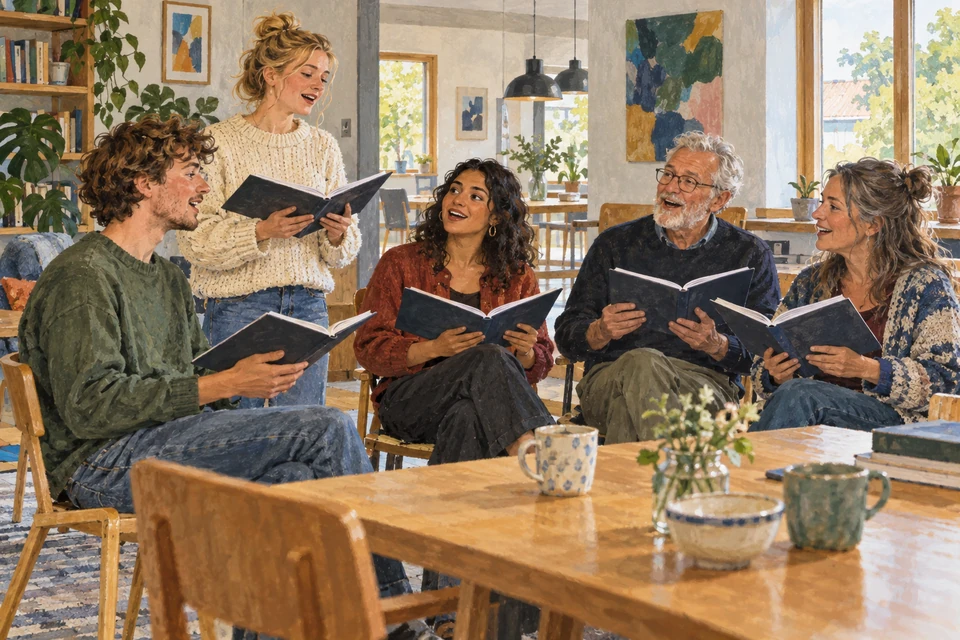
Communal singing provides another setting in which Danish texts circulate. Højskolesangbogen, the folk-high-school songbook, first appeared in 1894 and has been repeatedly revised. The publisher's account describes a repertoire combining older songs and hymns with newly written work and songs from popular culture. Its nineteenth edition appeared in 2020. A collection like this carries several periods of language into the same room: participants encounter inherited texts alongside more recent ways of expressing familiar concerns.
The songbook's website also describes a contemporary initiative in which folk high schools invite people to sing, share food and discuss nature. Bringing generations together is an explicit aim. This gives communal singing a concrete social setting, with conversation around the songs as well as performance of them. It is one documented strand of Danish cultural life, with room for participation rather than an assumption that every Danish speaker shares the same repertoire or interests.
Sources
- Jørgen Rischel; Revue belge de philologie et d’histoire 90(3), 809–832; Persée archive. Danish. https://www.persee.fr/doc/rbph_0035-0818_2012_num_90_3_8263
- Ministry of Foreign Affairs of Denmark. The Danish language: A story of history and identity. https://denmark.dk/people-and-culture/danish-language/
- Sydslesvigsk Forening (SSF). About SSF. https://syfo.de/en/about-ssf/
- Annika Høeg, Stockholm University; Phonological Data and Analysis 8, e3. Danish speakers’ preference for stød in monomorphemic nonce words ending in -en, -er, or ‑el. https://doi.org/10.1017/S2642182826000073
- Centre for Language Change In Real Time (LANCHART), University of Copenhagen. About the LANCHART Centre. https://lanchart.hum.ku.dk/aboutlanchart/
- Dansk Sprognævn / Danish Language Council. About The Danish Language Council. https://dsn.dk/organisation-og-lovgivning/about-the-danish-language-council/
- Dansk Sprognævn / Danish Language Council. Retskrivningsordbogen 5.1 er nu tilgængelig på ro.dsn.dk (2025-12-16). https://www.dsn.dk/nyheder-og-arrangementer/retskrivningsordbogen-5-1-er-nu-tilgaengelig/
- Højskolerne / Højskolesangbogen; Højskolernes Hus publisher site. Om Højskolesangbogen. https://hojskolesangbogen.dk/om-sangbogen
- Højskolerne / Højskolesangbogen; Højskolernes Hus publisher site. Fællessang. https://hojskolesangbogen.dk/syng-med/faellessang