Languages & Culture
Dari
Dari is Afghan Persian: a major regional form of Persian, with its own spoken varieties, formal usage and cultural institutions. It belongs to the Iranian branch of the Indo-European family. Iranian Persian and Tajik Persian are its close counterparts within the wider Persian language. The names identify different historical and social settings within a shared linguistic inheritance. Afghan speakers may call their language Dari or Farsi; the two names should not be treated as evidence of unrelated origins.
A history larger than modern borders
The deeper history reaches through New Persian to Middle Persian. Linguist Ludwig Paul's account of Early New Persian describes gradual development across the early Islamic centuries, with continuity alongside changes in writing and literary practice. Early Persian texts also come from different religious communities and use several scripts. This history helps explain why Persian cannot be assigned exclusively to a single modern country or one timeless literary standard. Its regional forms developed through sustained contact and changing centres of cultural activity.
John R. Perry and Rawan Farhadi describe Kabul Persian's longstanding role in administration, culture and communication, including the city's connections with Safavid Iran and Mughal India. They date the official naming of Afghanistan's standard written Persian as Dari to 1964. That naming decision did not create a language from nothing: it identified an Afghan standard within an already established Persian tradition.
Listening beyond a single standard
Kabul is an influential centre, but Afghan Persian extends far beyond the capital. Regional varieties are associated with Herat, Mazar-e Sharif, Badakhshan and other places; the speech of frontier regions connects with neighbouring Persian varieties across national borders. A broad Dari introduction therefore needs to distinguish a national written standard, formal spoken styles and particular local ways of speaking. A recording made in Kabul cannot by itself represent that whole geography.
Afghan and Iranian Persian use the Perso-Arabic script and have closely related formal written forms. Tajik's Soviet-period written standard developed with Cyrillic script and a different history of vocabulary and standardization. A shared Persian background consequently does not guarantee that every reader can immediately use every publication, or that every conversational exchange will sound familiar. Register, region and experience matter alongside the language name.
Adam Baker's 2016 phonetic study makes the role of register unusually concrete. It presents Kabul speech through recordings from two speakers, distinguishing formal and informal styles and describing their backgrounds. Formal pronunciation follows writing more closely, while informal speech differs in systematic ways. The study gives a carefully bounded account of particular speakers and styles. Its method is a useful reminder that language descriptions become more informative when they tell readers whose speech was recorded and in what circumstances.
Studying texts and sustaining literary life
Research and teaching can bring these different registers together. In its account of a 2024 Dari summer school, the Oriental Institute of the Czech Academy of Sciences describes work with personal letters, official correspondence, legal documents, newspapers and modern literature. Listening materials ranged from cooking and everyday experiences to news announcements. Teachers Ahmad Azizy and Thomas Loy combined historical reading with attention to living speech, showing how language study can connect documentary knowledge with ordinary communication.
Preserving printed sources has also been an important scholarly task. New York University's Afghanistan Digital Library was developed to recover and digitize publications from 1871–1930 after war and dispersal endangered collections. Its project account describes conservation and digitization training at Afghanistan's National Archives in 2006. NYU's later archival guide identifies books, documents and newspapers across literature, politics, government and other subjects. These are records of a multilingual publishing history, rather than a collection confined to poetry or to Persian alone.
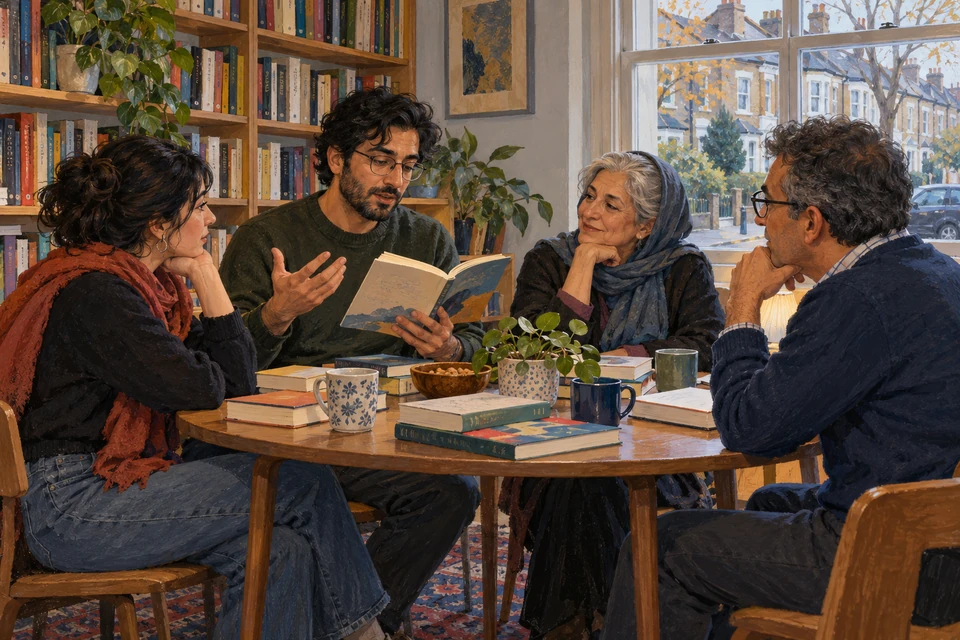
Contemporary literary exchange also continues in diaspora settings. London's Farsi Action Foundation reported a December 2025 gathering with poetry readings, a book exhibition and participants from Afghanistan and other Persian-speaking communities. Its July 2026 account describes Afghan, Iranian, Tajik and Uzbek contributors reading at another literary evening. These particular events show Afghan Persian participating in a wider cultural conversation while retaining named Afghan voices. They also offer a concrete view of language use: people read, listen, discuss new writing and meet across generations and places.
Sources
- Adam Baker; Journal of the International Phonetic Association 46(2), 229–234. Dari (Afghan Persian). https://www.cambridge.org/core/journals/journal-of-the-international-phonetic-association/article/dari-afghan-persian/E6FE187B387C9A3C2C2B79A3278BC697
- Ludwig Paul; Encyclopaedia Iranica. PERSIAN LANGUAGE i. Early New Persian. https://www.iranicaonline.org/articles/persian-language-1-early-new-persian/
- John R. Perry and Rawan Farhadi; Encyclopaedia Iranica. KĀBOLI. https://www.iranicaonline.org/articles/kaboli-colloquial-persian/
- Oriental Institute of the Czech Academy of Sciences; summer-school account credited to Ondřej Klimeš and Thomas Loy. Central Asia Research Platform — section “Courses of Afghan–Persian (Dari)”. https://orient.cas.cz/en/science-and-research/research-platforms/central-asia-research-platform/
- New York University Libraries, Afghanistan Digital Library. About The Afghanistan Digital Library. https://afghanistandl.nyu.edu/afghanistan/about.html
- New York University Archives, collection RG.38.29. Afghanistan Digital Library Archived Website. https://findingaids.library.nyu.edu/archives/rg_38_29/
- Farsi Action Foundation. The Unveiling of Ms. Sahar Rahimi's Poetry Book and a Memorable Persian Poetry Night in London. https://farsiactionfoundation.com/73/the-unveiling-of-ms-sahar-rahimi-s-poetry-book-and-a-memorable-persian-poetry-night-in-london
- Farsi Action Foundation. The Fourteenth Persian Poetry Night Held in London with the Launch of the Novel ((Goristan Sare Sartappeh)). https://farsiactionfoundation.com/78/the-fourteenth-persian-poetry-night-held-in-london-with-the-launch-of-the-novel-goristan-sare-sartappeh