Languages & Culture
Darija (Moroccan Arabic)
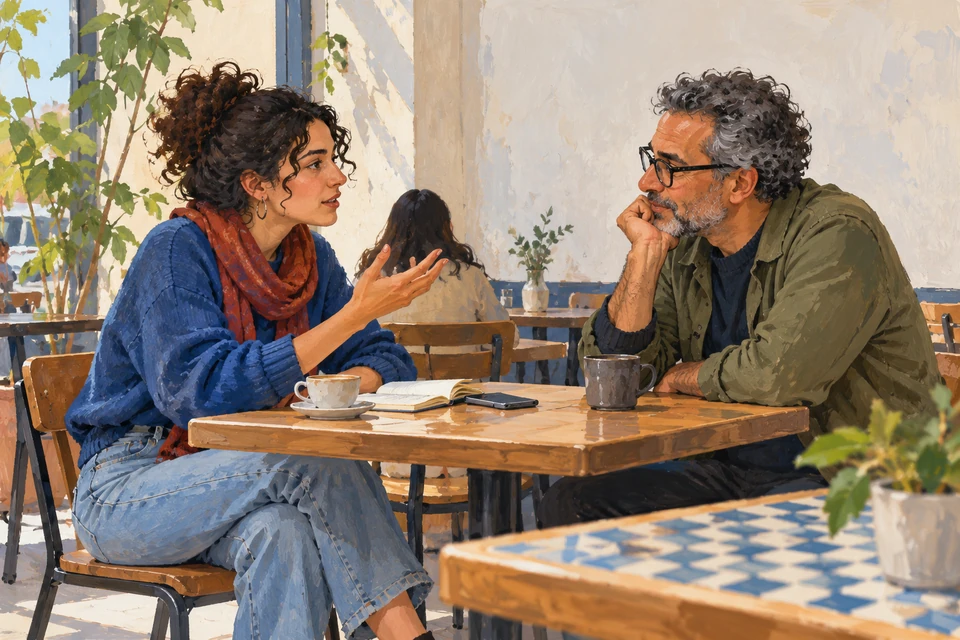
Darija is a common name for Moroccan Arabic: regional Arabic varieties used in Morocco, with connections to the wider Maghrebi Arabic landscape. The name does not identify one uniform accent or a speech community with identical language habits. Moroccan Arabic and Modern Standard Arabic are historically related varieties with different patterns of use; speakers can also combine them within an interaction. Describing Darija as a regional Arabic variety leaves room to examine its distinctive structures and the social meanings attached to it.
A history of contact
Arabic belongs to the Semitic branch of Afroasiatic. Its expansion into North Africa began with the Islamic conquests from the seventh century, entering a region where Amazigh languages were already established. Those languages form a different Afroasiatic branch. Long contact between Arabic and Amazigh, followed by further interaction with languages including Spanish and French, helped shape the region’s linguistic practices. Linguist Mena B. Lafkioui uses Darija more broadly for a North African continuum; this article keeps the narrower Moroccan scope. Contact between languages should not be confused with their becoming interchangeable names.
Moroccan language practices also travel. Lafkioui’s research discusses multilingual interaction in the diaspora, including an example from Ghent, Belgium, involving Darija, Dutch and Tarifit, an Amazigh language. Such evidence shows how people draw on particular local repertoires. It does not establish that every Moroccan migrant speaks those languages, or that a person’s ancestry determines which language they use. The relevant questions are who is speaking, with whom, and in what setting.
The history of documentation needs similar care. Bianca Brandea’s 2025 scholarly survey reproduces nineteenth-century missionary descriptions that ranked spoken Moroccan Arabic against literary Arabic and treated differences as defects. These passages reveal the assumptions of their authors. Reading an old grammar therefore involves two tasks: recovering observations about speech and recognising the hierarchy through which those observations were presented. Historical terminology is evidence about the observer as well as the language.
Poetry, print and screens
Malhoun offers a specific example of Darija’s artistic life. Rabat Région Patrimoine Historique describes this sung poetry as an orally transmitted practice in which carefully organised poems meet musical performance. Its subjects include love, spirituality, nature and social concerns. The organisation also describes cultural circles and literary cafés hosting malhoun activity, including in Rabat. Attention to phrasing, rhythm and interpretation matters here: the everyday familiarity of the language can coexist with demanding poetic craftsmanship. Malhoun is one cultural practice associated with Darija, rather than a description of every speaker’s interests.
Writing has also been a substantial research subject. Alexander E. Elinson’s 2013 study examined Darija in advertising, print media, music, fiction and translation, alongside the views of journalists, publishers and writers. The study’s published abstract documents this range without making writing and speech mutually exclusive categories. It gives readers a useful question to ask of any text: how does a writer use a familiar spoken register for a particular audience and purpose? A label such as colloquial cannot, by itself, tell us where a variety may appear.
What researchers can observe
Sound patterns vary within Morocco. In a 2025 study, Georgia Zellou and Mohamed Afkir investigated the acoustic separation between neighbouring consonants at the beginnings of words. Their abstract reports differences associated with speaking clearly rather than rapidly, speakers’ regional origins, and whether their first language was Moroccan Arabic or an Amazigh language. The study supplies a concrete reason to avoid a single national pronunciation model. Its findings concern the speakers and conditions studied; they do not license assigning a pronunciation to someone from their appearance or identity.
Digital texts present another kind of evidence. Younes Samih and Wolfgang Maier’s 2016 corpus collected material from Moroccan blogs and discussion forums, then involved Darija speakers in annotating individual words. The labels distinguished Standard Arabic, Darija, other languages, mixed forms and ambiguous material. That last category matters: not every word can be assigned neatly to one variety. Because the collection deliberately sought code-switching, it cannot tell us how frequently all Moroccans switch languages. It does provide documented material for studying how written interactions cross the boundaries that a textbook may draw more sharply.
Sources
- Georgia Zellou and Mohamed Afkir; University of California, Davis; Journal of the Acoustical Society of America, indexed by PubMed. Social factors condition consonant separation in Moroccan Arabic word-initial clusters: Amazigh-Arabic bilingualism, region, and speaking style. https://pubmed.ncbi.nlm.nih.gov/39912833/
- Younes Samih and Wolfgang Maier; Institute for Language and Information, University of Düsseldorf; European Language Resources Association. An Arabic-Moroccan Darija Code-Switched Corpus. https://aclanthology.org/L16-1658/
- Mena B. Lafkioui; École des hautes études en sciences sociales / CNRS-LIER-FYT; Lingua Posnaniensis. Darija and the global multilingual digital landscape. https://pressto.amu.edu.pl/index.php/linpo/article/view/52249
- Bianca Brandea; University of Bucharest; Romano-Arabica. A HISTORY OF MOROCCAN ARABIC STUDIES (2025-07-24). https://journals.unibuc.ro/index.php/roar/en/article/view/1129
- Rabat Région Patrimoine Historique (RRPH). Musique Malhoun. https://rabatsites.ma/tour-item/musique-malhoun/
- Alexander E. Elinson; International Journal of Middle East Studies / Cambridge University Press. DĀRIJA AND CHANGING WRITING PRACTICES IN MOROCCO. https://www.cambridge.org/core/journals/international-journal-of-middle-east-studies/article/abs/darija-and-changing-writing-practices-in-morocco/84C73C463BEAC75B17378D99426AE186