Languages & Culture
Eastern Armenian
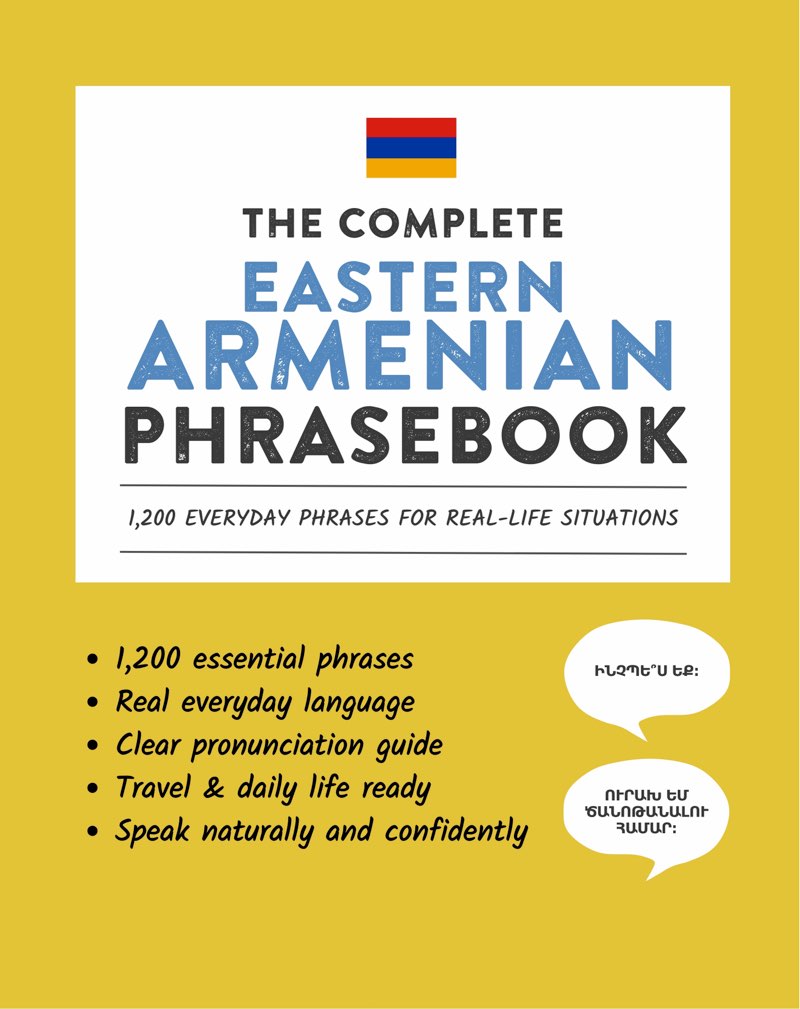
Eastern Armenian is one of the two principal modern standards of Armenian, which forms its own branch of Indo-European. The label also covers related local speech varieties. Its communities extend beyond Armenia to Georgia, Russia, Iran and California; Western Armenian communities also exist inside Armenia. A simple division between homeland and diaspora therefore misses part of the language's geography.
How a modern standard took shape
Eastern Armenian belongs to a much older written tradition. Armenian literature reaches back to the fifth century and the alphabet associated with Mesrop Mashtots. The literary language known as Classical Armenian, or Grabar, remained influential for centuries while everyday speech developed into many regional forms. The University of Chicago's historical overview distinguishes these spoken developments from the continuing written tradition. That distinction matters: a medieval Armenian manuscript and a contemporary conversation belong to connected histories, but require different linguistic knowledge.
During the nineteenth century, Armenian cultural life developed around different centres under Russian and Ottoman rule, notably Tbilisi and Istanbul. Writers increasingly used vernacular forms for literature, while newspapers and schools helped establish Eastern and Western standards. By the early twentieth century, both had displaced Grabar as the main literary vehicles. Soviet Armenia subsequently used Eastern Armenian; diaspora communities formed after the Armenian Genocide maintained Western Armenian. These histories explain the standards' institutional foundations without making either one a deficient version of the other.
Speech, spelling and experience
Spelling introduces a further distinction. In a 2019 UCLA interview, researcher Shushan Karapetian explains that Iranian Armenians use an Eastern Armenian variety while retaining traditional orthography, rather than the reformed system adopted in Soviet Armenia. Her guest, Tehran-born Gevick Safarians, recalls growing up in Los Angeles with family speech and Saturday-school books from Iran. His account places language learning within one person's movement between homes, schools and peer groups. It also shows why an Eastern Armenian speaker's writing conventions cannot simply be inferred from the language label.
Pronunciation varies systematically too. A study by Scott Seyfarth and colleagues, published online in 2023, compares Yerevan Eastern Armenian with Beirut Western Armenian. It describes a three-way contrast in voicing and aspiration for Yerevan stop consonants, compared with a two-way contrast in the Beirut variety. The researchers explicitly identify their recordings and judgments as representing relatively formal varieties, contributed by teachers, researchers and other educated professionals. This makes the study valuable for understanding particular patterns while leaving room for differences in regional and everyday speech.
Making usage available for study
The Eastern Armenian National Corpus offers another kind of evidence. Its team's 2022 report describes a project launched in 2006, collecting written material from the mid-nineteenth century onward alongside transcribed speech. Texts carry information about authors, dates and genres, as well as grammatical annotation for searching. The spoken collection represents the Yerevan standard, so it cannot stand for every Eastern Armenian community. The authors also note that older periods contain proportionally more literature, while recent material includes much online journalism. Comparisons across time therefore need to consider what was collected, not just how frequently a word appears.
Research also addresses decisions made by living writers and speakers. Yerevan State University's Armenian Language chair lists language change, modern norms, Eastern–Western relationships, translation and communication among its research fields. This connects the study of established usage with questions arising as the language changes. Translation, for example, belongs within the same departmental programme as work on modern Armenian, making contact between texts and languages part of its institutional approach.
Literary culture provides concrete settings for that exchange. On 19 February 2025, Yerevan State University marked Book Giving Day with donations, rare-book displays, discussions and workshops. Participants considered the relationship between research and fiction, the creation of literary characters and translated writing. The event brought readers and writers together around both new works and older collections, showing language in use through discussion as well as through the printed page.
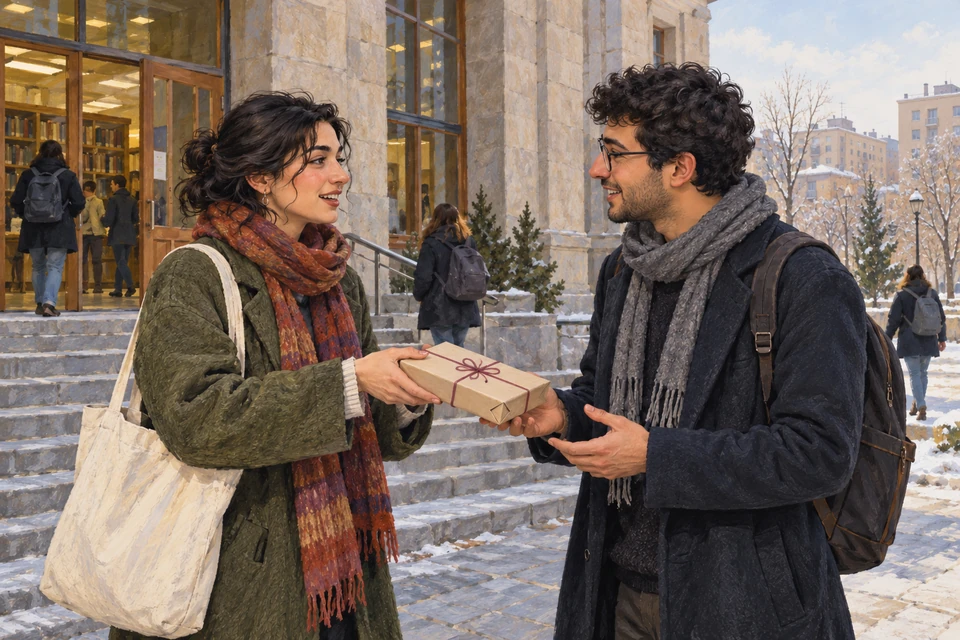
The university's cultural centre also reported students performing and giving books at Hovhannes Tumanyan's museum for the poet's birthday that day. This links a literary commemoration with an ordinary social action: choosing a book and offering it to another reader. Such particular practices help explain how written Armenian is passed between people, alongside the formal work of classrooms, dictionaries and research collections.
Sources
- Department of Middle Eastern Studies, University of Chicago. Armenian Language Program. https://mes.uchicago.edu/languages/armenian-language-program
- Victoria Khurshudyan, Timofey Arkhangelskiy, Michael Daniel, Dmitri Levonian, Vladimir Plungian, Alex Polyakov, Sergei Rubakov; European Language Resources Association. Eastern Armenian National Corpus: State of the Art and Perspectives. https://aclanthology.org/2022.digitam-1.5/
- Scott Seyfarth, Hossep Dolatian, Peter Guekguezian, Niamh Kelly, Tabita Toparlak; Journal of the International Phonetic Association. Armenian (Yerevan Eastern Armenian and Beirut Western Armenian). https://www.cambridge.org/core/journals/journal-of-the-international-phonetic-association/article/armenian-yerevan-eastern-armenian-and-beirut-western-armenian/69DD24FFE4FF3ABE79A5703FCBE345E7
- Shushan Karapetian (producer/interviewer), with Gevick Safarians; UCLA National Heritage Language Resource Center. A Persian-Armenian's linguistic experiences — Transcript. https://www.burkle.ucla.edu/nhlrc/article/206458/transcript
- Yerevan State University. Chair of the Armenian Language. https://www.ysu.am/en/faculty/83/230
- Yerevan State University. YSU celebrates Book Giving Day with a series of events, including book donations, discussions, and workshops (2025-02-19). https://www.ysu.am/en/news/74318
- Yerevan State University, Charles Aznavour Cultural Center. Preserving the tradition of Book Giving Day. https://www.ysu.am/en/cultural-center/articles/74337