Languages & Culture
Egyptian Arabic
Egyptian Arabic names regional spoken varieties within Arabic, a Semitic language. Cairo provides an important reference point, but the Nile Delta, Nile Valley and oases have their own documented speech patterns. The catalogue label is therefore treated here as a regional grouping, with attention to the particular community behind a description. A resource based on Cairo can be useful without representing every variety spoken elsewhere in Egypt.
A history shaped by settlement and contact
Arabic reached Egypt through the early Islamic conquests. Watson places Egypt within a wider region where initial expansion into towns was followed by later settlement affecting rural speech. Her account also links dialect change to continuing population movement and contact, including trade, pilgrimage and work.
The relationship with Modern Standard Arabic adds another dimension. The American University in Cairo describes Standard Arabic as common in official documents, formal media and schooling, while colloquial varieties are acquired through home and community life. Yet its explanation also stresses that speakers and writers move between the two. The term diglossia describes their differing social functions; it should not suggest that every conversation or written text occupies one sealed compartment. Egyptian colloquial speech has its own vocabulary, sound patterns and grammar, and the choices people make depend partly on the setting and the people involved.
Listening beyond a single model
Documentation has progressively widened the picture. In her survey of Arabic dialect research, Janet C. E. Watson explains how work by Woidich and Behnstedt from the 1970s brought the Delta, Nile Valley and oases into clearer view. Earlier scholarship had often treated Egyptian Arabic as synonymous with Cairene Arabic. Their regional studies made that assumption harder to sustain.
Digital resources make their own choices about coverage. The Linguistic Data Consortium's Egyptian Colloquial Arabic Lexicon explicitly represents Cairene Arabic. It draws vocabulary from telephone conversations and dictionary material, and records Arabic spelling alongside romanisation, grammatical information and pronunciation-related fields. This is useful documentation of a particular variety and source collection. The descriptive label attached to a resource matters as much as the national name on its cover.
Research also records multilingual interaction. The 2020 ArzEn project collected informal interviews with Egyptian students and employees at the German University in Cairo, where English is the instructional language. Participants discussed education, work, travel and personal experience while using Egyptian Arabic and English. Researchers transcribed the recordings and marked speaker turns, pauses and other features for speech-recognition research. The project captures one bilingual university setting; its interviews offer evidence about that setting rather than a national rate of English use. Its practical challenge is to build systems that can follow speakers when their conversation crosses a language boundary.
Voice and cultural transmission
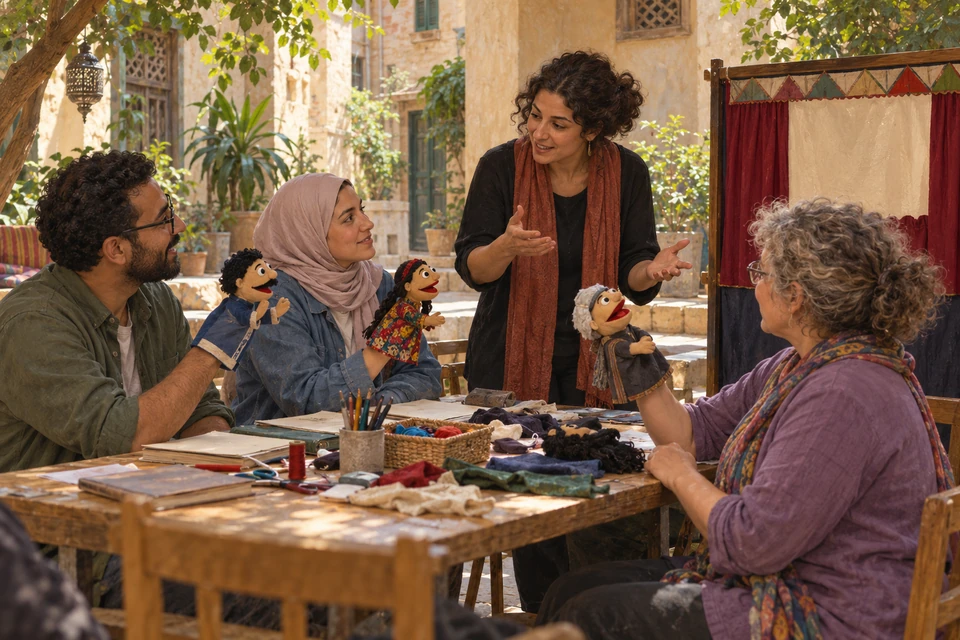
Egypt's verbal arts offer another way to think about listening. Al-Aragoz hand-puppet theatre depends on exchanges between performers and audiences. A voice modifier gives the principal puppet its recognisable sound, as UNESCO's documentary catalogue explains. UNESCO's description emphasises humour, participation and themes from daily life. Here meaning comes through timing, voice and response as well as words. This is a particular performance tradition, not a cultural practice shared by every Egyptian Arabic speaker.
Transmission remains an active undertaking. In August 2026, Egypt's National Centre for Children's Culture announced Aragoz training at its Cultural Garden in Cairo's Sayyida Zaynab district and its Arts Garden in Giza. The advertised curriculum included writing an interactive sketch, making a puppet and portable screen, voice performance and glove-puppet movement. The notice documents a planned course, without establishing who attended or what they produced. It nevertheless identifies the skills the centre intended to pass on: not simply preserving a puppet as an object, but teaching people how to make it speak and sustain a conversation with an audience.
Sources
- Janet C. E. Watson; in The Semitic Languages: An International Handbook, Walter de Gruyter; accepted version hosted by White Rose Research Online, University of Leeds. Arabic dialects (general article). https://eprints.whiterose.ac.uk/id/eprint/76443/8/HSKSE2_A050.pdf
- The American University in Cairo. The Arabic Language and Culture Program (ALCP) Frequently Asked Questions. https://www.aucegypt.edu/academics/arabic-language-and-culture-program/FAQ
- Hanaa Kilany, H Gadalla, Howaida Arram, A Yacoub, Alaa El-Habashi, C McLemore; Linguistic Data Consortium, University of Pennsylvania. Egyptian Colloquial Arabic Lexicon. https://catalog.ldc.upenn.edu/LDC99L22
- Injy Hamed, Ngoc Thang Vu and Slim Abdennadher; Proceedings of the 12th Language Resources and Evaluation Conference, pp. 4237–4246, European Language Resources Association. ArzEn: A Speech Corpus for Code-switched Egyptian Arabic-English. https://aclanthology.org/2020.lrec-1.523/
- UNESCO Multimedia Archives; documentary rights credited to The Cultural Development Fund, Egypt. Traditional hand puppetry. https://www.unesco.org/archives/multimedia/document-4773
- مروة طلبة (Marwa Talaba); المركز القومى لثقافة الطفل (National Centre for Children’s Culture, Egypt). القومي لثقافة الطفل يعلن عن مدرسة تعليم فن الأراجوز بالحديقة الثقافية وحديقة الفنون.. للموسم السابع (2026-08-31). https://enccc.org/%D8%A7%D9%84%D9%82%D9%88%D9%85%D9%8A-%D9%84%D8%AB%D9%82%D8%A7%D9%81%D8%A9-%D8%A7%D9%84%D8%B7%D9%81%D9%84-%D9%8A%D8%B9%D9%84%D9%86-%D8%B9%D9%86-%D9%85%D8%AF%D8%B1%D8%B3%D8%A9-%D8%AA%D8%B9%D9%84%D9%8A-3/