Languages & Culture
Esperanto
Esperanto is a constructed, or planned, language with an international community that reads, writes and meets through it. The Universal Esperanto Association describes its purpose as communication between people with different first languages, alongside those languages. That is an aspiration of the movement, rather than a guarantee that every encounter is equal or effortless. Its cultural life can be approached through particular books, meetings and research projects, each showing how people have put the original proposal to work.
A publication with literary ambitions
Ludwik Zamenhof introduced the language in a book published in July 1887. Now known as Unua Libro, it first appeared in Russian under the title Dr. Esperanto's International Language. Princeton University Library's account of its early Polish edition describes a combination of grammar, a small dictionary, and examples of prose and poetry. Literature was therefore part of the presentation from the beginning. Zamenhof later incorporated much of this material into the 1905 Fundamento de Esperanto, which set out an authoritative grammatical foundation.
An important feature of Esperanto is its capacity to build words by combining components. Linguists call its word structure agglutinating: stems and other meaningful elements can be assembled into more complex forms. In a 2016 study, W. Jansen examined the mechanisms behind this flexibility. His account also identifies difficulties, including choices involving verbs that take an object and those that do not. Regular word formation gives learners a productive resource, while using it still involves learning how meanings and grammatical patterns fit together.
Creative writing continues through organised literary activity. The Universal Esperanto Association's published results for its 2025 competitions include poetry, prose, microfiction, plays, essays and song lyrics. The prose awards named writers associated with the United States and Puerto Rico, the Democratic Republic of the Congo, and China. Such an award list offers a concrete glimpse of geographically dispersed authors working in one language. It also makes clear that literary participation involves different genres and audiences, from a very short narrative to a work intended for performance.
Places to use the language
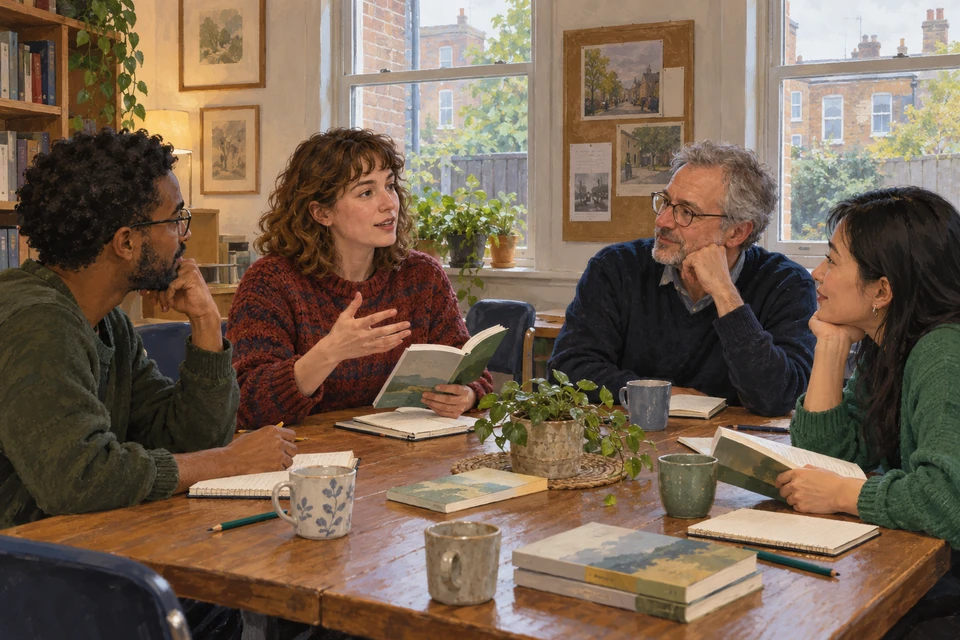
Community activity also happens at a much smaller scale. The London Esperanto Club describes meetings in Highbury as well as online sessions. Its meetings use Esperanto, and it welcomes learners with arrangements for help. Talks and the discussions that follow them form part of the programme. A local club gives the language a recurring social setting: people can listen to an argument, ask a question and continue a conversation, rather than restricting their use to exercises. This example identifies one community's practice, without making it a model for every group.
Learning and literary activity can meet in the same programme. NASK's published plan for its July 2025 courses in Toronto included a workshop led by Rafa Nogueras on reading and writing short stories and microfiction. The description welcomed participants who were neither dedicated readers nor aspiring authors, presenting creative work as a way to use and expand their Esperanto. The broader advertised schedule combined classes with reading groups, music practice and films with Esperanto subtitles. These planned activities show how organisers make room for shared interests alongside formal instruction.
Evidence of use
Researchers can examine written practice through the Tekstaro de Esperanto, an electronic corpus initiated by the Esperantic Studies Foundation in 2002. Bertilo Wennergren prepared its first phase, collecting and encoding existing electronic texts, including writings by Zamenhof and other established authors. Later phases added further historical material, postwar writing and modern texts. Its search system displays matches with surrounding context. That context matters: a sentence shows how a word was used by a particular writer, and repeated examples allow a reader to investigate patterns beyond the possibilities listed in a grammar.
The Austrian National Library preserves a complementary record. Its Department of Planned Languages holds books and journals, authors' and translators' papers, conference photographs, posters and recordings of music and radio. These materials document both texts and the settings in which people exchanged them. A literary manuscript and a meeting poster answer different historical questions, while together they help make Esperanto's social history researchable. Contemporary clubs and writing projects add further settings in which this deliberately planned language is used for purposes chosen by its speakers.
Sources
- Universal Esperanto Association (UEA), Esperanto.net. Esperanto: the International Language. https://esperanto.net/en/esperanto-the-international-language/
- David Jenkins, Librarian for Classics, Hellenic Studies, and Linguistics; Princeton University Library. Humphrey Tonkin gifts rare Esperanto book to Princeton University Library (2018-10-11). https://library.princeton.edu/about/library-news/2018/humphrey-tonkin-gifts-rare-esperanto-book-princeton-university-library
- W. Jansen; Linguistics 54(5), 1101–1133; University of Amsterdam UvA-DARE repository. Derivation in the lexicon: the case of Esperanto (2016). https://dare.uva.nl/id/a323061b-5031-4845-b554-91d2bff2f79e
- London Esperanto Club. LEK - Londona Esperanto-Klubo. https://londonaesperantoklubo.com/
- Universala Esperanto-Asocio; official journal Revuo Esperanto. Belartaj Konkursoj de UEA en 2025. Komuniko 1244. https://revuoesperanto.org/gk_1244
- NASK; organisers’ official course-programme website. NASK 2025 – Toronto. https://nask.org/nask-2025-english/
- Esperantic Studies Foundation; project implementation by Bertilo Wennergren. Tekstaro de Esperanto. https://tekstaro.com/tekstaro
- Austrian National Library, Department of Planned Languages. Explore our collections. https://www.onb.ac.at/en/departments/department-of-planned-languages/explore-our-collections