Languages & Culture
Filipino
Filipino is the Philippines' national language, with a linguistic base in Tagalog, an Austronesian language. The two names therefore require an explanation of history and social role. The University of Hawaiʻi at Mānoa describes the language it teaches as Tagalog-based Filipino; Cornell's linguistic overview emphasises the extensive vocabulary and grammatical structures that Filipino and Tagalog share. Treating the names as evidence of two unrelated genealogies would misrepresent that relationship.
The national designation has consequences for education, reference works and public communication. It also belongs within a multilingual country. Calling a language Filipino does not mean that every Filipino family has the same first language, or that the country's other languages are merely informal versions of the national standard. The Hawaiʻi programme makes that diversity explicit, naming Ilokano, Cebuano and Hiligaynon alongside the Tagalog-based language and addressing the different experiences of heritage and non-heritage learners.
A national language as an evolving project
In 1937, President Manuel L. Quezon approved Tagalog as the basis of the national language through Executive Order No. 134. The order records a recommendation by the Institute of National Language and a policy choice among existing Philippine languages. This was an institutional step in standard formation; the language selected already existed and had its own speakers.
The 1987 Constitution names the national language Filipino and directs its further development through existing Philippine and other languages. Its language provisions also identify Filipino and English for official communication and instruction, while recognising regional languages in auxiliary official and educational roles. These provisions place the national language alongside other languages within the same document. Their wording describes an intention to develop Filipino, rather than demonstrating that all Philippine languages have contributed equally to its actual structure or vocabulary.
That distinction between a linguistic description and a national aspiration helps explain why naming remains a subject of scholarship. In January 2026, the University of the Philippines Diliman Department of Linguistics announced a centennial publication containing a paper on the development of Filipino as the national language. The department's account describes continuing debate over the original vision of Filipino and the roles of its linguistics and Filipino-literature departments in policy and research. Its presentation of the wider volume also emphasises collaboration with language communities. National-standard development remains a question researchers examine within the country's multilingual life.
Making reference works useful to different readers
The Komisyon sa Wikang Filipino's online Filipino-English dictionary illustrates the practical work behind a standard. Its history page traces the collection to an earlier Institute of National Language project published under the commission in 1992. It explains that the present resource follows the national orthography and updates meanings in relation to the commission's monolingual dictionary. The intended readers include people more comfortable in English who want to improve their understanding and use of Filipino. Dictionary work here connects spelling, changing meanings and the different starting points of learners.
Language learning through media and community
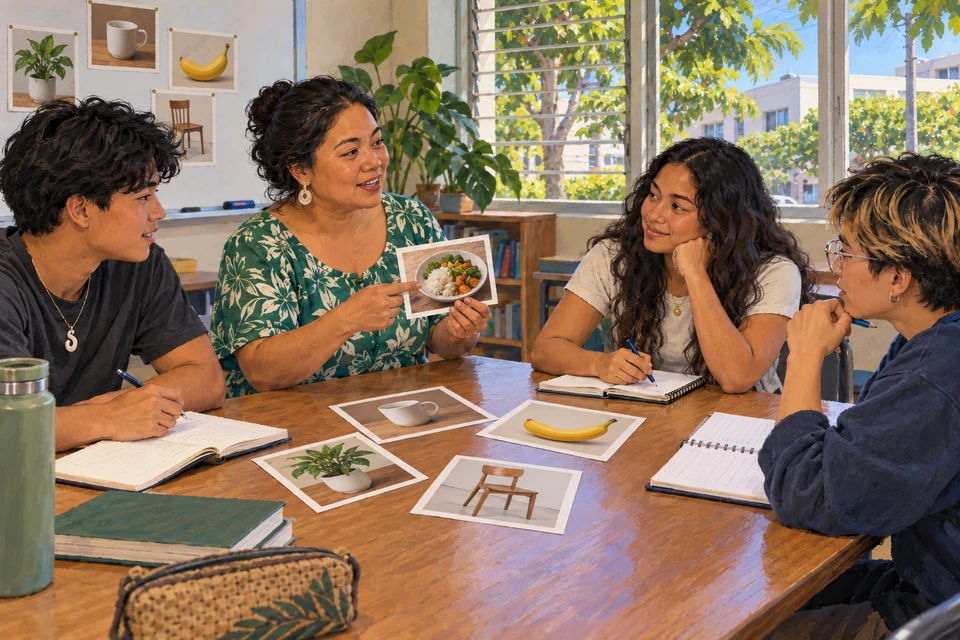
Filipino's contemporary educational life extends beyond the Philippines. At Hawaiʻi's university programme, language study serves both heritage students and people without Filipino family backgrounds. Its mission links communicative ability with an understanding of diverse Philippine experiences, including those of communities overseas. This allows language learning to support family connections without making ancestry a prerequisite for participation.
The programme's course catalogue gives concrete examples of what that learning can involve. Listening work draws on news broadcasts, songs, documentary narration and television or radio dramas. Other course descriptions cover film, contemporary literature and translation between Filipino and English. These are different kinds of language encounters: following a broadcast, interpreting a character's dialogue and translating a written passage each asks the learner to consider audience and context. The catalogue describes a curriculum, rather than guaranteeing that every course runs in every semester.
A university report published in October 2024 describes another approach through the Pamana ng Lahi workshops for young people in Hawaiʻi. The programme began as a pilot in 2019, combining Tagalog-based Filipino with Philippine geography, food and cultural learning. Later workshops included folklore and mythology. Such activities bring language into conversations about place, stories and family inheritance. They offer a particular example of diaspora education, with participants exploring their connections to the Philippines rather than being assumed to possess one uniform cultural experience.
Sources
- Nikolaus P. Himmelmann; in Morphologie / Morphology, volume 2, pp. 1473–1490; university-hosted chapter copy. Tagalog (Austronesian). https://ifl.phil-fak.uni-koeln.de/sites/linguistik/Personen/ASW/Himmelmann/Publikationen/2001-2005/Tagalog2005e.pdf
- Department of Asian Studies, Cornell University; no individual byline. Tagalog (Filipino). https://asianstudies.cornell.edu/research/tagalog-filipino
- President Manuel L. Quezon, Commonwealth of the Philippines; reproduced by The Lawphil Project, Arellano Law Foundation. Executive Order No. 134 — Proclaiming the National Language of the Philippines Based on the “Tagalog” Language. https://lawphil.net/executive/execord/eo1937/eo_134_1937.html
- Republic of the Philippines; copy hosted by the University of Minnesota Human Rights Library. The 1987 Constitution of the Republic of the Philippines. https://hrlibrary.umn.edu/research/Philippines/PHILIPPINE%20CONSTITUTION.pdf
- Komisyon sa Wikang Filipino. KWF Diksiyonaryong Filipino-English — Kasaysáyan. https://www.dfe.kwfdiksiyonaryo.ph/tungkosa.php
- Divine Angeli P. Endriga; Department of Linguistics, University of the Philippines Diliman. The Archive Releases Special Publication No. 19 (2024): A Century of Philippine Linguistics. https://linguistics.upd.edu.ph/news/the-archive-releases-special-publication-no-19-2024-a-century-of-philippine-linguistics/
- University of Hawaiʻi at Mānoa Filipino & Philippine Culture Program. Our Mission. https://www.hawaii.edu/filipino/Mission.html
- University of Hawaiʻi at Mānoa Filipino & Philippine Culture Program. Courses. https://www.hawaii.edu/filipino/Courses.html
- UH News, University of Hawaiʻi System. UH awarded $64K to expand a Filipino youth cultural program (2024-10-02). https://www.hawaii.edu/news/2024/10/02/64k-to-expand-filipino-youth-program/