Languages & Culture
Georgian
Georgian belongs to Kartvelian, also called the South Caucasian language family. Georgian, Svan, Mingrelian and Laz are its principal modern members. They should not all be described as dialects of Georgian: the family name identifies their relationship, while each has its own linguistic history. Georgian is centred in Georgia, but its language geography extends across the surrounding region. This wider setting matters both to its past and to the way researchers document it.
The terminology also has a history. Mingrelian and Laz are often grouped as Zan and have sometimes been analysed as varieties of a single language. Rasmus Thorsø's account describes the convention of treating them separately while recognising that close relationship. This discussion concerns the internal classification of Kartvelian; it does not turn either one into a variety of Georgian. Distinguishing these levels helps readers follow scholarship without confusing a family, a language and a regional dialect.
A written tradition with several forms
Old Georgian is attested from the fifth century. Among its early literary works is the account of Queen Shushanik's martyrdom, associated with Iakob Curtaveli. Christian literature and translation connected Georgian writers with wider religious and intellectual networks. Later secular literature developed its own engagements with neighbouring traditions: Charles University's medieval-literature overview discusses Persian and Near Eastern forms and imagery in Shota Rustaveli's The Knight in the Panther Skin. Georgian writing thus preserves evidence of cultural exchange as well as local literary creation.
Readers also encounter different historical scripts. Asomtavruli, Nuskhuri and Mkhedruli are three established systems for writing Georgian, with Mkhedruli now the most widely used. They represent writing traditions, not three separate spoken languages. For a newcomer, identifying the script is therefore a practical first step before comparing a medieval page with a modern book. A history of the language needs to follow changes in both written forms and the uses to which texts were put.
Recording variation across places and time
Georgian itself contains regional diversity. Jost Gippert and Manana Tandashvili describe broad eastern and western dialect groupings, with Kartlian, associated with central eastern Georgia and Tbilisi, particularly close to the modern written language. Their 2015 research account also identifies documented Georgian varieties in Iran, Turkey and Azerbaijan. These communities widen the picture beyond the national border; a standard-language description alone cannot capture all the regional material researchers have collected.
The Georgian National Corpus project brought several kinds of evidence into a shared research programme. Its public description identifies historical text collections, modern materials and dialect resources, with partners in Georgia, Germany and Norway. Gippert and Tandashvili explain why this requires more than putting old and new documents into one searchable collection. Dates, scripts, regional speech, genres and modes of communication need to remain distinguishable. Otherwise, a difference between a handwritten religious text and a modern spoken recording could be mistaken for a simple change over time.
Dialect dictionaries contribute another layer. Marina Beridze, David Nadaraia and Lia Bakuradze describe the Georgian Dialect Corpus as combining texts, a library and online dialect dictionaries. Their account also introduces a lexicographic editor for organizing dictionary information, with attention to linguistic and social features of regional speech. This is a useful reminder that documenting a word involves its context and local meanings, alongside deciding how to spell it or connect its grammatical forms.
Writing as a contemporary shared practice
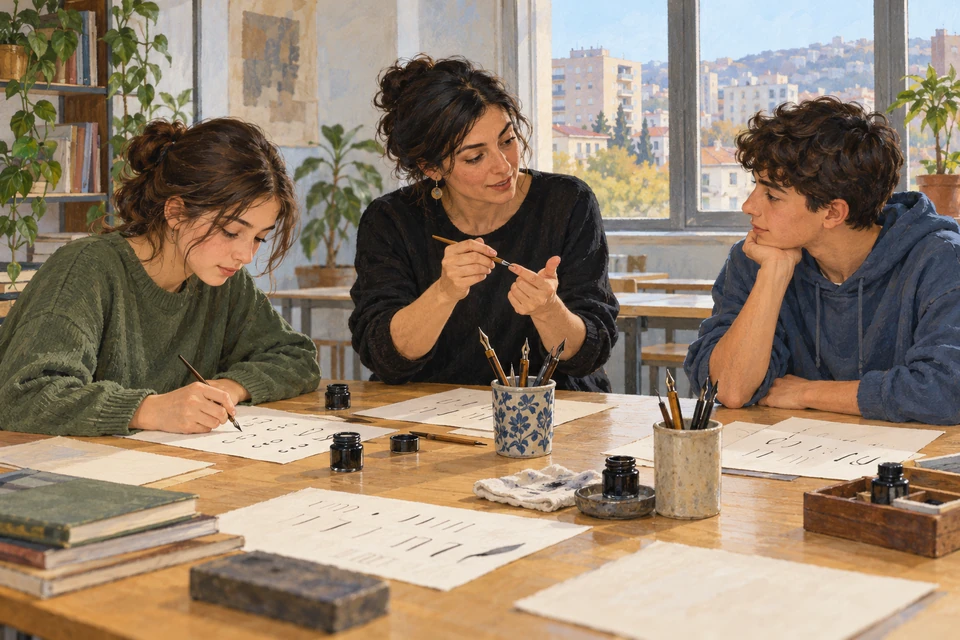
Calligraphy provides one tangible connection between script history and present-day learning. In May 2025, Tbilisi's European School reported a Georgian calligraphy masterclass followed by a student competition, organised with the involvement of its Georgian language and literature teacher. This was an educational activity involving learners and practising calligraphers. The particular example shows written language becoming something students make and discuss, rather than encountering it only as a finished page in a textbook.
That practice also travels. Caucasus University reported an April 2026 workshop at Vilnius University where Lithuanian students and professors learned with a representative of the Georgian Calligraphers Association. Participants fitted nibs into pen holders and worked with ink to form Mkhedruli letters. The event illustrates a specific route into Georgian cultural life through careful attention to writing tools and shapes. It also makes room for learners from outside Georgian-speaking families: participation begins with listening, observing and trying the practice themselves.
Sources
- Rasmus Thorsø; Leiden University doctoral dissertation, author-hosted copy. Prehistoric loanwords in Armenian: Hurro-Urartian, Kartvelian, and the unclassified substrate. https://rasmus.ukrudt.net/pub/2023-PLA.pdf
- Center for Language Technology, Indiana University. Georgian. https://celt.indiana.edu/portal/Georgian/index.html
- Medieval Languages and Literatures, Faculty of Humanities, Charles University. Georgian. https://medlit.fhs.cuni.cz/language/georgian/
- Jost Gippert and Manana Tandashvili; in Jost Gippert and Ralf Gehrke (eds.), Historical Corpora: Challenges and Perspectives, Narr Francke Attempto. Structuring a diachronic corpus. The Georgian National Corpus project. https://titus.uni-frankfurt.de/personal/jg/pdf/jg2014e.pdf
- Goethe University Frankfurt and Georgian National Corpus project partners. The Georgian National Corpus Project. https://armazi.fkidg1.uni-frankfurt.de/gnc/gnc.htm
- Marina Beridze, David Nadaraia and Lia Bakuradze; Journal of Linguistics/Jazykovedný časopis, Slovak Academy of Sciences, Ľudovít Štúr Institute of Linguistics. Georgian Dialect Corpus: Linguistic and Encyclopedic Information in Online Dictionaries. https://reference-global.com/article/10.1515/jazcas-2017-0022?tab=article
- European School / American School of Advanced Studies, Tbilisi. Reviving Tradition: Georgian Calligraphy Masterclass and Student Competition. https://europeanschool.ge/en/reviving-tradition-georgian-calligraphy-masterclass-and-student-competition/
- Caucasus University. Masterclass on the Art of Georgian Calligraphy at Vilnius University. https://www.cu.edu.ge/en/news-page/masterclass-in-the-art-of-georgian-calligraphy-at-vilnius-university