Languages & Culture
Greek
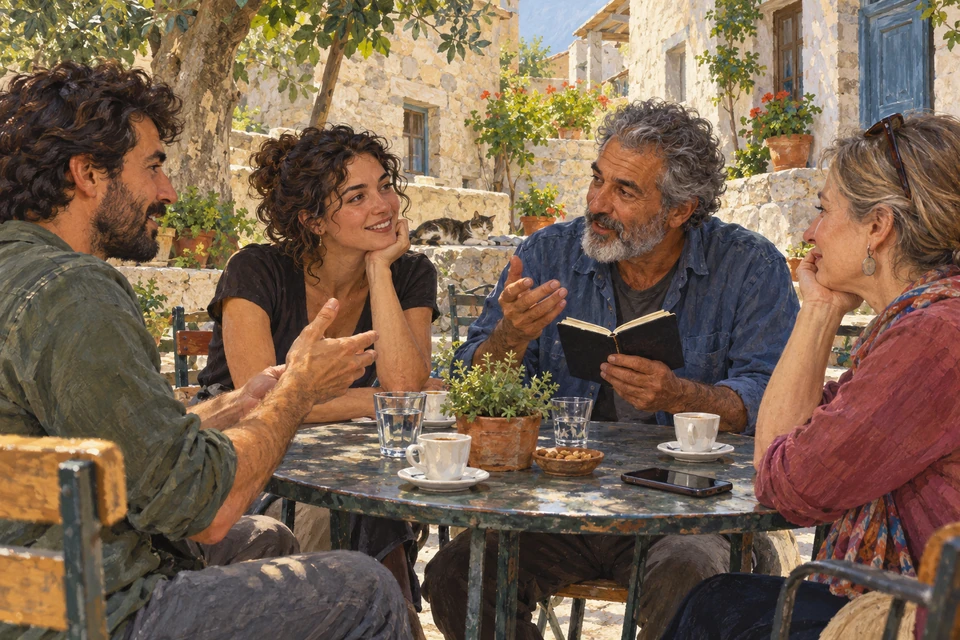
Greek has an exceptionally long written history, but an introduction to the language today begins with Modern Greek. This article concerns its modern standard and regional diversity, with earlier stages supplying historical context. Greek is used in Greece and Cyprus and in diaspora communities, including those in Australia, North America and central Europe. Descent and language use are different measures: Christos Karvounis’s university overview explicitly cautions that population estimates sometimes count people of Greek ancestry who no longer speak Greek.
How the modern standard took shape
Greek forms a separate branch of the Indo-European family. Its earliest surviving written evidence includes Mycenaean administrative tablets in Linear B from the second millennium BCE. Ancient Greek, the widely used Koine of the Hellenistic and later periods, medieval Greek and Modern Greek are historical stages, not interchangeable versions of one unchanging language. Angela Ralli’s scholarly overview notes that scholars do not agree on a single periodisation: linguistic changes, political events and literary history can suggest different boundaries.
A more recent debate concerned the relationship between everyday speech and formal writing. The written, archaizing variety called katharevousa competed with dimotiki, or demotic Greek. The conflict affected education, administration and literature. The 1976 settlement established Standard Modern Greek in education and administration, but did not remove the learned tradition from the language. The modern standard is primarily demotic while retaining vocabulary and forms associated with katharevousa. Karvounis emphasises the role of literature in giving the vernacular prestige and helping its standardisation.
Regional voices and individual histories
Standardisation does not describe the whole linguistic landscape. The Austrian Academy of Sciences’ VLACH project explains that most modern Greek varieties developed through Koine and medieval Greek, while Tsakonian has a different historical connection with Laconian Doric. Its overview includes Pontic, Cappadocian, Cretan, Cypriot and South Italian varieties. A simple north–south division captures some pronunciation differences but cannot adequately classify them all. VLACH also distinguishes linguistic classification from the community identities used to organise its recordings.
Those recordings connect linguistic variation with experience. In the project’s Cappadocian collection, one narrative describes learning the Misti variety from grandparents and recalls agricultural work. The accompanying description traces the family’s movement from Cappadocia to northern Greece and notes language shift in the receiving village. The individual story supplies something a language map cannot: an account of where learning occurred and what the language meant within a particular family. It should not be generalised to every Cappadocian speaker.
Studying words in their settings
The Academy of Athens’ Historical Dictionary of Modern Greek investigates both the standard and dialects from 1800 onward. Entries consider when a word is attested, its etymology, variant forms and geographical distribution. Publication began in 1933; a collaboration with the Thesaurus Linguae Graecae at the University of California, Irvine, has made digitised volumes available. The project treats a word’s history and location as evidence, allowing readers to see more than a single present-day definition.
Other research follows large collections of recent writing. A 2026 paper by Maria Gavriilidou and Nikos Sidiropoulos describes the Hellenic National Corpus, which combines printed and internet material and supports searches for words in context, grammatical information and frequencies. Its selection concentrates on Standard Modern Greek; the paper explicitly says that dialect material was excluded from the collection it describes. That limitation is useful to know: a corpus of standard writing and an archive of local speech answer different research questions.
A Cretan example: poetry as exchange
In the Cretan town of Anogeia, mantinades belong to local oral and musical tradition. The Centre of Music and Dance Tradition presents this practice through listening, reading and interactive activities linked to Cretan dialect. Its account identifies themes including love, separation, death and nature. Visitors can explore how verses are made as well as encounter existing examples. This local approach places Greek’s regional resources within contemporary cultural education, alongside the dictionaries, recordings and corpora through which scholars investigate the language.
Sources
- Angela Ralli; Revue belge de philologie et d’histoire 90(3), 939–966. Greek (2012). https://www.angelaralli.gr/sites/default/files/Greek_revue%20belge.pdf
- Christos Karvounis; Johannes Gutenberg-Universität Mainz, FB06 Neugriechisch. Neugriechische Sprache: ein Überblick. https://www.neugriechisch.fb06.uni-mainz.de/neugriechische-sprache-ein-ueberblick/
- Austrian Academy of Sciences, VLACH. Greek varieties. https://www.oeaw.ac.at/de/vlach/collections/greek-varieties
- Austrian Academy of Sciences, VLACH; selected narrative performer Panagiotis Giltidis; interview/transcription/translation Thede Kahl and Sotirios Rousiakis; editor Valentina Paul. Narratives and life stories. https://www.oeaw.ac.at/de/vlach/collections/greek-varieties/cappadocian-greek/video-collection/narratives-and-life-stories
- Academy of Athens; Thesaurus Linguae Graecae, University of California, Irvine. Τhe Historical Dictionary of Modern Greek (ILNE). https://stephanus.tlg.uci.edu/ilne/about.php
- Maria Gavriilidou and Nikos Sidiropoulos; Institute for Language and Speech Processing, Athena Research Center; Proceedings of the 12th Workshop on Challenges in the Management of Large Corpora, 57–62, ELRA. Hellenic National Corpus: the current state (2026-05-11). https://aclanthology.org/2026.cmlc-1.7.pdf
- Centre of Music and Dance Tradition, Municipality of Anogeia. Αρχική - Κέντρο Μουσικοχορευτικής στα Ανώγεια [homepage heading: Κέντρο Μουσικοχορευτικής Παράδοσης Ανωγείων]. https://anogeiamusicdance.gr/