Language & culture
Gullah: Language, Life and Stories along the Sea Islands
Language at a glance
- Speakers
- No dependable global count
Published estimate (2013): broad competence, mainly U.S.
- Names
- Gullah · Geechee
Names used within the communities.
- Communities
- Southeastern U.S. coast
Carolinas, Georgia and northeastern Florida.
- Language type
- English-lexified creole
English vocabulary, with African contributions.
- Writing
- Roman letters
Spelling conventions vary.
- Varieties
- Coastal variation · Afro-Seminole
Related varieties.
Who speaks Gullah, and what do they call it?
Gullah is spoken in African American communities on the southeastern U.S. mainland and Sea Islands, from the Carolinas through Georgia to northeastern Florida. Gullah and Geechee are community names; Geechee is especially associated with Georgia and parts of South Carolina.
How many people speak Gullah worldwide?
There is no dependable worldwide total. An estimate published in 2013 suggested that up to a couple of hundred thousand people, mainly in the United States, might have some competence alongside English. This is not a current count of fluent or first-language speakers.
Where did Gullah come from, and who spoke it in the past?
Gullah developed among enslaved Africans speaking different languages and English speakers on plantations in the colonial coastal South. It is an English-lexified creole: much vocabulary comes from English, alongside African contributions.
Early printed records include Charles Colcock Jones Jr.’s 1888 stories and glossary. Lorenzo Dow Turner’s 1932–1933 recordings and 1949 Africanisms in the Gullah Dialect documented speakers’ voices and African connections.
Which Gullah words might an English speaker already recognise?
English contributed familiar words: Demarra means tomorrow, dem comes from them, and the question ending ainty comes from isn’t it.
How does Gullah vary from region to region?
Speech varies across coastal communities and with setting and company, overlapping with neighbouring African American and Southern English. Migration produced related varieties, including Afro-Seminole in inland Florida and varieties in Texas, Oklahoma and Middle Caicos in the Turks and Caicos Islands.
How is Gullah written, and where is it used?
Different conventions appear in community publications, storytelling and religious writing, including the Sea Island Translation Team’s 2005 De Nyew Testament and the Gullah/Geechee Nation’s bilingual publications.
Which alphabet does Gullah use, and what might surprise an English speaker?
Gullah uses Roman letters. In David B. Frank’s practical spelling, cona means corner and chullun means children: recognisable English words take spellings that reflect Gullah pronunciation.
Does Gullah have grammatical gender?
Gullah nouns have no masculine or feminine classes. The pronoun e can mean he, she or it, though some speakers use gender distinctions in pronouns.
How do you say hello, thank you and goodbye in Gullah?
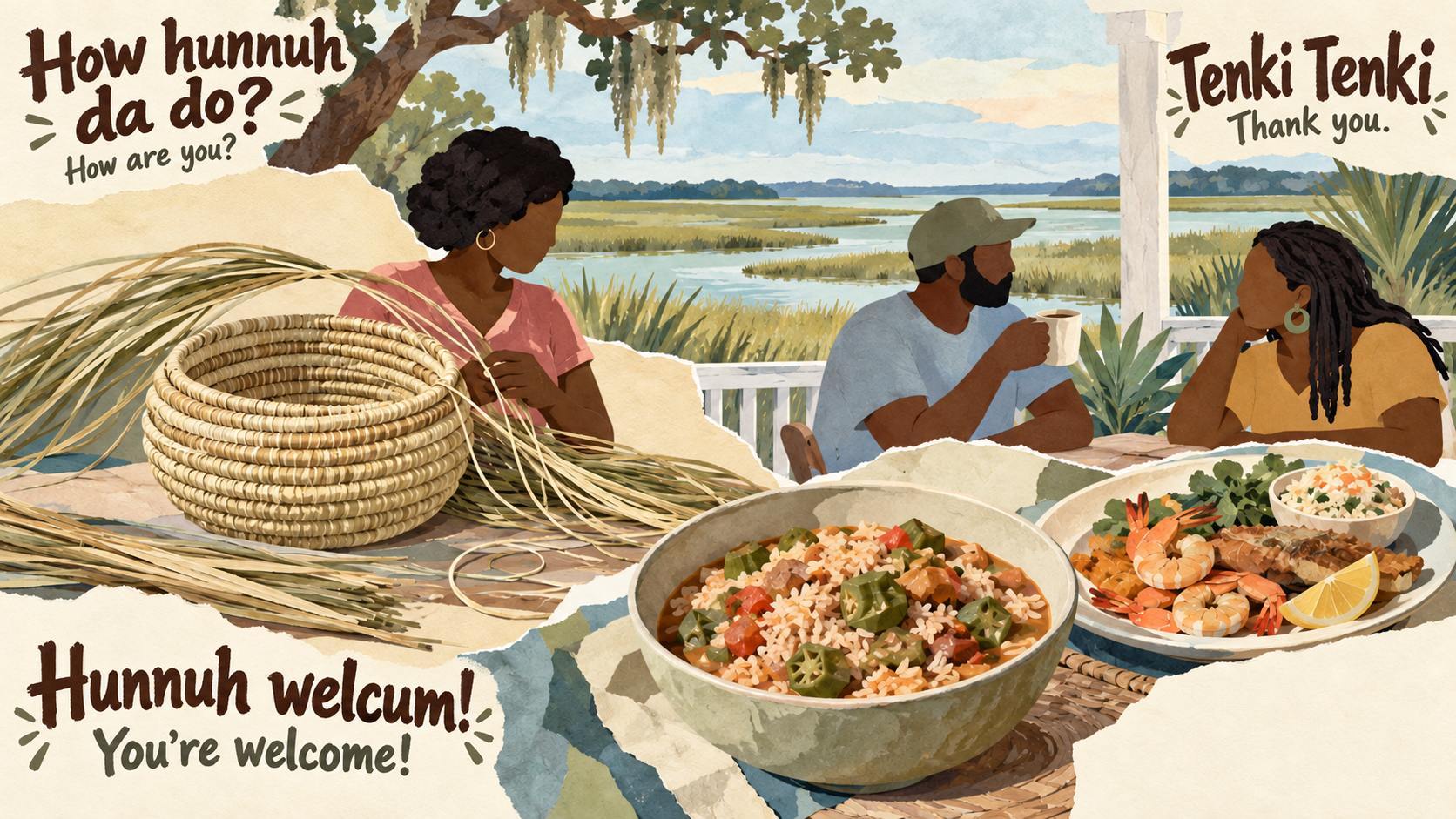
- How hunnuh da do? — How are you?, used as a greeting.
- Tenki Tenki — Thank you.
- See hunnuh dey ya! — See you there!, a closing when a meeting is planned.
- Hunnuh welcum! — You’re welcome!, a reply to thanks.
What are some memorable Gullah sayings?
- De wata bring we and de wata gwine tek we bak. Water brought us here and will take us back. Queen Quet used it in her 2019 congressional testimony, connecting coastal waters with fishing, baptism and ancestral burial places.
- Mus tek cyear a de root fa heal de tree. A tree’s recovery depends on its roots. The Gullah Geechee Cultural Heritage Corridor uses this image in its community preservation work.
What everyday customs might surprise a visitor?
At Emily Meggett’s Edisto Island home, an open side door meant food was available to share. The cook and author planned meals for neighbours who needed them and delivered food door to door from a large pot in her car.
Which Gullah-language song and film offer a cultural introduction?
In 1926, Robert Winslow Gordon recorded Henry Wylie singing “Come By Here”, an early performance of the spiritual now known as “Kumbaya”. Wylie’s dialect is thought to be a form of Gullah; the original composer is unknown.
Julie Dash’s Daughters of the Dust (1991) follows younger Peazant relatives preparing to leave their Sea Island home while Nana defends their ties to it. Gullah dialogue carries family memories and arguments. The 2017 Environmental Film Festival in the Nation’s Capital version has English subtitles.
What is available for someone curious about the language now?
- Indiana University’s Dow Turner Collections: online sound examples, including Diana Brown’s 1932 prayer from Edisto Island.
- Gullah Tours’ free online glossary: words and English meanings from Alphonso Brown and The Black Border.
- The Gullah/Geechee Nation website: contemporary community news and writing in Gullah and English.
Fun Facts
- Eyewata, tears, and dayclean, dawn, are compounds: familiar-looking pieces combine into a single everyday meaning.
- Sara dem can mean Sarah and her family or friends. A name followed by dem can include that person’s companions.
Sources
- Gullah Geechee Cultural Heritage Corridor. The Gullah Geechee People. n.d. https://gullahgeecheecorridor.org/the-gullah-geechee/
- Thomas B. Klein. Gullah: Survey chapter. Atlas of Pidgin and Creole Language Structures Online, 2013. https://apics-online.info/surveys/13
- Thomas B. Klein. Structure dataset 13: Gullah. Atlas of Pidgin and Creole Language Structures Online, 2013. https://apics-online.info/contributions/13
- David B. Frank. Gullah Grammar Sketch. Paper presented at the Association for the Study of African American Life and History conference, 25 September 2015. https://www.dbfrank.net/papers/gullah_grammar_sketch.pdf
- Cosmo Historical Preservation Corporation. About. n.d. https://www.cosmohistoricalpreservation.com/about
- Indiana University Libraries, Archives of Traditional Music. Dow Turner Collections. n.d. https://libraries.indiana.edu/dow-turner
- Gullah/Geechee Nation. Disya Who WEBE! and site-owner replies, 22 May 2025 and 19 May 2026. https://gullahgeecheenation.com/
- Queen Quet. A Cultural Eclipse: Remembering the Slave Trade and Abolition. 23 August 2017; author replies 30 August 2017. https://gullahgeecheenation.com/2017/08/23/a-cultural-eclipse-remembering-the-slave-trade-and-abolition-by-queen-quet/
- Queen Quet Marquetta L. Goodwine; U.S. House Committee on Natural Resources. Prepared statement in Healthy Oceans and Healthy Economies: The State of Our Oceans in the 21st Century. 7 February 2019, pp. 9–10. https://www.govinfo.gov/content/pkg/CHRG-116hhrg34955/html/CHRG-116hhrg34955.htm
- Gullah Geechee Cultural Heritage Corridor. Discovering the Legacy of African Cultures. n.d. https://gullahgeecheecorridor.org/
- The Takeaway, WNYC Studios; Emily Meggett and Kayla Stewart. Replay: Gullah Geechee Home Cooking. 27 April 2023; replay of a 2022 interview. https://www.wnycstudios.org/podcasts/takeaway/segments/gullah-geechee-home-cooking
- Stephen Winick. Kumbaya: History of an Old Song. American Folklife Center, Library of Congress, 6 February 2018. https://blogs.loc.gov/folklife/2018/02/kumbaya-history-of-an-old-song/
- Library of Congress, American Folklife Center. Gullah Geechee Collections: Archival Collections. Updated 26 May 2026. https://guides.loc.gov/gullah-geechee-folklife/archival-collections
- Cohen Media Group. Daughters of the Dust. n.d. https://cohenmedia.net/product/daughters-of-the-dust
- Lizzie Francke. Daughters of the Dust review: a transportive, transformative colonial rites-of-passage movie. Sight and Sound, British Film Institute; 1991 review, web publication 2 June 2017, updated 3 August 2017. https://www.bfi.org.uk/sight-and-sound/reviews/daughters-dust-review-transportive-transformative-colonial-rites-passage-movie
- Environmental Film Festival in the Nation’s Capital. Daughters of the Dust. 2017 festival programme. https://dceff.org/film/daughters-of-the-dust/
- Gullah Tours; Alphonso Brown. Gullah Words. n.d. https://gullahtours.com/gullah/gullah-words/
Start learning today
Explore these books to keep learning.