Languages & Culture
Gullah
Gullah belongs to the living communities of the southeastern United States’ Atlantic coast. The Gullah Geechee Cultural Heritage Corridor identifies communities in North Carolina, South Carolina, Georgia and Florida, with histories rooted in Africans’ enslavement on coastal plantations. Gullah Geechee also names people and a much wider cultural inheritance. A language description therefore answers a different question from a family history or a statement of cultural identity; the terms should not be treated as interchangeable measures of who speaks what.
A language formed through contact
Linguist Thomas B. Klein’s survey classifies Gullah as an English-lexified creole: English supplied much of its vocabulary, while its development involved contact among languages and communities under slavery. English-lexified describes a historical relationship, not a judgment that Gullah is unsuccessful English. Names vary locally. Klein records a preference for Geechee in Georgia and parts of South Carolina, while Sea Island Creole occurs mainly in formal writing. These are overlapping usages, rather than neat boundaries dividing populations into separate languages.
The Corridor’s account connects this history with rice, indigo and Sea Island cotton cultivation. Many enslaved Africans brought knowledge from West African rice-growing regions, but neither their origins nor their languages were uniform. The resulting community life cannot be reduced to the survival of one unchanged African language. The Corridor describes practical arts, including agricultural baskets and fishing nets, as part of a heritage that people continue to develop. Language belongs within that history of work, relationships and creativity.
Listening changes the historical record
Lorenzo Dow Turner’s research changed the scholarly evidence available about Gullah. Indiana University’s Archives of Traditional Music holds his recordings from the Sea Islands, including material collected in 1932 and 1933. The catalogue describes sermons, work songs, stories, spirituals and accounts of slavery. His 1949 book, Africanisms in the Gullah Dialect, incorporated transcriptions and challenged assumptions that African American cultural practices were simply derivatives of white American culture. These sources preserve identifiable acts of speaking and singing, with dates and places, rather than an anonymous collection of picturesque sayings.
Later documentation asks how different descriptions fit together. Klein’s APiCS dataset combines Turner’s material with subsequent linguistic studies, a New Testament translation and examples from his own fieldwork. It explicitly describes the end of the speech continuum most distinct from surrounding English varieties. That methodological choice matters: one grammatical description need not represent every conversation or every speaker’s repertoire.
In his 2013 survey, Klein also describes relationships with African American English, Southern English and Standard American English. Speakers may use more than one variety. His warning that speaker numbers are difficult to establish remains a reason to distinguish language ability from ancestry or cultural affiliation; no present-day total is asserted here.
Communities tell their own stories
Gullah Geechee geography extends beyond the best-known South Carolina islands. In northeastern Florida, the Cosmo Historical Preservation Corporation documents a community near Jacksonville, including churches, cemeteries and connections with the St. Johns River. Its account describes fishing and produce-shipping businesses in neighbouring Fulton and identifies surviving places amid later redevelopment. The National Park Service’s associated Cosmo material includes community oral histories and singing. This is evidence of active historical work by descendants, and it also shows why cultural belonging should not be used as a substitute for a language-proficiency survey.
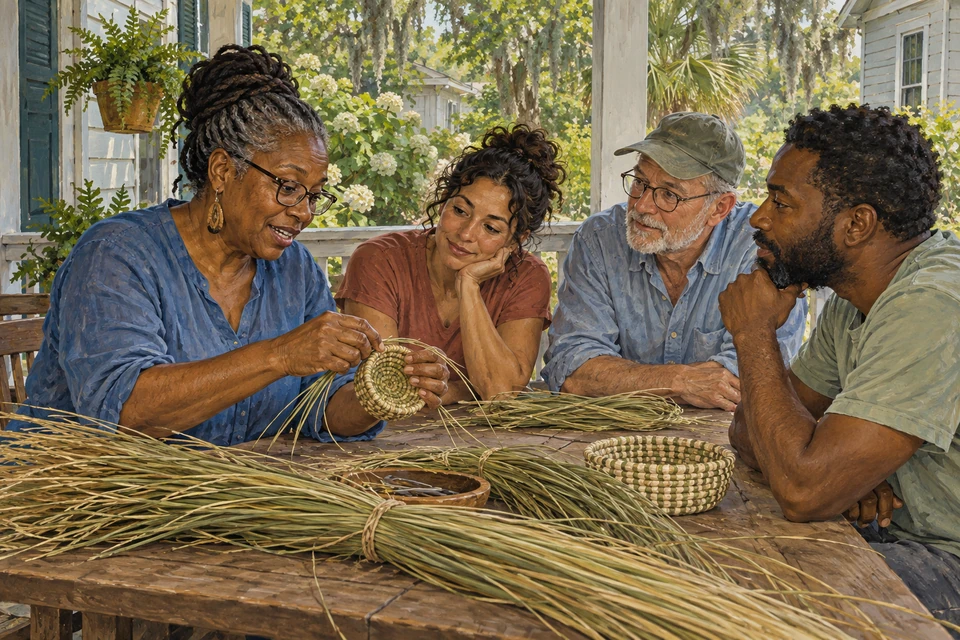
On St. Helena Island, South Carolina, Penn Center brings language into a broader educational programme. Its public offerings include a Gullah-language presentation, sweetgrass-basket demonstrations and workshops, and indigo-batik activities. The institution also interprets the Penn School Collection and points researchers to the school’s papers at the University of North Carolina at Chapel Hill. These are different routes into community knowledge: conversation, material practice, museum interpretation and archival study.
Basketry provides a specific example of continuity through innovation. A Smithsonian account of Gullah artist Corey Alston describes sweetgrass being arranged in coils and sewn together, then shaped into contemporary sculptural forms. It records his learning through his wife’s family and his teaching his daughter. This individual history complicates any image of a tradition transmitted automatically or practised identically by everyone. Gullah language and Gullah Geechee cultural life are best approached with the same attention to particular people, places and choices.
Sources
- Gullah Geechee Cultural Heritage Corridor. The Gullah Geechee People. https://gullahgeecheecorridor.org/the-gullah-geechee/
- Thomas B. Klein; in The Survey of Pidgin and Creole Languages, edited by Susanne Maria Michaelis, Philippe Maurer, Martin Haspelmath and Magnus Huber; Oxford University Press / APiCS Online. Gullah [online heading: Survey chapter: Gullah] (2013). https://apics-online.info/surveys/13
- Indiana University Libraries, Archives of Traditional Music; highlight contributor Amelia Lopez. Dow Turner Collections. https://libraries.indiana.edu/dow-turner
- Thomas B. Klein; Atlas of Pidgin and Creole Language Structures Online, Max Planck Institute for Evolutionary Anthropology. Gullah structure dataset [online heading: Structure dataset 13: Gullah] (2013). https://apics-online.info/contributions/13
- Cosmo Historical Preservation Corporation. The Cosmo Historical Preservation Corporation. https://www.cosmohistoricalpreservation.com/
- U.S. National Park Service, Timucuan Ecological & Historic Preserve. Gullah Geechee Communities. https://www.nps.gov/timu/learn/historyculture/gullah-geechee-communities.htm
- Penn Center. Visit. https://www.penncenter.com/visit/
- SAAM; Smithsonian American Art Museum. Contemporary Craft in Focus: From Traditional to Contemporary (2023-02-27). https://americanart.si.edu/blog/corey-alston