Language & culture
Hawaiian: The Story of a Language
Language at a glance
- Hawaiian at home
- 27,611 · Hawaiʻi
Ages 5+ · 2019–2023 ACS estimate.
- Local name
- ʻōlelo Hawaiʻi
The Hawaiian name for the language.
- Communities
- Hawaiian Islands
Niʻihau families and immersion communities.
- Language family
- Austronesian
Eastern Polynesian, alongside Tahitian and Māori.
- Writing
- 13 letters
Latin alphabet, including the ʻokina.
- Regional varieties
- Niʻihau · other islands
Family speech and educational varieties coexist.
Who speaks Hawaiian, and what do they call it?
Hawaiian, ʻōlelo Hawaiʻi, is the Indigenous language of Hawaiʻi. Speakers across the inhabited islands include families who pass it between generations and people learning through immersion schools, universities and community programmes. It is distinct from local Pidgin, or Hawaiʻi Creole.
How many people use Hawaiian at home in Hawaiʻi?
An estimated 27,611 Hawaiʻi residents aged five or older spoke Hawaiian at home during 2019–2023. A worldwide speaker total remains uncertain.
Where did Hawaiian come from, and who spoke it in the past?
Hawaiian developed from Polynesian voyagers’ speech and belongs to the Eastern Polynesian branch of Austronesian.
William Anderson collected the first Hawaiian word list at Waimea, Kauaʻi, in 1778; it appeared in 1784, though his original journal is lost. Hawaiian printing began in 1822, with Native Hawaiians helping shape written usage as authors, translators and printers.
After nineteenth-century use in government and schools, Hawaiian lost ground to English. Official status returned in 1978; Pūnana Leo preschools began in 1984 and public-school immersion in 1987. Niʻihau families and immersion communities speak it today.
Which Hawaiian words might an English speaker already recognise?
Ukulele comes from Hawaiian ʻukulele, a leaping flea. The instrument developed in Hawaiʻi from Portuguese stringed instruments. Lei, a garland or necklace, is also a Hawaiian borrowing.
Wiki came through Ward Cunningham’s 1995 name WikiWikiWeb. He chose a Hawaiian word associated with quickness after encountering the airport’s Wiki Wiki shuttle.
How does Hawaiian vary from region to region?
Niʻihau Hawaiian, also spoken by connected families on Kauaʻi, continues as a family language. Its vocabulary, intonation and pronunciation differ from other varieties: t can occur where learners expect k, and variation between l and r is also documented.
What is Standard Hawaiian, and where is it used?
Standard or Neo Hawaiian describes a contemporary variety associated largely with immersion students and second-language speakers. It draws on traditional Oʻahu and Hawaiʻi Island speech.
Educational writing generally includes ʻokina and kahakō; some Niʻihau writers follow older, unmarked conventions.
Which alphabet does Hawaiian use, and what might surprise an English speaker?
The modern Hawaiian alphabet has 13 letters: five vowels and eight consonants, including the ʻokina (ʻ). This letter marks a glottal stop, a brief closure in the voice.
The kahakō marks a long vowel, as in ā; it is not another letter. Pau can mean finished; paʻu, soot; and pāʻū, a skirt.
Does Hawaiian have grammatical gender?
No. Hawaiian nouns have no masculine or feminine grammatical classes.
How do you say hello, thank you and goodbye in Hawaiian?
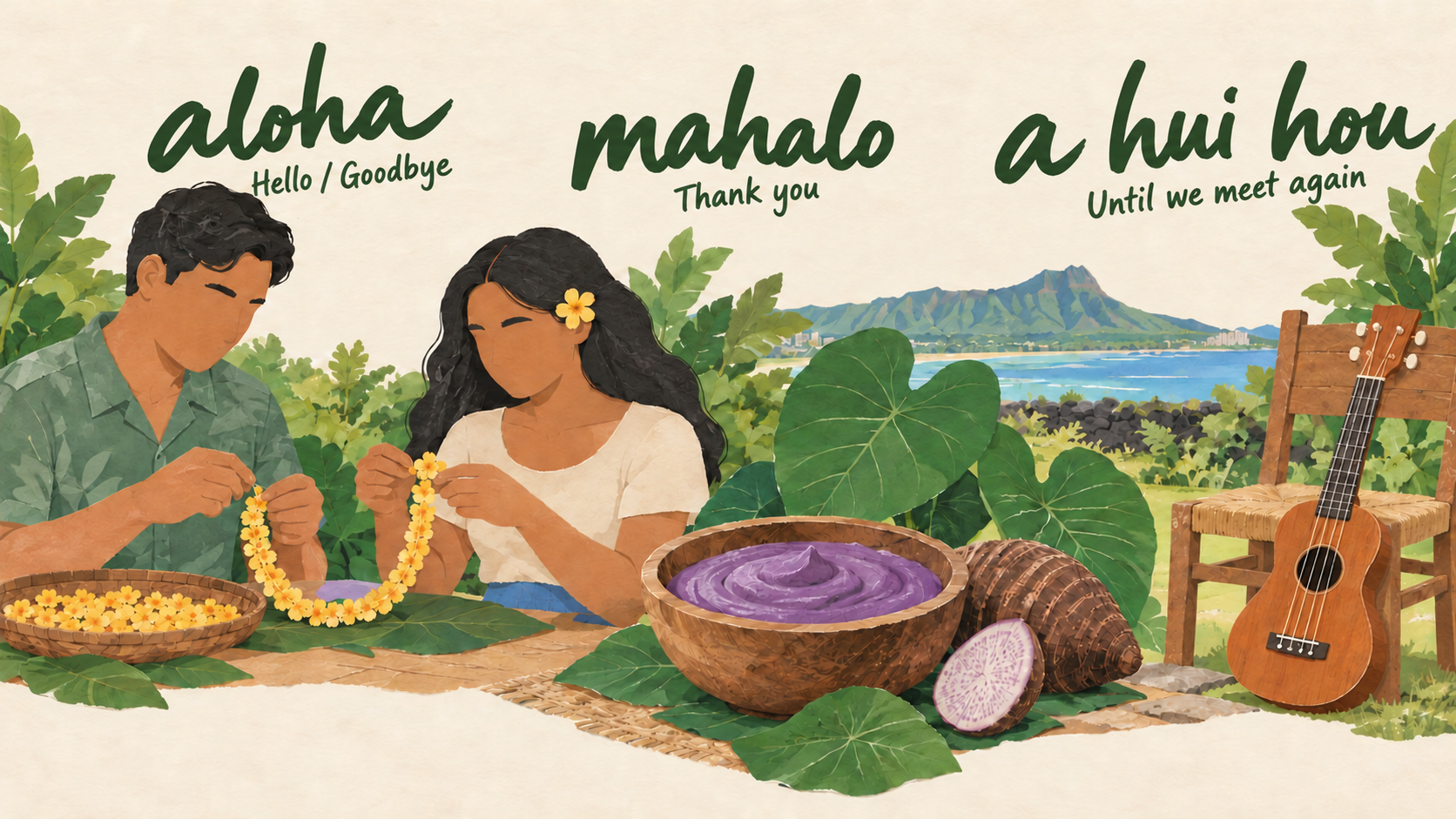
- Hello: aloha, also expressing love or affection.
- Thank you: mahalo, thanks or appreciation.
- Goodbye: aloha; or a hui hou, until we meet again.
What are some memorable Hawaiian sayings?
- ʻAʻohe pau ka ʻike i ka hālau hoʻokahi. Knowledge comes from more than one school or source. UH Hilo uses this saying in its mission statement.
- ʻAʻohe hana nui ke alu ʻia. Shared effort makes a large task manageable. Hawaiʻi’s 2026 Invasive Species Awareness Month used it to express cooperation among communities and agencies.
What everyday customs might surprise a visitor?
Directions often follow the landscape: mauka means towards the mountains, and makai towards the ocean.
Graduations include lei-giving. At Hilo’s Hawaiian language college in 2026, graduates wore handmade lei from supporters and received a kīhei, a ceremonial cloth associated there with accomplishment and responsibility.
Which Hawaiian-language song and film offer a cultural introduction?
Waipunalei, written and sung by Kainani Kahaunaele, is a Hawaiian-language love song sharing its name with her 2020 album. Its Hilo place-name, forest and rain imagery draw on stories of ʻUmi-a-Līloa.
Kapaemahu (2020), an animated short by Hinaleimoana Wong-Kalu, Dean Hamer and Joe Wilson, tells of four Tahitian healers who embody male and female spirit, and their stones at Waikīkī. Wong-Kalu narrates in Niʻihau Hawaiian, with English subtitles.
What is available for someone curious about the language now?
- Wehewehe Wikiwiki, at UH Hilo, offers searchable Hawaiian–English dictionary entries with meanings, examples and dictionary attributions.
- HAW 101, Kainani Kahaunaele’s elementary Hawaiian podcast, provides public MP3 lessons by chapter on UH Hilo’s website.
- Ka Leo ʻŌiwi, from community broadcaster ʻŌiwi TV, is a 13-episode introductory series available on its website.
Fun Facts
- Kāua means you and me. Another form of “we”, Māua, also means two of us, but excludes the listener.
- Kaʻiu and Larry Kimura helped name ʻOumuamua, an interstellar visitor, in 2017. The name combines reaching out with a repeated element meaning first or ahead, evoking an advance messenger from the distant past.
Sources
- Ka Haka ʻUla O Keʻelikōlani College of Hawaiian Language / University of Hawaiʻi at Hilo. About the Hawaiian Language. n.d.
https://www.olelo.hawaii.edu/en/olelo - Harald Hammarström, Robert Forkel, Martin Haspelmath and Sebastian Bank (editors) / Glottolog. Hawaiian (ISO 639-3: haw), Glottolog 5.3. n.d.
https://glottolog.org/glottolog?iso=haw - Ermile Hargrove, Kent Sakoda and Jeff Siegel / Language Varieties Network, University of Hawaiʻi. Hawaiʻi Creole. n.d.
https://www.hawaii.edu/satocenter/langnet/definitions/hce.html - ʻAha Pūnana Leo. Our History. n.d.
https://www.ahapunanaleo.org/history-hl-1 - ʻAha Pūnana Leo. FAQ’s. n.d.
https://www.ahapunanaleo.org/faqs - ʻAha Pūnana Leo. Programs. n.d.
https://www.ahapunanaleo.org/n-programs - University of Hawaiʻi. Hawaiian Language Online. Last modified 2 April 2018.
https://www.hawaii.edu/site/info/diacritics.php - Mary Kawena Pukui and Samuel H. Elbert. Hawaiian Dictionary, revised and enlarged edition. University of Hawaiʻi Press, 1986; entries reproduced in Wehewehe Wikiwiki, University of Hawaiʻi at Hilo: aloha, mahalo, pau/paʻu/pāʻū, kāua, māua, wiki, ʻukulele and ia.
https://wehe.hilo.hawaii.edu/?q=aloha
https://wehe.hilo.hawaii.edu/?q=mahalo
https://wehe.hilo.hawaii.edu/?q=pau
https://wehe.hilo.hawaii.edu/?q=k%C4%81ua
https://wehe.hilo.hawaii.edu/?q=m%C4%81ua
https://wehe.hilo.hawaii.edu/?q=wiki
https://wehe.hilo.hawaii.edu/?q=ʻukulele
https://wehe.hilo.hawaii.edu/?q=ia - University of Hawaiʻi–West Oʻahu Communications. Hawaiian saying of the week (March 14) — A hui hou. 2016-03-14.
https://westoahu.hawaii.edu/ekamakanihou/?p=3137 - University of Hawaiʻi at Mānoa. Instructions for Candidates. n.d.
https://manoa.hawaii.edu/commencement/instructions-for-candidates/ - Susan Enright / University of Hawaiʻi at Hilo. UH Hilo Ka Haka ʻUla o Keʻelikōlani holds 2026 ʻAha Hoʻomoloa ceremonies for undergraduates, graduates, and doctoral candidates. 2026-05-27.
https://hilo.hawaii.edu/chancellor/stories/2026/05/27/ka-haka-ula-2026-aha-hoomoloa/ - Kiaria Zoi Nakamura / University of Hawaiʻi at Hilo. UH Hilo alumna Kainani Kahaunaele’s primary goal is to teach ʻŌlelo Hawaiʻi and all things Hawaiian. 2021-02-11.
https://hilo.hawaii.edu/chancellor/stories/2021/02/11/kainani-kahaunaele/ - Kainani Kahaunaele / University of Hawaiʻi at Hilo. HAW 101 Elementary Hawaiian I (4) Podcast by Kumu Kainani Kahaunaele. n.d.
https://www.olelo.hawaii.edu/en/olelo/hoolele101 - University of Hawaiʻi at Hilo staff. ʻOumuamua: First interstellar object in solar system named by UH Hilo Hawaiian language experts. 2017-11-20.
https://hilo.hawaii.edu/chancellor/stories/2017/11/20/%CA%BBoumuamua-first-interstellar-object-in-solar-system/ - Hawaii State Department of Business, Economic Development & Tourism, Research and Economic Analysis Division / Hawaii State Department of Business, Economic Development & Tourism (DBEDT). The State of Hawaii Data Book 2024, Table 1.44: Top 20 Detailed Languages Other Than English Spoken at Home and Ability to Speak English: 2019–2023. 2024 edition; exact publication date not stated in the table.
https://files.hawaii.gov/dbedt/economic/databook/2024-individual/01/014424.pdf - Katie Drager; Bethany Kaleialohapauʻole Chun Comstock; Hina Puamohala Kneubuhl / University of Hawaiʻi at Mānoa; Language Documentation & Conservation, Special Publication 13. He nui nā ala e hiki aku ai: Factors Influencing Phonetic Variation in the Hawaiian Word kēia. 2017-07.
https://scholarspace.manoa.hawaii.edu/bitstreams/2c5d3076-93a0-4f34-a355-3e0a0496ebd4/download - UH News / University of Hawaiʻi. UH faculty members from Niihau preserve and promote olelo Kanaka. 2019-06-26.
https://www.hawaii.edu/news/2019/06/26/olelo-kanaka-on-niihau/ - Adam Keawe Manalo-Camp / Ka Wai Ola, Office of Hawaiian Affairs. Some Observations About the Hawaiian Spoken on Niʻihau. 2022-02-01.
https://kawaiola.news/hoonaauao/some-observations-about-the-hawaiian-spoken-on-niihau/ - Merriam-Webster editors; Merriam-Webster. Ukulele — Merriam-Webster.com Dictionary. n.d.
https://www.merriam-webster.com/dictionary/ukulele - The Metropolitan Museum of Art, Musical Instruments department. Ukulele, ca. 1880, object 89.4.727. n.d.
https://www.metmuseum.org/art/collection/search/501343 - Ward Cunningham; correspondence with Patrick Taylor and Catherine Soanes. Correspondence on the Etymology of Wiki. 2003-11 and 2005-02.
https://c2.com/doc/etymology.html - Merriam-Webster editors; Merriam-Webster. Lei — Merriam-Webster.com Dictionary. n.d.
https://www.merriam-webster.com/dictionary/lei - Greville G. Corbett; WALS Online, edited by Matthew S. Dryer and Martin Haspelmath. Datapoint Hawaiian / Number of Genders. n.d.
https://wals.info/valuesets/30A-haw - Greville G. Corbett; WALS Online. Number of Genders, WALS Online chapter 30. n.d.
https://wals.info/chapter/30 - University of Hawaiʻi at Hilo. Mission — University of Hawaiʻi at Hilo Catalog 2026–2027. 2026–2027 catalog.
https://hilo.hawaii.edu/catalog/mission - ʻĀinahou, Native Hawaiian collaborative movement, University of Hawaiʻi at Mānoa College of Education. Who We Are — ʻĀinahou. n.d.
https://coe.hawaii.edu/ainahou/ - Hawaiʻi Invasive Species Council; State of Hawaiʻi Department of Land and Natural Resources. 2026 Hawaiʻi Invasive Species Awareness Month. 2026.
https://dlnr.hawaii.gov/hisc/hisam2026/ - PBS Hawaiʻi; interview testimony by songwriter Kainani Kahaunaele. Nā Mele: Kainani Kahaunaele. 2022-01-31.
https://www.pbs.org/video/kainani-kahaunaele-khpfmk/ - PBS Hawaiʻi, publisher; song by Kainani Kahaunaele. Waipunalei [Hawaiian lyrics and English interpretation]. n.d.
https://www.pbshawaii.org/wp-content/uploads/2024/06/Waipunale-Lyrics-Hawaiian-and-English.pdf - Kanaka Pakipika and Pacific Islanders in Communications; director's statement by Hinaleimoana Wong-Kalu. Kapaemahu. n.d.
https://www.kapaemahufilm.com/ - Frameline Distribution. Kapaemahu. Film 2020; catalogue page n.d.
https://www.frameline.org/distribution/films/kapaemahu - ʻŌiwi TV. Ka Leo ʻŌiwi. n.d.
https://oiwi.tv/ka-leo-oiwi/ - UH News / University of Hawaiʻi. Linguist challenges conventional beliefs on ʻōlelo Hawaiʻi origins. 2021-08-24.
https://www.hawaii.edu/news/2021/08/24/linguist-challenges-conventional-olelo-hawaii-origins/ - Rare Book and Special Collections Division / Library of Congress. Hawaiian Imprint Collection: A Resource Guide — About the Collection. Last updated 3 December 2025.
https://guides.loc.gov/early-hawaiian-imprints/about-the-collection - American Antiquarian Society. Early Printing in Hawaiian. n.d.
https://www.americanantiquarian.org/hawaiian-language-printing/early-printing-hawaiian - Hawaiʻi Visitors and Convention Bureau / Hawaiʻi Tourism Authority / Go Hawaiʻi Media. Hawaiian Language. n.d.
https://media.gohawaii.com/statewide/hawaii-information/hawaiian-language - Jeffrey “Kapali” Lyon. Some Thoughts on Demonstrative and Locative Nā and the Loss of /ŋ/ in Hawaiian. Palapala 2, 2018, pp. 34–50.
https://scholarspace.manoa.hawaii.edu/bitstreams/ff927473-6c97-450d-b08e-5cf030727896/download - Albert J. Schütz. Reading between the Lines: A Closer Look at the First Hawaiian Primer (1822). Palapala 1, 2017, pp. 1–29.
https://scholarspace.manoa.hawaii.edu/bitstreams/dd239521-7e88-4ad6-b9bf-f43d4fef9bd5/download
Start learning today
Explore these books to keep learning.