Languages & Culture
Hawaiian
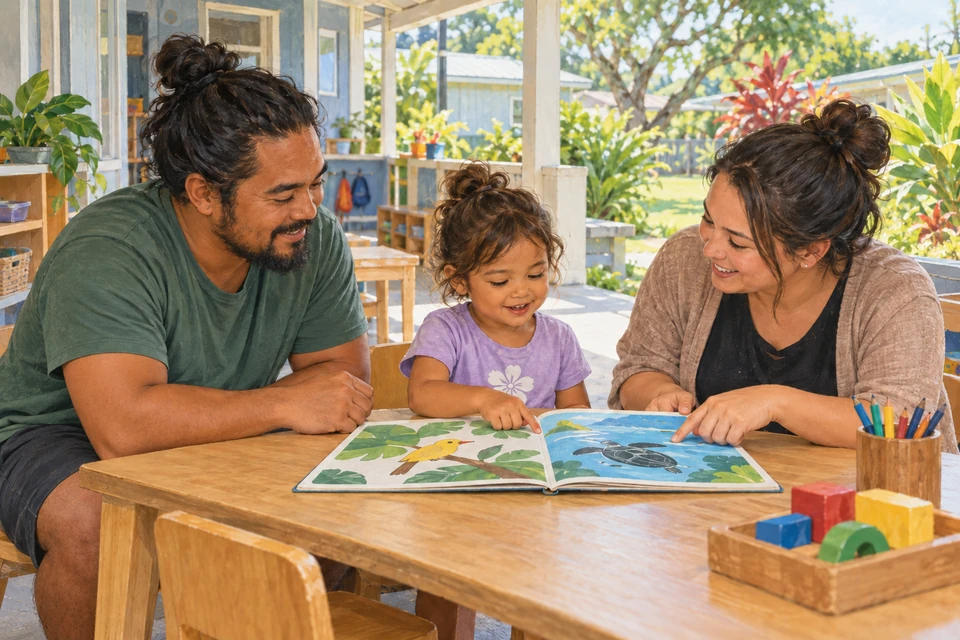
Hawaiian is a Polynesian language whose history extends across the inhabited islands of Hawaiʻi. Its contemporary life includes homes, schools, universities and the work of reading older records. These settings connect language learning with relationships between generations: passing on a language involves people making time and space to use it together. The community organisation ʻAha Pūnana Leo places that everyday interaction at the centre of its account of revitalisation.
Hawaiian must be distinguished from Hawaiʻi Creole, also called Hawaiʻi Creole English and commonly known as Pidgin. The latter developed in the islands’ multilingual plantation setting and draws much of its vocabulary from English, alongside contributions from Hawaiian and other languages. It is a different language, not a casual or simplified way of speaking Hawaiian. Recognising that distinction leaves room for the islands’ multiple language histories without treating every local expression as Hawaiian.
Niʻihau’s native-speaking community also contributes directly to language education. A 2019 University of Hawaiʻi report describes initiatives led by faculty members from Niʻihau, including a programme on Kauaʻi in which learners took part in activities with native speakers. This gives future teachers opportunities to learn from community practices and speech, bringing regional knowledge into their preparation.
Rebuilding opportunities to speak
Hawaiian had an extensive public written life in the nineteenth century. The University of Hawaiʻi at Hilo describes its use in government, courts, the legislature and schools, including communication across communities of different origins. English subsequently displaced it in major institutions, especially following the imposition of American rule in 1898. This history helps explain why revitalisation involves creating settings for education and public communication as well as encouraging individual learners.
In January 1983, educators met to organise what became ʻAha Pūnana Leo. Its history describes concern about declining opportunities for children to acquire the language and the importance of elders’ knowledge. Māori language nests provided an influential example. The first preschool opened in Kekaha on Kauaʻi in August 1984; Hilo and Honolulu sites followed in 1985. The central ambition was practical and social: children would experience Hawaiian through ordinary activity and relationships, with language use becoming part of the day’s shared life.
That approach appears in the organisation’s description of children learning, playing and eating through Hawaiian. Its FAQ also explains that attendance does not require Hawaiian ancestry. Families have a role beyond bringing children to school: the organisation describes language and cultural learning for adults, shared family activities and care for the school environment. Such practices connect classroom language with the people and places surrounding it. They also make clear that participation involves sustained relationships, not simply the acquisition of a list of words.
Learning across ages and institutions
Support for adults and educators forms another part of this work. ʻAha Pūnana Leo describes its Aukukui professional development programme, established with the university’s Hawaiian language college, and Niuolahiki distance learning. The latter is described as reaching participants both in Hawaiʻi and in locations abroad. These programmes address different needs: educators require preparation for teaching through the language, while people outside an immediate Hawaiian-speaking setting need ways to sustain study and contact. Their existence should not be mistaken for a measure of every participant’s proficiency.
The University of Hawaiʻi at Hilo’s Ka Haka ʻUla O Keʻelikōlani College of Hawaiian Language, established in 1997, describes Hawaiian as a medium of its work and instruction. Its programmes include teacher preparation and graduate study in Indigenous language, culture and education. Its Hale Kuamoʻo division supports language development and wider use. This gives the language roles in professional preparation and research: students can work through Hawaiian while investigating how education and language revitalisation are organised.
Reading the record with care
Historical documents offer further resources, but making them available is only one stage of the work. The Institute of Hawaiian Language Research and Translation at the University of Hawaiʻi at Mānoa describes an archive that includes nineteenth- and early twentieth-century newspapers, government records and manuscripts. Its account stresses that older vocabulary, idiom and context can challenge even proficient contemporary speakers. A searchable page therefore does not guarantee an immediately transparent meaning.
The institute sets out aims to catalogue, interpret and translate material while training researchers and translators. Those are continuing tasks, not a claim that the archive has already been fully understood. Reading historical Hawaiian carefully can reconnect present-day questions with earlier writers’ accounts and ideas. Alongside family language use and education, that scholarship gives communities more ways to engage with a substantial written inheritance.
Sources
- Ka Haka ʻUla o Keʻelikōlani College of Hawaiian Language, University of Hawaiʻi at Hilo. About the Hawaiian Language. https://www.olelo.hawaii.edu/en/olelo
- Ermile Hargrove, Kent Sakoda and Jeff Siegel; University of Hawaiʻi Language Varieties website. Hawai‘i Creole. https://www.hawaii.edu/satocenter/langnet/definitions/hce.html
- ʻAha Pūnana Leo. Our History. https://www.ahapunanaleo.org/history-hl-1
- ʻAha Pūnana Leo. FAQ’s. https://www.ahapunanaleo.org/faqs
- ʻAha Pūnana Leo. Programs. https://www.ahapunanaleo.org/n-programs
- University of Hawaiʻi at Hilo. Ka Haka ʻUla O Keʻelikōlani, College of Hawaiian Language. https://www.olelo.hawaii.edu/en/
- Institute of Hawaiian Language Research and Translation, University of Hawaiʻi at Mānoa. About Us. https://manoa.hawaii.edu/ihlrt/about-us/
- University of Hawaiʻi System News. UH faculty members from Niihau preserve and promote olelo Kanaka (2019-06-26). https://www.hawaii.edu/news/2019/06/26/olelo-kanaka-on-niihau/