Languages & Culture
Hebrew
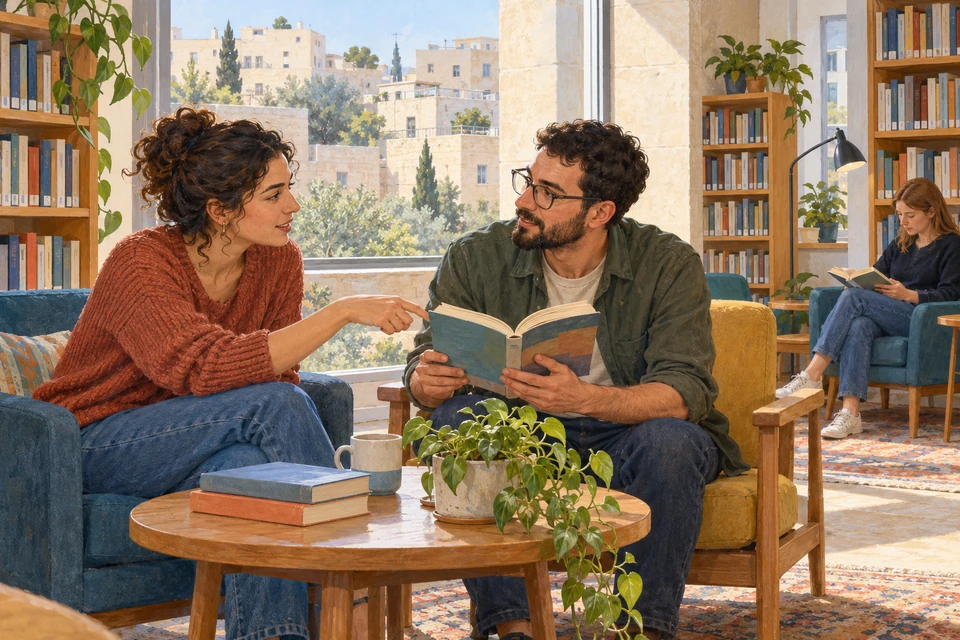
Modern Hebrew is an everyday language in Israel and a language of learning and cultural activity beyond it. It belongs to the Semitic family and draws on a much longer history of Jewish religious, scholarly and literary use. The modern language incorporates earlier Hebrew material while developing new meanings, constructions and vocabulary. Its relationship with the past is therefore part of how it works in the present, rather than a reason to treat contemporary conversation as a reproduction of an ancient text.
A revival with a written history
Hebrew’s expansion into modern everyday speech followed continuing activity in other domains. Yael Reshef’s historical overview distinguishes a phase of literary and journalistic modernisation in late eighteenth-century Europe from the development of everyday spoken Hebrew in late nineteenth- and early twentieth-century Palestine. Biblical and later traditions supplied resources for this process, but new circumstances also required change. This chronology helps avoid the impression that people recovered an abandoned body of words all at once: writing, religious practice, education and new speaking communities belong to connected but different parts of the history.
One feature learners encounter is the interaction of consonantal roots with word patterns. The Academy of the Hebrew Language describes roots as usually containing three consonants, while explicitly recognising other lengths. The writing system also combines consonant letters, some letters that can indicate vowels, and a separate system of pointing called nikkud. Pointing provides information about pronunciation beyond the letters themselves. Different historical reading traditions matter here; the Academy cautions that contemporary Israeli pronunciation does not correspond completely to any single one of them.
Investigating how modern usage developed
The EMODHEBREW research project turns the history of renewed everyday speech into questions about grammar. Its stated programme examines both earlier Hebrew and languages with which speakers were in contact. It distinguishes a stage involving additional-language speakers from the emergence of a community of native speakers, asking how syntactic constructions developed across those stages. This is a research agenda, not a declaration that all sources of modern Hebrew grammar have been settled. Its focus on documented constructions offers a way to investigate change beyond accounts centred on individual campaigners.
The Academy’s Historical Dictionary Project approaches continuity through texts. Established in the 1950s, it examines changes in words across periods and genres. Its methodology gives particular attention to manuscripts, including versions that differ from familiar printed editions. Researchers transcribe and mark up texts, analyse words grammatically and have the work checked by colleagues. Its material also includes inscriptions on objects such as coins and tombstones. This breadth makes the written record more than a sequence of celebrated literary works; small surviving texts can also provide linguistic evidence.
Several tools serve different reading needs. The Academy’s online-resources directory describes historical text searches, terminology databases, verb and noun tables, and guidance on spelling and punctuation. A historical occurrence and a recommended modern term answer different questions: one establishes how a word appears in a record, while the other addresses usage in a particular contemporary setting. Recognising those purposes helps a learner use reference works more carefully, especially when moving between a modern article and an older religious or literary text.
Reading and discussing Hebrew today
Language history also has a public educational setting. The Academy reports that its Cultural and Educational Center opened in September 2023, combining historical displays with interactive activities about contemporary language. Its description includes visits by families, students, retirees and new immigrants. An institution can therefore place historical material alongside questions that arise for people learning and using the language now. That is a different task from reconstructing historical pronunciation or settling a point of grammar.
Literary collections provide another connection between readers and writers. The National Library of Israel describes holdings that include authors’ personal archives, naming S.Y. Agnon, David Grossman and A.B. Yehoshua among them. It also presents modern Hebrew literature in relation to encounters with other literary traditions, including Russian, German and American literature. Such collections invite attention to drafts, documents and wider cultural relationships as well as finished books. A language’s literature develops through those interactions, with authors choosing how to engage with inherited forms and contemporary experience.
Learning outside Israel can likewise involve more than a single historical period. Yale’s Modern Hebrew programme describes work with film, poetry, media, popular music and graphic novels, alongside courses connecting biblical and modern reading. The variety illustrates why learners benefit from identifying the kind of Hebrew they want to engage with. Everyday conversation, academic prose and an older poem belong within a shared history while presenting different reading and listening tasks.
Sources
- Academy of the Hebrew Language. An Overview of Hebrew (2023-05-07). https://eng.hebrew-academy.org.il/overview-of-hebrew/
- Yael Reshef; John Benjamins Publishing Company. Historical overview of Modern Hebrew. https://www.benjamins.com/catalog/slcs.210.03res
- EMODHEBREW research project. EMODHEBREW: The Emergence of Modern Hebrew. https://www.emodhebrew.com/about/
- Academy of the Hebrew Language. Historical Dictionary Project (2024-01-24). https://eng.hebrew-academy.org.il/our-work/historical-dictionary-project/
- Academy of the Hebrew Language. Online Resources (2024-01-24). https://eng.hebrew-academy.org.il/our-work/online-resources/
- Jewish Studies, Yale University. The Modern Hebrew Program. https://jewishstudies.yale.edu/the-modern-hebrew-program
- Academy of the Hebrew Language. Cultural and Educational Center (2024-01-24). https://eng.hebrew-academy.org.il/our-work/cultural-and-educational-center/
- National Library of Israel. Authors. https://www.nli.org.il/en/discover/literature-and-poetry/authors