Languages & Culture
Hindi
The modern standard and its neighbours
Hindi is an Indo-Aryan language within the Indo-European family. This article focuses on modern standard Hindi, written in Devanagari, while recognising the wider literary traditions associated with its name. The standard developed from Khari Boli, the speech of the Delhi region. Hindi is used particularly widely in northern India, with communities and learning networks extending overseas. A national label therefore describes neither one local accent nor the complete linguistic life of every person who uses it.
Hindi's relationship with Urdu is especially close. The University of Texas's Hindi Urdu Flagship explains that they share their Delhi-region origins, grammar and much everyday vocabulary, while differing in scripts and more specialised vocabulary. Hindi uses Devanagari; Urdu uses an adapted Persian script. These shared foundations coexist with distinct literary histories and language identities. Understanding the connection helps explain why a conversation and a highly formal written text can present rather different experiences of the relationship.
Print helped shape a public language
The history of Hindi literature reaches beyond the modern standard. Medieval poetry flourished in Braj Bhasha and Avadhi, while modern standard literature includes fiction, drama, poetry and essays. These regional literary traditions deserve recognition in their own right. Their inclusion in accounts of Hindi literature does not make them interchangeable with the language of a contemporary standard textbook.
Publishing helped establish the modern literary norm. Sanjukta Poddar's 2023 study examines the Indian Press and its Hindi, Urdu, Bengali and English journals in colonial Allahabad. Her account shows how the Hindi journal Saraswatī, under editor Mahavir Prasad Dwivedi, promoted standardised Khari Boli. She also traces tensions between a multilingual publishing business and increasingly restrictive ideas about language and national identity. Standardisation emerges here as a process involving editors, readers and political choices. The presence of several languages in the same city did not automatically make their relationships equal or harmonious.
Hindi's constitutional designation is specific. Article 343 names Hindi in Devanagari as the official language of the Union. The Official Languages Act of 1963, as amended in 1967, provides for English to continue alongside Hindi in Union business and Parliament. These provisions concern government functions. They do not describe everyone's home language, and should not be turned into a claim that all Indian languages fall under Hindi.
Reading, listening and meeting
Hindi learning also has institutional homes outside India. Indiana University offers a sequence of language instruction alongside opportunities to study culture, art, religion and history. Its language portal lists resources for conversation, everyday Hindi and intermediate reading. These different categories suggest useful distinctions for learners: managing an exchange, following a sustained account and interpreting a literary text require overlapping skills, but different kinds of practice. A recording catalogue identifies resources; it cannot by itself demonstrate how any particular community speaks.
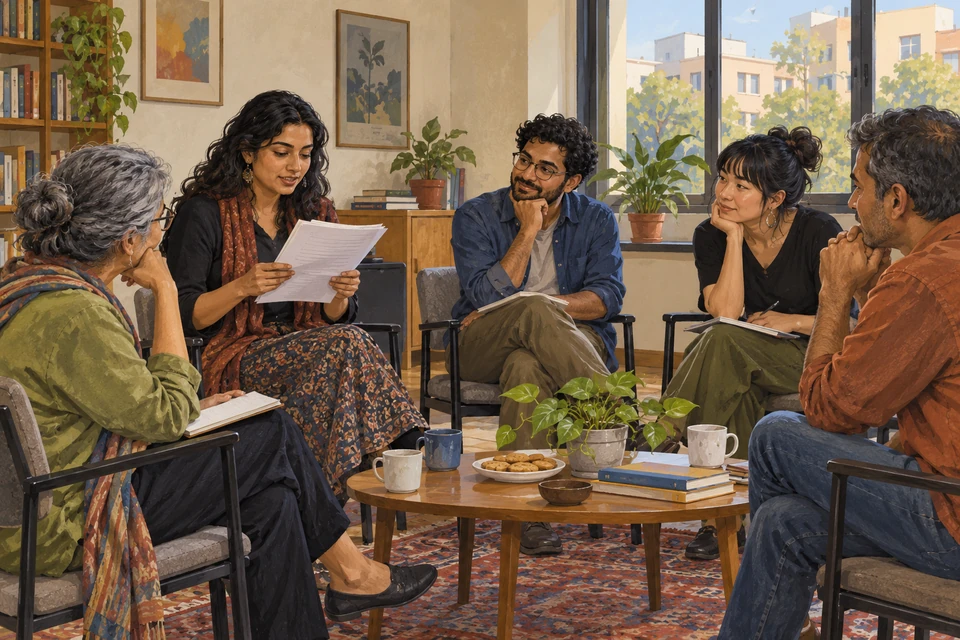
Literary gatherings place Hindi alongside other languages. A Sahitya Akademi invitation for a May 2025 forum in New Delhi advertised story and poetry readings by writers working in Assamese, English, Hindi and Punjabi. The programme joined different literary voices in one meeting, with tea scheduled afterwards. This is evidence of what the organisers planned, rather than a report of attendance or audience responses. It offers a concrete example of Hindi's participation in multilingual cultural life: a Hindi reading can be part of an encounter across languages as well as an event devoted to Hindi alone.
Making grammatical description usable
Language research also works at the scale of individual sentences. The Hindi-Urdu Treebank collaboration, involving IIIT Hyderabad and universities in the United States, describes a design with several layers of annotation for syntax and the relationships between predicates and their arguments. In plain terms, a treebank records analyses of how words fit together. Such carefully described material supports research into computer systems that analyse sentences, while making the researchers' grammatical decisions available for scrutiny.
The Hindi resource in Universal Dependencies was converted from the Hyderabad treebank. Its documentation identifies the genre as news and distinguishes manually created annotations from their automatic conversion into a shared format. That detail matters when using the evidence: patterns in edited reporting need not represent every casual conversation, regional variety or poem. The resource makes a substantial part of Hindi usage available for systematic analysis, with an explicit account of where the material came from and how it was processed.
Sources
- University of Pennsylvania, Department of South Asia Studies. The Hindi Language. https://www.southasia.upenn.edu/languages/explore-languages/hindi-language
- Indiana University, Center for Language Technology. Hindi. https://celt.indiana.edu/portal/Hindi/index.html
- Government of India, Ministry of Law and Justice, Legislative Department, Official Languages Wing. THE CONSTITUTION OF INDIA [As on 1st May, 2024]. https://cdnbbsr.s3waas.gov.in/s380537a945c7aaa788ccfcdf1b99b5d8f/uploads/2024/07/20240716890312078.pdf
- Parliament of India; public reproduction hosted by Heavy Water Board, Government of India. THE OFFICIAL LANGUAGES ACT, 1963 (AS AMENDED, 1967). https://hwb.gov.in/sites/default/files/2025-05/the_official_languages_act.pdf
- Sanjukta Poddar; Modern Asian Studies 57(6), 1798–1828, Cambridge University Press. The decline of multilingualism in a divided public sphere: The Indian Press and cultural politics in colonial Allahabad (1890–1920). https://www.cambridge.org/core/journals/modern-asian-studies/article/decline-of-multilingualism-in-a-divided-public-sphere-the-indian-press-and-cultural-politics-in-colonial-allahabad-18901920/3CA709F6A0B6720460FC26A100E4644A
- Language Technologies Research Centre, International Institute of Information Technology Hyderabad; Hindi-Urdu Treebank collaboration. Hindi Dependency Treebank (HDTB). https://ltrc.iiit.ac.in/treebank_H2014/
- Universal Dependencies contributors; Riyaz Ahmad Bhat and Daniel Zeman credited for UD contribution. UD Hindi HDTB. https://universaldependencies.org/treebanks/hi_hdtb/index.html
- Sahitya Akademi. Literary Forum. https://sahitya-akademi.gov.in/pdf/LF-7May2025.pdf
- Hindi Urdu Flagship, University of Texas at Austin. Two Languages or One?. https://hindiurduflagship.org/about/two-languages-or-one/