Languages & Culture
Hungarian
A language across borders
Hungarian belongs to the Uralic language family, which also includes Finnish and Estonian. Its place in that family concerns linguistic history, rather than proximity on a present-day map. Hungarian is used in Hungary, in neighbouring communities, particularly in Romania, Slovakia, Serbia and Ukraine, and in diaspora settings farther away. Describing the language therefore requires looking beyond a single country's borders. Residence, citizenship and language use are different questions; none can simply stand in for the others.
There is also regional variation within Hungarian. The Research Centre for Linguistics identifies regional standards and differences in pronunciation and vocabulary. Standard written Hungarian provides a common reference, while local forms remain important. To investigate related structures, the centre's comparative database presents modern and historical Hungarian beside other Uralic languages. Examples carry sources, grammatical annotation and English translations.
Manuscripts and everyday records
Written evidence reaches far into the medieval period. The 1055 foundation charter of Tihany contains Hungarian words and phrases. The research centre distinguishes such scattered records from the longer texts that subsequently allow more sustained grammatical investigation. These surviving documents mark stages in the available evidence, rather than the moment when people first began speaking Hungarian.
A particularly important witness is the late-twelfth-century Funeral Sermon and Prayer in the Pray Codex. The National Széchényi Library describes its position within a Latin liturgical manuscript: the Hungarian text accompanies the funeral service, with a longer Latin sermon nearby. This context helps explain what the document can reveal. It preserves Hungarian used for a particular religious purpose within a multilingual written environment; it cannot stand for every conversation of its time. The library's conservation and digitisation work makes that material available in new forms while protecting the manuscript.
Other projects seek evidence closer to informal interaction. The Historical Corpus of Hungarian Private Language brings together private letters and witnesses' testimony in trial records, all predating 1772. Its texts have normalised spelling, morphological analysis and sociolinguistic metadata. That combination permits questions about language choices and social relationships as well as grammatical change. These are written records, mediated by their circumstances of production, rather than sound recordings of past speakers. Even so, they broaden historical research beyond religious manuscripts and formal literary works.
What a corpus can show
Modern documentation has different problems to solve. Csaba Oravecz, Tamás Váradi and Bálint Sass's 2014 account of the Hungarian Gigaword Corpus describes material ranging from journalism and literature to social media, official documents and transcribed radio. Its predecessor already included Hungarian from neighbouring countries. The enlarged resource required decisions about selection, repeated text and the grammatical analysis of words. A large collection is useful because it allows repeated patterns to be investigated; its size does not remove the need to understand its composition.
The researchers explain why Hungarian word structure needs particular attention. Inflection, derivational suffixes and productive compounding can create several possible analyses for a written form. Their tools therefore record more than a simple dictionary headword. The project's public documentation also describes facilities for filtering results and investigating words that occur together. These resources connect grammatical scholarship with practical questions about how Hungarian is used in different texts.
Learning a song with other people
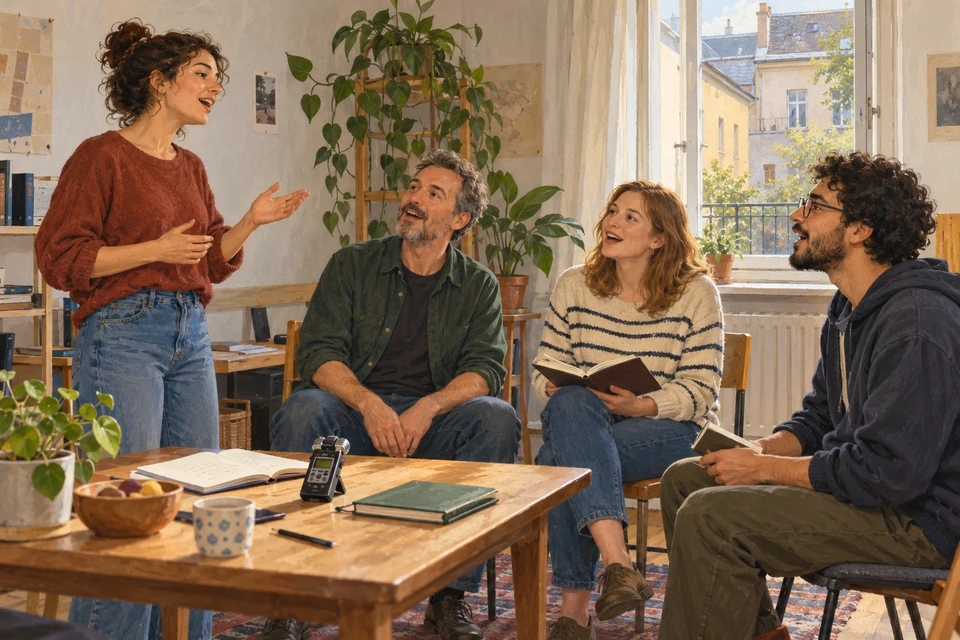
Songs provide another kind of evidence about language and cultural transmission. Hungary's heritage coordination institution describes the táncház method as active learning of music, dance, poetry and other traditions in an urban setting. The movement developed in Budapest in the 1970s, drawing on bearer communities, archival materials and specialist research. Participants learn by taking part, and help recreate what they inherit. This is a particular cultural practice, rather than a description of every Hungarian speaker's interests or daily life.
A study by Zsuzsa Nagy-Sándor and Pauwke Berkers, published in 2018, examined folk singers interviewed in Budapest in 2015. They described learning from recordings, teachers and people who carried local traditions. They also discussed how to preserve a regional style while choosing material that could express their own feelings. The study makes transmission a matter of listening, interpretation and relationships. The Dance-house Guild's continuing programme listings locate this cultural work in an active community setting, alongside clubs, courses and festivals.
Sources
- Indiana University, Center for Language Technology. Hungarian. https://celt.indiana.edu/portal/Hungarian/index.html
- Hungarian Research Centre for Linguistics; principal investigator Barbara Egedi; named research team. Nominal Structures of Uralic Languages. https://nsul.nytud.hu/index.html
- National Széchényi Library, Hungary. Decorative facsimile copy of the Pray Codex - The gift to the Holy Father on behalf of the Government of Hungary made by the NSZL (2021-09-10). https://oszk.hu/en/news/decorative-facsimile-copy-pray-codex
- TMK project, Research Centre for Linguistics; cited project researchers Attila Novák, Katalin Gugán, Mónika Varga and Adrienne Dömötör. A Történeti magánéleti korpusz (TMK) — About the project. https://tmk.nytud.hu/about.php
- Csaba Oravecz, Tamás Váradi and Bálint Sass; Research Institute for Linguistics, Hungarian Academy of Sciences; Proceedings of LREC 2014. The Hungarian Gigaword Corpus (2014). https://www.lrec-conf.org/proceedings/lrec2014/pdf/681_Paper.pdf
- Hungarian Research Centre for Linguistics, Language Technology Research Group. MNSZ2 - HGC. https://clara.nytud.hu/mnsz2-dev/en/
- Directorate of Intangible Cultural Heritage, Hungarian Open Air Museum. Táncház method: a Hungarian model for the transmission of intangible cultural heritage (2011). https://szellemikulturalisorokseg.hu/index0_en.php?name=en_0_tanchaz_modszer
- Zsuzsa Nagy-Sándor and Pauwke Berkers; Cultural Sociology 12(3), 400–417. Culture, Heritage, Art: Navigating Authenticities in Contemporary Hungarian Folk Singing. https://repub.eur.nl/pub/111838/Nagy-Sandor-Berkers-Navigating-CS-version.pdf
- Dance-house Guild, Táncház Egyesület. Home. https://tanchaz.hu/en/