Languages & Culture
Indonesian
Indonesian, or Bahasa Indonesia, belongs to the Austronesian family and developed from Malay. A recent scholarly description identifies Standard Indonesian as a standardized Malay variety. That relationship matters, but so does the distinct history of Indonesian as a national language. Its public role cannot be understood simply by imagining a single local mother tongue spreading unchanged across an archipelago.
How a shared language became a national project
Malay had long helped people communicate across communities with different languages. The 1928 Youth Pledge gave Indonesian a particularly important place in the independence movement. Museum Sonobudoyo’s historical account explains that the declaration of 28 October upheld Indonesian as the language of unity, alongside a shared homeland and nation. This was a political commitment about a common future, not the sudden creation of a vocabulary or grammar from nothing.
Print helped make that future imaginable. In an essay hosted by Indonesia’s language agency, Eko Sulistyo describes the contribution of newspapers and popular literature to the spread of the language in the early twentieth century. His account includes Chinese Peranakan publishers among the participants. This history makes room for multiple communities and institutions: literary circulation and political discussion helped readers encounter a shared public language across local boundaries.
Formal Indonesian and everyday voices
Indonesian now serves education, government, media and communication between people with different linguistic backgrounds. Some speakers learn it as a first language; others use it alongside another language. Soderberg and Olson’s linguistic description also stresses regional variation and the influence of speakers’ regional languages. A national standard therefore does not imply that people throughout Indonesia sound alike or use precisely the same conversational forms.
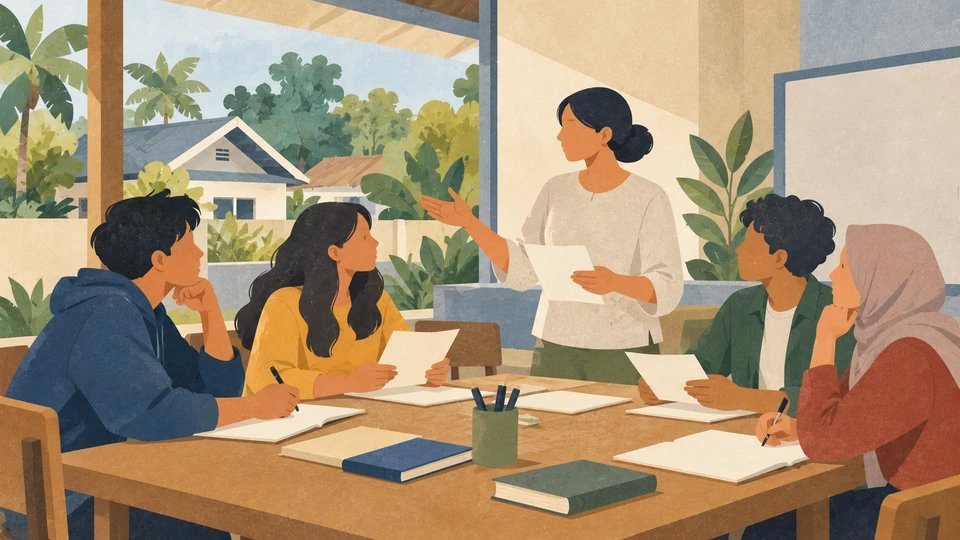
The distinction matters in teaching. At Universitas Negeri Malang, the Indonesian programme for speakers of other languages explicitly aims to balance formal and colloquial competence. Its description connects classroom work to situations in shops, streets, offices, transport and homes, with peer tutors helping learners use what they study. Reading a formal document and taking part in an informal exchange call for related but different skills. Learning how a form fits a situation is part of learning the language, alongside knowing its dictionary meaning.
Documenting a language that keeps developing
The national dictionary is continually edited rather than treated as a finished monument. The publicly available April 2026 editorial note for the sixth edition of Kamus Besar Bahasa Indonesia, commonly abbreviated KBBI, describes revisions to definitions, word-class labels and examples, as well as the removal of duplicate entries. It also acknowledges public suggestions and the work of editors and validators. Dictionary maintenance involves deciding how to present evidence clearly, as well as adding new vocabulary.
Computer-based research confronts another question: which kinds of Indonesian should a language tool encounter? The 2020 IndoNLU project assembled resources for tasks such as identifying sentiment and recognising names in text. Its paper distinguishes formal and colloquial materials, including news and social-media writing. Researchers from Indonesian universities and other academic and industry partners contributed. The authors also explain restrictions on distributing some collected material. The resulting resource is a documented research selection, rather than a complete inventory of how every Indonesian community communicates.
Verse as a shared and continuing practice
One literary connection with the wider Malay world is pantun. UNESCO’s archive describes this verse tradition across maritime Southeast Asia; the common four-line form uses alternating rhyme, and transmission can involve music, song or writing. Its regional reach is important: a tradition practised in Indonesia can also belong to communities beyond Indonesia’s borders. It should not be presented as the exclusive possession of one modern national language.
There are concrete contemporary settings for passing on the craft. The Riau Islands language office reports a 2023 workshop for secondary-school students in Bintan, with instruction in composition and practice exchanging pantun. The activity links writing with response and performance, giving learners a reason to attend to how words work together. Alongside national publishing, dictionary revision and everyday conversation, such local practices help explain Indonesian’s cultural setting without reducing the country’s many languages to a single voice.
Sources
- Craig D. Soderberg and Kenneth S. Olson. Indonesian. https://www.cambridge.org/core/journals/journal-of-the-international-phonetic-association/article/indonesian/AE405481B94A4E0B7234A8BBE9C6F5FD
- Simon Musgrave, Wayan Arka and Gede Primahadi W Rajeg. Applicative constructions in standard Indonesian (Bahasa Indonesia) (2024). https://researchportalplus.anu.edu.au/en/publications/applicative-constructions-in-standard-indonesian-bahasa-indonesia/
- Museum Sonobudoyo Yogyakarta. Understanding the Youth Pledge. https://sonobudoyo.jogjaprov.go.id/en/tulisan/read/memaknai-sumpah-pemuda
- Eko Sulistyo; hosted by Badan Pengembangan dan Pembinaan Bahasa. Bahasa sebagai Pemersatu Bangsa* (2022-01-23). https://badanbahasa.kemendikdasmen.go.id/artikel-detail/854/bahasa-sebagai-pemersatu-bangsa
- Universitas Negeri Malang, Office of International Affairs / Center for Indonesian Studies. BIPA — Bahasa Indonesia bagi Penutur Asing. https://oia.um.ac.id/bipa/
- KBBI editorial team; Badan Pengembangan dan Pembinaan Bahasa. Pemutakhiran — Catatan Redaksi tentang Pemutakhiran KBBI VI April 2026. https://kbbi.kemendikdasmen.go.id/Beranda/Pemutakhiran
- UNESCO Multimedia Archives. Pantun, a Malay oral tradition. https://www.unesco.org/archives/multimedia/document-4752
- Kantor Bahasa Provinsi Kepulauan Riau. Gelar Bengkel Menulis Pantun bagi Siswa SMA Se-Kabupaten Bintan (2023-08-31). https://kantorbahasakepri.kemendikdasmen.go.id/detail-431-Gelar.Bengkel.Menulis.Pantun.bagi.Siswa.SMA.Se-Kabupaten.Bintan.html
- Bryan Wilie, Karissa Vincentio, Genta Indra Winata, Samuel Cahyawijaya, Xiaohong Li, Zhi Yuan Lim, Sidik Soleman, Rahmad Mahendra, Pascale Fung, Syafri Bahar and Ayu Purwarianti. IndoNLU: Benchmark and Resources for Evaluating Indonesian Natural Language Understanding. https://aclanthology.org/2020.aacl-main.85.pdf