Language & culture
Iñupiaq: Words Across Alaska’s Arctic Communities
Language at a glance
- Alaska speakers
- 500–1,500 highly proficient
Plus 10–50 highly proficient second-language speakers; undated.
- Local names
- Iñupiaq · Iñupiatun
Bering Strait spelling also uses Inupiaq.
- Communities
- Northern and northwestern Alaska
North Slope to Bering Strait communities.
- Family
- Inuit–Yupik–Unangax̂
Inuit branch; relatives east to Greenland.
- Writing
- Atchagat · 24 entries
MacLean’s North Slope Roman alphabet order.
- Varieties
- North Alaskan · Seward Peninsula
North Slope, Malimiut, Qawiaraq and Bering Strait.
Who speaks Iñupiaq, and what do they call it?
The Iñupiat speak Iñupiaq, also called Iñupiatun, across Alaska’s North Slope, Northwest Arctic, Seward Peninsula and Bering Strait. Communities include Utqiaġvik, the Kotzebue Sound and Kobuk River region, and Diomede.
Iñupiaq means a real or genuine person; many Bering Strait speakers write Inupiaq, reflecting regional sound differences.
How many people speak Iñupiaq worldwide?
Alaska’s Council for Alaska Native Languages lists 500–1,500 highly proficient speakers in Alaska, plus 10–50 highly proficient second-language speakers, without a reference year. These are Alaska estimates; a comparable worldwide total remains unverified.
Where did Iñupiaq come from, and who spoke it in the past?
Iñupiaq belongs to the Inuit branch of the Inuit–Yupik–Unangax̂ language family. The family’s probable early homeland lay around the Bering Sea. Related Inuit languages extend through Canada to Greenland.
Alaskan communities spoke their local varieties before explorers recorded words. Written records include expedition word lists from the late eighteenth and early nineteenth centuries, later religious texts and school materials. Russian and English contact also contributed vocabulary.
Which Iñupiaq words might an English speaker already recognise?
Igloo and kayak have Inuit origins. In North Slope Iñupiaq, iglu means a house and qayaq names a kayak. The house word is broader than the snow-built shelter an English speaker may first picture.
How does Iñupiaq vary from region to region?
North Alaskan includes North Slope and Malimiut; Seward Peninsula includes Qawiaraq and Bering Strait varieties, such as Diomede. Differences affect sounds and vocabulary: tupiq is a tent on the North Slope but a house in Malimiut. North Slope and Malimiut speakers generally understand one another.
What is Standard Iñupiaq, and where is it used?
Standardization chiefly concerns writing. In 1946, Iñupiaq minister Roy Ahmaogak and linguist Eugene Nida developed a Roman writing system. Regional teaching adapts it to local speech: North Slope reference works and the King Island beginning curriculum use their communities’ forms.
Which alphabet does Iñupiaq use, and what might surprise an English speaker?
The North Slope Atchagat alphabet has 24 entries in Edna Ahgeak MacLean’s abridged dictionary. The Roman-based order counts ch and sr once each; ñ and ŋ are distinct letters. Doubled vowels and consonants mark longer sounds, which can change a word’s meaning. Regional alphabets differ.
Does Iñupiaq have grammatical gender?
Malimiut Iñupiaq has no masculine, feminine or neuter noun classes.
How do you say hello, thank you and goodbye in Iñupiaq?
Coastal Malimiut expressions include:
- Qanuq itpich? — How are you?
- Taikuu. — Thank you.
- Maatnugunlu. — See you later.
The first is a greeting question.
North Slope:
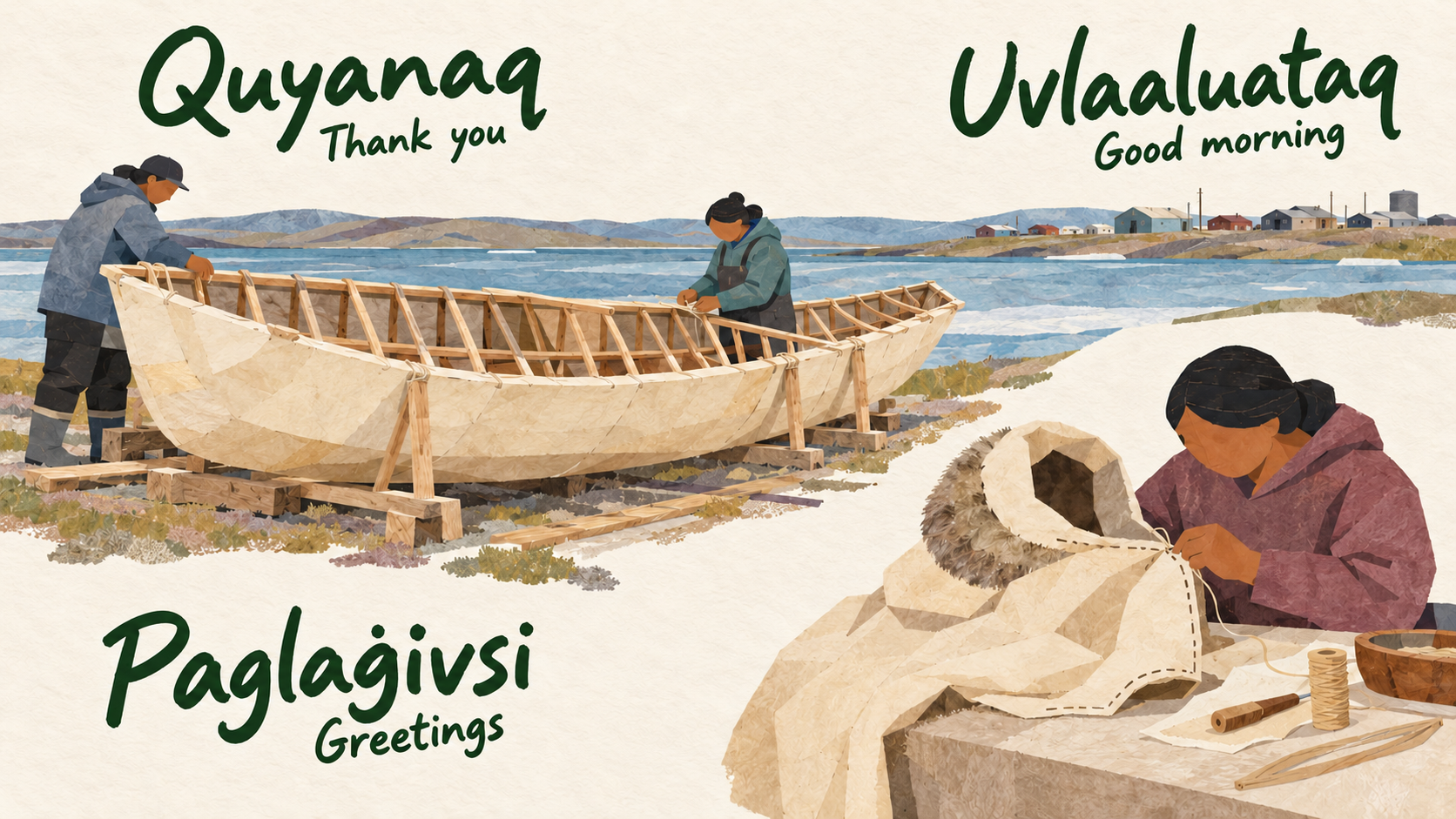
- Quyanaq — Thank you.
- Uvlaaluataq — Good morning.
- Paglaġivsi — Greetings.
What are some memorable Iñupiaq sayings?
Nikaitchuatguuq piraqtut means “Those who think they can, will accomplish something.” Iḷisaqativut uses this proverb to encourage learners.
What everyday customs might surprise a visitor?
In Sean Topkok’s 2015 account of meetings with the Pavva Iñupiaq Dancers and other Iñupiat, older participants speak first and elders have time for final reflections. Speakers are allowed to finish without interruption.
Which Iñupiaq-language song and film offer a cultural introduction?
The Atchagat Song for BSSD, developed by Suzzuk Mary Huntington, adapts a North Slope and Malimiut alphabet song by adding Bering Strait sounds. The Bering Strait School District offers audio and video.
Sikumi / On the Ice, Andrew Okpeaha MacLean’s 2008 short film, follows a hunter who witnesses a killing and knows both men. The fifteen-minute drama uses Iñupiaq dialogue and English subtitles.
What is available for someone curious about the language now?
Iñupiatun Tusaalaŋa offers free online lessons, a glossary, dialogues and sound files. Kawerak and the King Island Native Community offer a beginning curriculum PDF on pronunciation and word structure.
Iḷisaqativut links to North Slope and Malimiut dictionaries and a Wales sea-ice terminology book.
Fun Facts
- Iñupiaq can name one person, Iñupiak two, and Iñupiat three or more.
- Iñupiaq counts in groups of twenties, with fives inside. Students in Kaktovik created numeral shapes in 1994 that show these groupings.
Sources
- National Park Service. Indigenous Languages of Alaska: Iñupiaq. Last updated 1 November 2021.
https://www.nps.gov/articles/000/indigenous-languages-of-alaska-inupiaq.htm - Alaska Native Language Center, University of Alaska Fairbanks. Inupiaq. n.d.
https://www.uaf.edu/anlc/languages-move/inupiaq.php - Kapniaq Lorena Williams and Taġġaq Lawrence Kaplan. Iñupiaq Phrases and Conversations. 2000; online phrasebook hosted by Iḷisaqativut, n.d.
https://ilisaqativut.org/phrasebook - Iḷisaqativut. Conventions When Writing about Iḷisaqativut, Media. Updated 2025.
https://ilisaqativut.org/media - Alaska Native Language Archive, University of Alaska Fairbanks. Guide to the Inupiaq Language Collection. n.d.
https://www.uaf.edu/anla/collections/inupiaq/ - Iḷisaqativut. Dictionaries. n.d.
https://ilisaqativut.org/dictionaries - Eduardo Marín Silva, Kirk Miller and Catherine Strand. Unicode request for Kaktovik numerals, L2/21-058. 16 March 2021.
https://www.unicode.org/L2/L2021/21058-kaktovik-numerals.pdf - Smithsonian National Museum of the American Indian. 2015 Native Cinema Showcase. 2015.
https://americanindian.si.edu/sites/1/files/pdf/events/ncs-2015-web.pdf - Edna Ahgeak MacLean. Abridged Iñupiaq and English Dictionary. Alaska Native Language Center and Iñupiat Language Commission, North Slope Borough. 1981; copy marked sixteenth printing, August 2009.
https://beringstraits.com/language-resources/abridged-lnupiaq-and-english-dictionary-by-edna-maclean/ - Iñupiatun Tusaalaŋa. The Iñupiaq Writing System. n.d.
https://inupiaq.tusaalanga.ca/node/2507 - Iñupiatun Tusaalaŋa. Differences between the Iñupiaq Varieties. n.d.
https://inupiaq.tusaalanga.ca/node/2504 - Bernadette (Yaayuk) Alvanna-Stimpfle and Myles Creed. Ilisazaqta Inupiaqtun: Beginning Curriculum for Learning and Teaching Inupiaq — Pronunciation and Word Structure. Kawerak, Inc. and King Island Native Community. n.d.
https://static1.squarespace.com/static/58929ed817bffc5e4d930b78/t/6691a74d289bc87861c4a6cd/1720821594243/Ilisazaqta%2BInupiaqtun_Final.pdf - Bering Strait School District. Inupiaq Language, Cultural Integration. n.d.
https://sites.google.com/bssd.org/bssdculturalintegration/language/inupiaq-language?authuser=1 - Bering Strait School District. Videos, Cultural Integration. n.d.
https://sites.google.com/bssd.org/bssdculturalintegration/language/videos - Council for Alaska Native Languages, Alaska Department of Education and Early Development. Languages. n.d.
https://education.alaska.gov/canl/Languages - Lawrence D. Kaplan, edited by Jane McGary. Inupiaq and the Schools: A Handbook for Teachers. Alaska Department of Education. First printing, June 1984.
https://files.eric.ed.gov/fulltext/ED255038.pdf - Iḷisaqativut. Our Values. n.d.
https://ilisaqativut.org/our-values - Merriam-Webster. Igloo, Word History. n.d.
https://www.merriam-webster.com/dictionary/igloo - Merriam-Webster. Kayak, Word History. n.d.
https://www.merriam-webster.com/dictionary/kayak - Maureen P. Hogan and Sean A. Topkok. Teaching Indigenous methodology and an Iñupiaq example. Decolonization: Indigeneity, Education & Society 4(2), 50–75. 2015.
https://ikdll.nau.edu/id/eprint/42/1/Hogan_Topkok_Teaching-Indigenous-Methodology.pdf - Iñupiatun Tusaalaŋa. Welcome to Tusaalanga. n.d.
https://inupiaq.tusaalanga.ca/ - Wolf A. Seiler. Iñupiatun Eskimo Dictionary. SIL International, with NANA Regional Corporation and Iñupiat Ilitqusiat community support. 2012.
https://static1.squarespace.com/static/58929ed817bffc5e4d930b78/t/61958cc63307101642669087/1637190868466/In%CC%83upiatun%2BEskimo%2BDictionary%E2%80%94NANA.pdf - Patuk Glenn and Tommy Nageak. Iñupiat History, Language and Culture / Inuit Cultural Orientation. Iñupiat Heritage Center, North Slope Borough. n.d. PDF p.63, “Common Easy Phrases”. https://www.north-slope.org/wp-content/uploads/2022/02/Inuit_Cultural_Orientationpg.pdf
Start learning today
Explore these books to keep learning.