Languages & Culture
Japanese
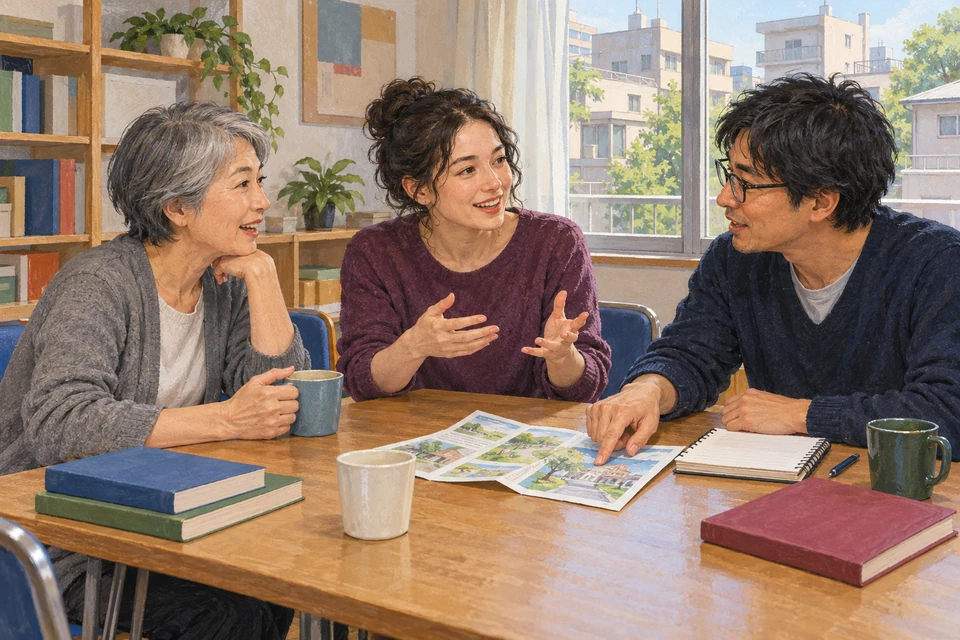
Japanese connects everyday life in Japan with learning, work and family relationships across borders. Its users include people who grew up with it and people acquiring it for new circumstances; the Japan Foundation’s teaching materials explicitly address communication among neighbours and coworkers from different backgrounds. Japanese belongs to the Japonic family, alongside the Ryukyuan languages. That family relationship matters: Japanese is not a collective name for every language spoken in Japan. Comparative linguistics uses related varieties to investigate earlier forms, rather than assuming that the modern standard preserves everything about the past.
A written history that requires interpretation
The Oxford-NINJAL Corpus of Old Japanese identifies Old Japanese as the earliest attested stage, largely represented by the seventh and eighth centuries. Its current poetic collection includes the Man’yōshū. The original writing used Chinese characters for both sound and meaning, so understanding a text involves more than substituting modern words for old ones. The project presents original script alongside transcription and grammatical analysis. Its editors also identify their annotations as work that can be corrected: a searchable historical corpus makes scholarly decisions inspectable, rather than removing the need for interpretation.
Modern writing carries that history into ordinary reading. Kanji, characters of Chinese origin, appear alongside two forms of kana: hiragana and katakana. In Mariko Kuno’s university explanation, the former developed from cursive character forms and the latter from portions of characters. Their functions have changed over time. Hiragana supported poetry and stories; katakana was associated with scholarly annotations and practical writing. Today, script choice can distinguish grammatical material, borrowed words, sound effects or emphasis. The three scripts work together; they are not three competing languages.
The spoken standard also has a history. Yuko Igarashi’s account of standardisation describes how a variety based on educated Tokyo speech was promoted during the Meiji period through a national school system. Its widespread role does not make regional speech a recent departure from an originally uniform language. The same study discusses research showing that speakers may use regional and standard forms in different relationships and settings. A description of Japanese therefore needs both the shared standard and the local repertoires through which people actually communicate.
Conversation, learning and family experience
Everyday interaction is itself a serious research subject. In a 2022 paper, Hanae Koiso and colleagues describe the Corpus of Everyday Japanese Conversation, for which participants recorded activities at home, in workplaces, restaurants and other settings. Audio, video and transcripts allow researchers to relate words to interaction. The researchers also explain imbalances in the material: children are represented less than adults, and work or school conversations occur less often than in their comparison survey. That transparency helps readers distinguish a carefully designed collection from a complete portrait of everyone’s Japanese.
For people building a life in Japan, useful learning likewise depends on situations. The Japan Foundation’s Irodori materials organise communication around activities such as shopping, eating, working and interacting with others. The emphasis falls on what a learner can accomplish with language. This approach gives ordinary exchanges a place alongside grammar and vocabulary: understanding another person’s purpose, asking for information and participating in shared activities are practical parts of learning. The programme’s stated design is not, by itself, evidence that every learner achieves the same outcome.
Family connections can produce a different learning path. In a 2026 first-person account for Discover Nikkei, Janina Tiemi Enomoto recalls Japanese vocabulary and writing in her childhood in Brazil, alongside difficulty following adults’ conversations. She describes later formal study and experiences in Japan that helped her communicate with her grandmother. Her account illustrates why ancestry, familiar words and conversational ability cannot simply be counted as the same thing. It also places Japanese within changing relationships between generations and countries, rather than within one fixed national experience.
When a written story becomes a shared performance
One concrete meeting of writing and speech is kamishibai, a form of illustrated storytelling. The International Kamishibai Association of Japan describes separate sheets placed in a small wooden stage, with pictures facing the audience and text printed on the backs. The performer faces the listeners, sliding sheets to move the story forward. Images, timing, voice and audience response all contribute to the encounter. This practice offers a particular example of Japanese children’s culture and its international connections, without making one art form stand for every speaker. It also shows how a text can become a social event through the choices of the person performing it.
Sources
- Thomas Pellard, CNRS/CRLAO; NINJAL International Symposium Approaches to endangered languages in Japan and Northeast Asia: Description, documentation and revitalization. The comparative study of the Japonic languages. https://www2.ninjal.ac.jp/ael/files/resume/Keynote_PellardThomas.pdf
- University of Oxford and National Institute for Japanese Language and Linguistics, Oxford-NINJAL Corpus of Old Japanese. Oxford NINJAL Corpus of Old Japanese (ONCOJ). https://oncoj.ninjal.ac.jp/
- Mariko Kuno; Kokugakuin University, Kokugakuin Media; originally The Japan News. Why do you use both hiragana and katakana scripts? (2015-08-31). https://www.kokugakuin.ac.jp/en/article/11151
- Yuko Igarashi; Ritsumeikan University; 立命館国際研究 31(2), 267–283. Standardization and Japanese People’s Perception Toward Languages. https://www.ritsumei.ac.jp/ir/isaru/assets/file/journal/31-2_02Igarashi.pdf
- Hanae Koiso, Haruka Amatani, Yasuharu Den, Yuriko Iseki, Yuichi Ishimoto, Wakako Kashino, Yoshiko Kawabata, Ken’ya Nishikawa, Yayoi Tanaka, Yasuyuki Usuda and Yuka Watanabe; NINJAL/Chiba University; Proceedings of LREC 2022, 5587–5594, ELRA. Design and Evaluation of the Corpus of Everyday Japanese Conversation. https://aclanthology.org/2022.lrec-1.599.pdf
- The Japan Foundation, Irodori: Japanese for Life in Japan. What is "Irodori"?. https://www.irodori.jpf.go.jp/en/about.html
- The International Kamishibai Association of Japan (IKAJA). What's Kamishibai. https://www.kamishibai-ikaja.com/en/kamishibai-eng.html
- Janina Tiemi Enomoto; Descubra Nikkei / Discover Nikkei, a Japanese American National Museum project. A importância da língua de herança: aprender japonês no Brasil e português no Japão (2026-02-09). https://discovernikkei.org/pt/journal/2026/2/9/lingua-de-heranca/