Languages & Culture
Kansai Japanese
Kansai Japanese is a regional label within Japanese, a language of the Japonic family. It covers speech associated with places such as Osaka, Kyoto and Kobe in western Japan, rather than a single independent language or an identical way of speaking across the region. The familiar name Kansai-ben is useful as an introduction, but locality and generation matter. Even a teaching resource designed around the regional label deliberately includes speakers from different places and age groups to make that diversity audible.
A region with its own linguistic history
The region includes Kyoto and Nara, former capitals that were important centres in the history of Japanese. The MIT-hosted Kansai Dialect Self-study Site sets this history alongside the later prominence of Tokyo and the development of a Tokyo-based standard. Learning a national standard and retaining regional speech can coexist in a speaker’s repertoire. This history helps explain why Kansai varieties deserve description on their own terms: their significance cannot be measured simply by how closely they resemble the Japanese of a general introductory course.
Relationships expressed through grammar
Regional differences reach beyond vocabulary or an easily recognised accent. Linguist Fumiko Inoue discusses the form haru, associated with respect, in an explanation republished by NINJAL in 2020 from a 2004 text. She shows that local conventions can permit its use when talking about one’s family or a baby, where learners following common-standard honorific rules might not expect it. She also reports differences between Kyoto and Osaka in how the form is used and understood. The practical lesson is that a grammatical form and the relationships it expresses must be interpreted together. This dated account should not become a rule about every resident’s speech today.
Research can follow change within one city and one set of speakers. Kayoko Tsuji’s 2002 study compared casual conversation among middle-aged and older Kyoto women with literary dialogue from the later Edo period. It examined honorific forms used for a person being discussed and for the person being addressed. Patterns in the contemporary conversations differed from those in the older material. Such work makes regional history concrete: it investigates changes in conversational practice, instead of presenting a dialect as a collection of expressions preserved unchanged for centuries.
What a recording can tell us
Different research designs capture different aspects of Kansai speech. Koichiro Yoshino and colleagues’ 2016 parallel-corpus project included Kansai among its regional varieties. Participants independently converted common-language sentences into their own forms and then read them aloud. The researchers explicitly recognised that people grouped under the same dialect label could make different choices because of their backgrounds. This material served speech-processing research, where a system trained only on the common language may handle regional speech poorly. Because the task involved prepared sentences, it provides a different kind of evidence from an unprompted conversation between friends.
Older recordings supply another perspective. NINJAL’s description of its Corpus of Japanese Dialects, COJADS, traces the material to Agency for Cultural Affairs collection work in 1977–1985. Its catalogue describes searching through dialect and standard-Japanese versions. A recording’s date, location and circumstances remain essential: an archive can help investigate earlier usage without being treated as a direct survey of what everyone says now. These distinctions matter when a learner encounters an unfamiliar form in a recording or a researcher compares accounts made decades apart.
Local speech in public storytelling
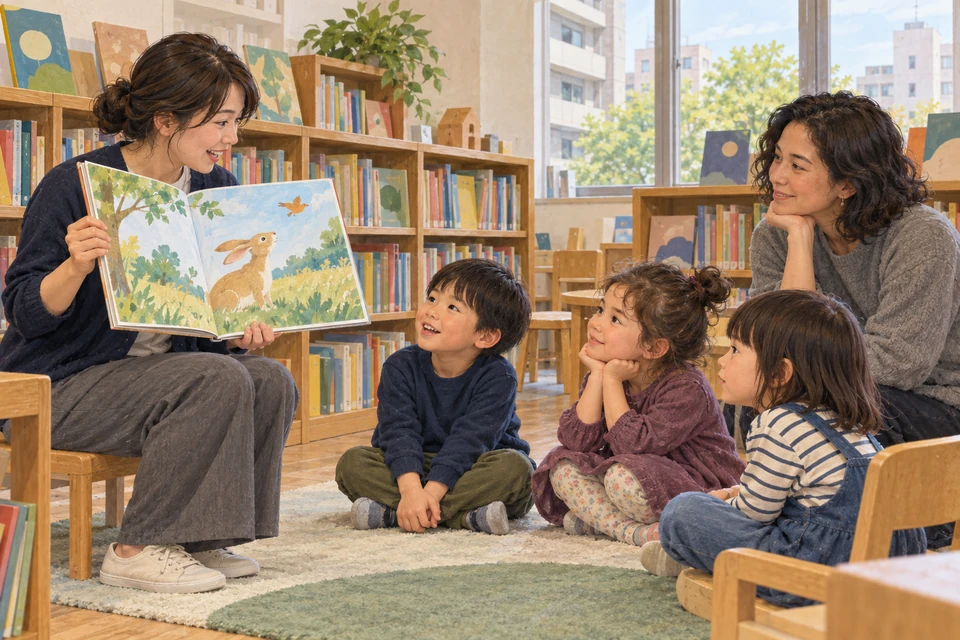
Osaka speech also appears in deliberately accessible cultural settings. A June 2021 Osaka Municipal Library newsletter described a librarian reading the picture book じごくのそうべえ aloud in Osaka speech. The library linked the picture book to a Kamigata rakugo story and highlighted the lively rhythm of its Osaka narration. The example brings local speech into a children’s reading activity, linking written adaptation with spoken performance. The newsletter documented a video offered for a limited period; it does not establish that the video remains available.
A more recent public notice provides evidence of continuing programming: Izumisano Public Library announced Osaka-dialect storytelling for 25 October 2026. At the research date, 22 October, this remained a scheduled activity. Its announcement supports the existence of a contemporary institutional interest in local speech, without proving that the session took place.
For learners, the most useful starting point is attentive listening with context. The Kansai self-study project combines structural comparison with conversations and interviews, placing people alongside grammar. Asking where a speaker learned a form, whom they are addressing and what they are doing is more informative than collecting supposedly universal regional catchphrases. A regional label opens the enquiry; individual voices supply its detail.
Sources
- Kansai Dialect Self-study Site; Massachusetts Institute of Technology host; project directed by Ikue Shingu with collaborators Junko Hatanaka and Mayumi Ishida. READ FIRST. https://web.mit.edu/kansai/0readfirst.html
- Kansai Dialect Self-study Site; Massachusetts Institute of Technology host. 2. The Standard Japanese VS the Kansai dialect. https://web.mit.edu/kansai/1.Characteristics/1.Standardvskansai/2Standardvskansai.html
- Fumiko Inoue / 井上文子; National Institute for Japanese Language and Linguistics, ことば研究館. 家族や赤ちゃんに尊敬語を使うのは間違った言い方ですか. https://kotoba.ninjal.ac.jp/qa/yokuaru/qa-128/
- Kayoko Tsuji / 辻加代子; The Japanese Journal of Language in Society 5(1), 28–41; Japanese Association of Sociolinguistic Sciences. A diachronic study of haru-keigo in the Kyoto city dialect female speech : Focusing on treatment expressions referring to a third person(<Special Issue>Interpersonal Functions in Language and Linguistic Politeness). https://www.jstage.jst.go.jp/article/jajls/5/1/5_KJ00008439926/_article/-char/en
- Koichiro Yoshino, Naoki Hirayama, Shinsuke Mori, Fumihiko Takahashi, Katsutoshi Itoyama and Hiroshi G. Okuno; Proceedings of LREC 2016, 4652–4657, ELRA. Parallel Speech Corpora of Japanese Dialects. https://www.lsta.media.kyoto-u.ac.jp/publications/yoshino-LREC16.pdf
- National Institute for Japanese Language and Linguistics. Search for Resources. https://www.ninjal.ac.jp/english/resources/search/
- Osaka Municipal Library; issued by Osaka Municipal Central Library. 大阪市立図書館メールマガジン第90号 (2021-06-17). https://www.oml.city.osaka.lg.jp/page/1797.html
- Izumisano Public Library; Izumisano City Board of Education, Lifelong Learning Division. プラレールで遊ぼう!(同時開催:大阪弁のおはなし会)中央特別イベント. https://library.city.izumisano.lg.jp/event/?id=134
- Thomas Pellard, CNRS/CRLAO; NINJAL International Symposium Approaches to endangered languages in Japan and Northeast Asia: Description, documentation and revitalization. The comparative study of the Japonic languages. https://www2.ninjal.ac.jp/ael/files/resume/Keynote_PellardThomas.pdf