Language & culture
Kashmiri: A Language of the Kashmir Valley
Language at a glance
Who speaks Kashmiri, and what do they call it?
Kashmiri speakers call their language Koshur. Its main home is the Kashmir Valley, with communities elsewhere in India and overseas. Both Muslim and Hindu Kashmiris speak it.
How many people speak Kashmiri worldwide?
India’s 2011 census language statistics recorded 6,797,587 speakers under Kashmiri. This is a dated count for India; it excludes communities elsewhere and is not a current worldwide estimate.
Where did Kashmiri come from, and who spoke it in the past?
Kashmiri belongs to the Indo-Aryan family and is related to Shina. By the fourteenth century, Lal Ded was composing her vakhs, short poems about spiritual life. Those poems show an established literary voice; they do not mark the moment the spoken language began.
Which Kashmiri words might an English speaker recognise?
Saykal, meaning “cycle”, is one familiar-looking example. Kashmiri vocabulary includes borrowings from English alongside much older Sanskrit and Persian layers. Some Persian words remain recognisable across languages: āb means “water”, and āsmān means “sky”.
How does Kashmiri vary from region to region?
Within the valley, Maraz in the south and southeast, Kamraz in the north and northwest, and Srinagar have differences in vocabulary and pronunciation. Speakers can move towards the Srinagar variety in different settings. These regional differences sit within a shared language.
What is Standard Kashmiri, and where is it used?
The variety associated with Srinagar and its surroundings is the usual reference for literature, broadcasting and education.
Which alphabet does Kashmiri use, and what might surprise an English speaker?
Adapted Perso-Arabic and Devanagari scripts are both used, and each has a CIIL–NCERT primer published in May 2025. Their inventories differ. The Perso-Arabic primer’s opening chart displays 44 entries, with vowel forms listed separately. It reads right to left; Devanagari reads left to right. Older writing also used Sharada. In statements, the verb carrying tense usually follows the opening word or phrase, even when that opening is not the subject. An English speaker who knows German may recognise that pattern.
Does Kashmiri have grammatical gender?
Yes. Nouns, including words for objects, are grammatically masculine or feminine.
Which greetings might you hear in Kashmiri?
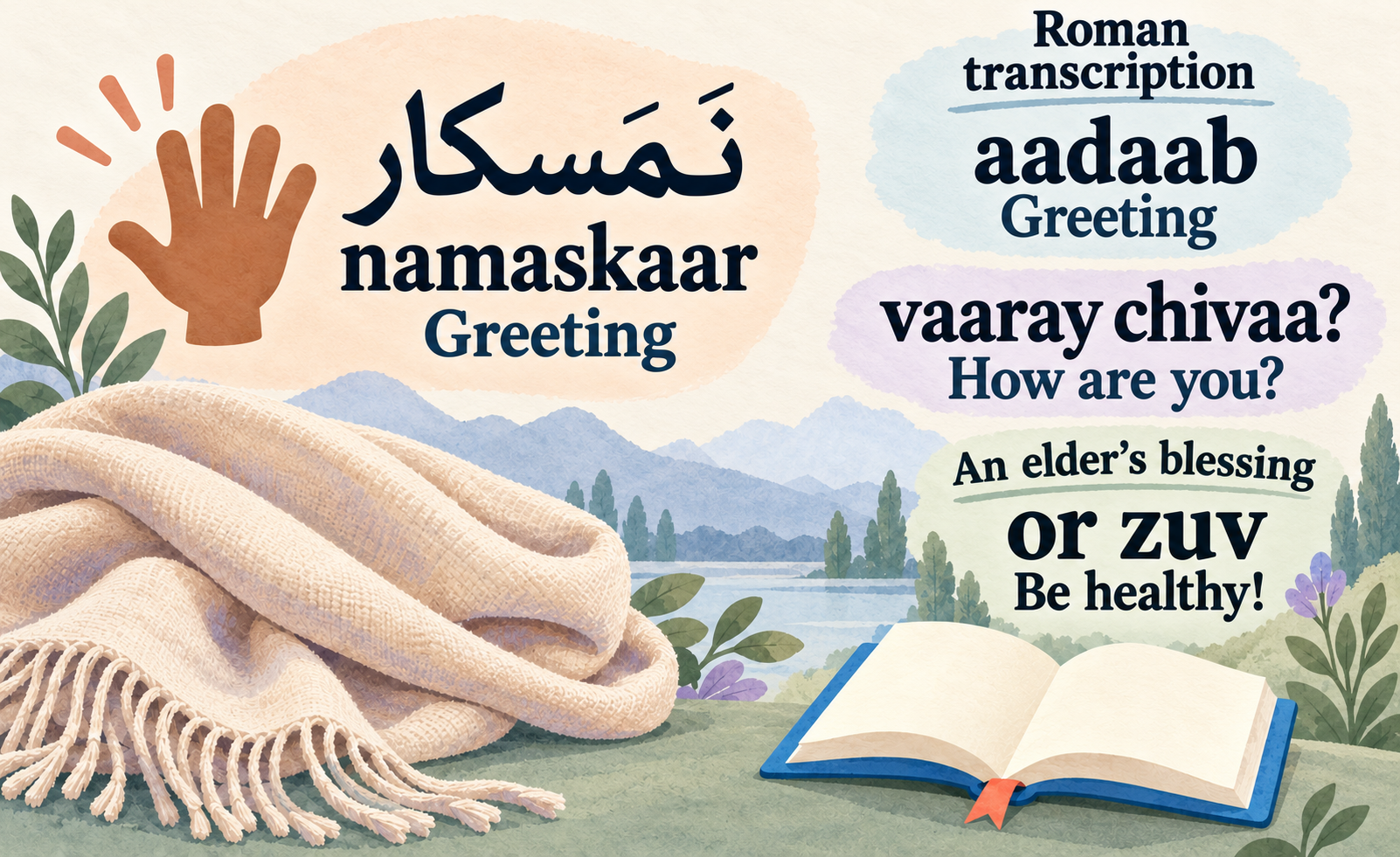
In Roman transcription, namaskaar and aadaab are greetings. Namaskaar is written نَمَسکار in Perso-Arabic. Vaaray chivaa? asks “How are you?” An elder’s reply may be a blessing: or zuv, “Be healthy!” Both namaskaar and aadaab can be answered with the same greeting; a health question leaves room for several replies. The choice also depends on the people’s relationship.
What are some memorable Kashmiri sayings?
Tatsar chu matsar means “Anger is madness”, a warning against losing one’s temper. Ta:bas chu la:b says that patience pays.
Another saying, pashmi:nas cha narmi:, literally says “Pashmina is soft”. It likens a good person’s gentleness to the feel of the fabric.
What everyday customs might surprise a visitor?
A classroom greeting can involve standing up to greet the teacher. Outside class, a verbal greeting, folded hands or a raised hand may take its place. Younger people commonly greet elders first.
Which books and poetry offer a cultural introduction?
Lal Ded’s vakhs offer a route into fourteenth-century Kashmiri poetry. Ranjit Hoskote’s I, Lalla presents English translations. Habba Khatoon’s sixteenth-century lyrics offer another voice from Kashmiri’s early literary history. Another strand appears in Mehmood Gami’s Kashmiri verse translation of Yusof o Zolayḵā, part of the language’s encounter with Persian literature.
What is available for someone curious about the language now?
The two CIIL–NCERT primers introduce writing through illustrated words and numbers. They are designed for young children and adult literacy programmes. Omkar N. Koul’s Spoken Kashmiri has twenty lessons with dialogues and English translations. The University of Chicago’s digital Grierson dictionary provides a searchable historical reference, whose original publication dates to 1932.
Fun Facts
- In Lal Ded’s name, Ded is a respectful term used for a mother or grandmother.
- Pormut chu gormut compares an educated person to a carefully cut stone: learning has shaped the person, just as carving shapes the stone.
Sources
Central Institute of Indian Languages and NCERT. Kashmiri Primer (Devanagari). First edition, May 2025. https://www.ciil.org/primers/Kashmiri_(Devanagari)_Primer.pdf
Central Institute of Indian Languages and NCERT. Kashmiri Primer (Perso-Arabic). First edition, May 2025. https://www.ciil.org/primers/Kashmiri_(Perso-Arabic)_Primer.pdf
Choudhary, Narayan. “LDC-IL: The Indian repository of resources for language technology.” Language Resources and Evaluation 55 (2021), 855–867. Table 1 reproduces Census of India 2011 language statistics. DOI 10.1007/s10579-020-09523-3. https://link.springer.com/content/pdf/10.1007/s10579-020-09523-3.pdf
Koul, Omkar N. Spoken Kashmiri: A Language Course. First published 1987; revised web reprint, undated. Introduction and Lesson 1 Notes. https://koshur.org/Kashmiri/introduction.html ; https://koshur.org/Kashmiri/chapter1/n.html
Koul, Omkar N. Modes of Greetings in Kashmiri. Indian Institute of Language Studies, undated standalone text; also a chapter in Studies in Kashmiri Linguistics (2005). https://www.academia.edu/3093347/Modes_of_Greetings_in_Kashmiri
Koul, Omkar N. Studies in Kashmiri Linguistics. Indian Institute of Language Studies, 2005. Relevant sections on nouns and personal names. https://www.academia.edu/28384097/STUDIES_IN_KASHMIRI_LINGUISTICS_by_Omkar_N_Koul
Koul, Omkar N. A Dictionary of Kashmiri Proverbs. Second edition, Indian Institute of Language Studies, 2005. Entries on printed pages 91 and 134; additional author excerpt, “pashmi:nas cha narmi:”, https://koshur.org/pdf/proverbs.pdf ; https://ikashmir.net/proverbs/proverbs2.html
Koul, Omkar N. “Kashmir iv. Persian Elements in Kashmiri.” Encyclopaedia Iranica, 2011; updated 2016. https://www.iranicaonline.org/articles/kashmiri-language/
Grierson, George Abraham. A Dictionary of the Kashmiri Language. Asiatic Society of Bengal, 1932. Digital South Asia Library, University of Chicago; database updated February 2024. https://dsal.uchicago.edu/dictionaries/grierson/
Penguin Random House India. I, Lalla: The Poems of Lal Ded, translated by Ranjit Hoskote. Listed paperback edition, July 2013. https://www.penguin.co.in/book/i-lalla/
Jammu and Kashmir Academy of Art, Culture and Languages. Kashir Dictionary, volume 6, printed page 302, right column. Edition year not established from the inspected page. Public archival scan: https://archive.org/details/in.ernet.dli.2015.241984/page/n294
Original bibliography accessed 23 October 2026; dictionary scan accessed 24 October 2026.
Wish there were a Kashmiri book?
Save a wish for a Kashmiri language-learning book. No account or email is needed.
Active book wishes: —
Wishes stop counting after 180 days, or immediately when you remove them. Expired server records are deleted by the hourly cleanup, normally within one additional hour. An expiring browser key lets you manage your wish; expired keys are cleared on your next visit. It is not linked to analytics or an email address. After removal, the record expires within one day. These are browser wishes, not a count of people or a promise to publish a book.
Your wishlist
- Your wishlist has not loaded yet.
Book-availability email alerts aren’t enabled yet. Saving a wish does not subscribe you to the newsletter.