Languages & Culture
Khmer
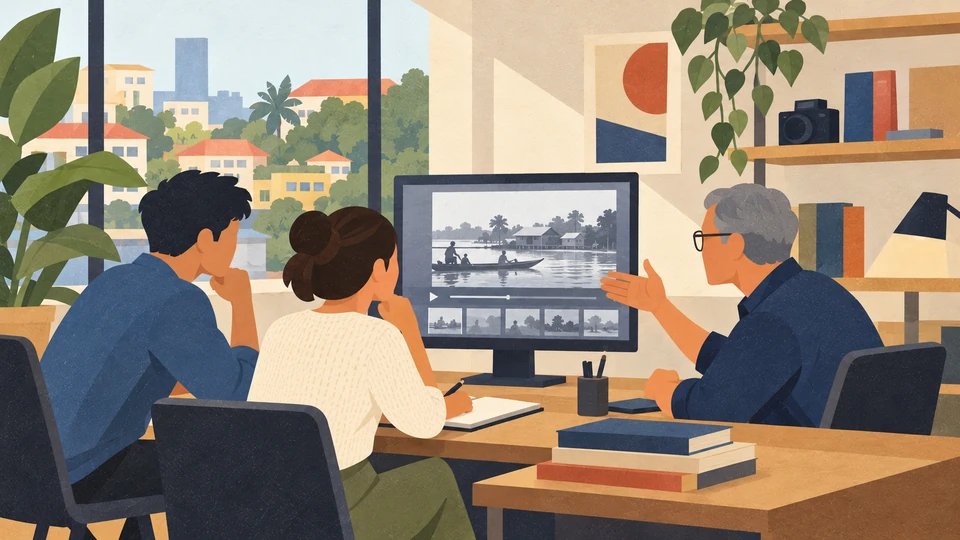
Khmer is an Austroasiatic language and the official language of Cambodia. Its communities also extend into southeastern Thailand and southern Vietnam, while language education and cultural documentation connect speakers abroad. This article concerns modern Khmer, with the Cambodian standard as its reference point. Historical inscriptions supply context for its development; they are not substitutes for the language people learn and use today.
Reading the historical record
Old Khmer, the ancestor of modern Khmer, is attested in inscriptions dating back to the seventh century. These records invite questions about grammar as well as political or religious history. Chhany Sak-Humphry’s description of her study of the Sdok Kak Thom inscription explains that the monument contains both Sanskrit and Old Khmer texts. Her work analyses the grammatical structure of the Old Khmer passages and supplies translations and a glossary. The two languages occur together in one historical document; recognising that distinction matters when reading accounts of Cambodia’s written heritage.
How writing shapes digital research
Modern Khmer is written from left to right. Richard Ishida’s 2026 W3C Group Note Draft describes the script as an abugida: consonant letters have inherent vowels, and attached vowel signs modify the reading. Consonant class also affects vowel interpretation. Written words are generally not separated by visible spaces; spaces instead help divide phrases. A beginner therefore needs to learn how combinations of signs work, not merely memorise a row of letters and assume each has one fixed sound.
These features have practical consequences for computer processing. In a 2025 paper, Hour Kaing and colleagues describe PrahokBART, a language model trained on curated Khmer and English texts. Their work considers word segmentation, which identifies word boundaries, and normalisation, which makes textual representations more consistent. It also treats the spaces used within Khmer writing as meaningful elements to preserve. The researchers evaluate translation, summarisation and headline generation. This is a specific research contribution with a defined language scope, rather than evidence that automatic systems can reliably interpret every Khmer text or replace a knowledgeable reader.
Community history beyond Cambodia
In Long Beach, California, Khmer learning connects with a substantial Cambodian community and its institutions. California State University Long Beach’s Cambodian language and culture minor explicitly aims to develop heritage speakers’ language capacity while remaining open to other students. The programme combines language courses with options addressing culture, society and the Cambodian American experience. Its description shows why learners may approach Khmer with very different starting points: familiarity through family life and ability to study written texts are not necessarily the same thing.
The Cambodian Community History and Archive Project, formed in 2008, links two universities with the Historical Society of Long Beach. Its materials include English and Khmer newspapers, photographs, documents and contributions from community organisations. The project also presents narratives and short documentary videos about local community history. This preserves evidence of lives shaped by a particular city, including cultural practices and participation in neighbourhood development. Khmer’s documentary record thus includes the experiences of communities building institutions far from Cambodia.
Sung stories and recorded memories
One Cambodian practice joins verbal creativity with music. In Chapei Dang Veng, singing accompanies a lute; lyrics can include poems, folk tales, Buddhist stories, satire and social commentary. UNESCO’s 2020 account describes improvisation, wit and storytelling as important skills, and identifies family and master–apprentice relationships as routes of transmission. It also reports work on documentation and training. This is a particular performance tradition, with its own practitioners and learning relationships, rather than a description of how every Khmer speaker participates in culture.
Screen and sound archives preserve other forms of expression. In their 2019 account of collaboration with Bophana Audiovisual Resource Center in Phnom Penh, ACMI staff describe films, photographs and sound recordings, alongside screenings and training for young documentary filmmakers. They explain how an archive interface lets visitors explore historical material and researchers locate particular content. Such work connects preservation with opportunities to interpret and create: an old recording can become material for a new discussion, research project or film.
Sources
- University of Washington, Center for Southeast Asia and its Diasporas, Henry M. Jackson School of International Studies. Khmer. https://jsis.washington.edu/csead/programs/language-instruction/khmer/
- Chhany Sak-Humphry; University of Hawai‘i Khmer programme. The Sdok Kak Thom Inscription with a Grammatical Analysis of Old Khmer. https://www.hawaii.edu/khmer/KhmerMaterials/SdokKakThom.html
- Richard Ishida, editor; W3C Internationalization Working Group, with Southeast Asia Language Enablement contributors. Khmer Script Resources (2026-03-20). https://www.w3.org/TR/khmr-lreq/
- California State University Long Beach, Department of Asian and Asian American Studies. Cambodian/Khmer. https://www.csulb.edu/college-of-liberal-arts/asian-and-asian-american-studies/cambodiankhmer
- California State University Dominguez Hills, Department of Anthropology; CamCHAP collaborators California State University Long Beach and Historical Society of Long Beach. The Cambodian Community History & Archive Project. https://www.csudh.edu/anthropology/cambodian-community-history-archive-project
- UNESCO Phnom Penh Office. Chapei Dang Veng, four years after its inscription on UNESCO Intangible Cultural Heritage List. https://www.unesco.org/en/articles/chapei-dang-veng-four-years-after-its-inscription-unesco-intangible-cultural-heritage-list
- Candice Cranmer, Julia Murphy and Nick Richardson; ACMI. ACMI and Bophana: preserving Cambodia's fragile stories (2019-10-30). https://www.acmi.net.au/stories-and-ideas/acmi-and-bophana-preserving-cambodias-fragile-stories/
- Hour Kaing, Raj Dabre, Haiyue Song, Van-Hien Tran, Hideki Tanaka and Masao Utiyama; National Institute of Information and Communications Technology, Kyoto, Japan; Proceedings of the 31st International Conference on Computational Linguistics, 1309–1322. PrahokBART: A Pre-trained Sequence-to-Sequence Model for Khmer Natural Language Generation. https://aclanthology.org/2025.coling-main.87.pdf