Language & culture
Lakota: Language and Communities in the Dakotas
Language at a glance
- Speaker estimate
- About 2,000 first-language speakers
Published 2018; mainly North/South Dakota reservations.
- Local names
- Lakȟótiyapi
People: Lakȟóta or Lakhóta.
- Communities
- North and South Dakota
Standing Rock, Pine Ridge and Rosebud.
- Language family
- Siouan
Mississippi Valley branch; closely related to Dakota.
- Writing
- 35 symbols
Pustet’s Latin transcription; digraphs count once.
- Regional varieties
- Northern · Southern
Standard Lakota and community orthographies.
Who speaks Lakota, and what do they call it?
Lakota communities include Standing Rock, Cheyenne River, Pine Ridge, Rosebud and Lower Brule. Lakȟóta is a name for the people; Lakȟótiyapi names the language. Another established spelling of the people’s name is Lakhóta.
How many people speak Lakota worldwide?
An estimate published in 2018 identified about 2,000 first-language speakers, mainly on five reservations in North and South Dakota. A worldwide total remains uncertain.
Where did Lakota come from, and who spoke it in the past?
Lakota belongs to the Siouan family’s Mississippi Valley branch and is closely related to Dakota. Before the reservation period, its speakers occupied country across present-day North and South Dakota and parts of Nebraska, Wyoming and Montana. Lakota names appear in the records of Lewis and Clark’s 1804–06 expedition.
Which Lakota words might an English speaker already recognise?
Black Hills is probably an English translation of a Lakota name meaning black hills. Teton, as a name for Lakota people, also comes from Lakota. The matching name in Wyoming’s Grand Teton has a different, French origin.
How does Lakota vary from region to region?
Two broadly similar regional varieties are Northern Lakota, around Standing Rock and parts of Cheyenne River, and Southern Lakota, around Pine Ridge, Rosebud and other parts of Cheyenne River.
What is Standard Lakota, and where is it used?
Standard Lakota Orthography is one convention used in educational materials. Siċaŋġu Co’s children’s app offers it alongside Siċaƞġu and White Hat orthographies. St. Joseph’s Indian School adopted the Lakota Language Consortium’s spelling in 2015.
Which alphabet does Lakota use, and what might surprise an English speaker?
Lakota commonly uses Latin-based writing with additional marks. The transcription in Regina Pustet’s Lakota Texts has 35 symbols: eight vowel entries and 27 consonant entries, counting digraphs and the glottal stop. An acute accent marks the stressed syllable.
Does Lakota have grammatical gender?
Lakota has no masculine or feminine noun classes.
How do you say hello, thank you and goodbye in Lakota?
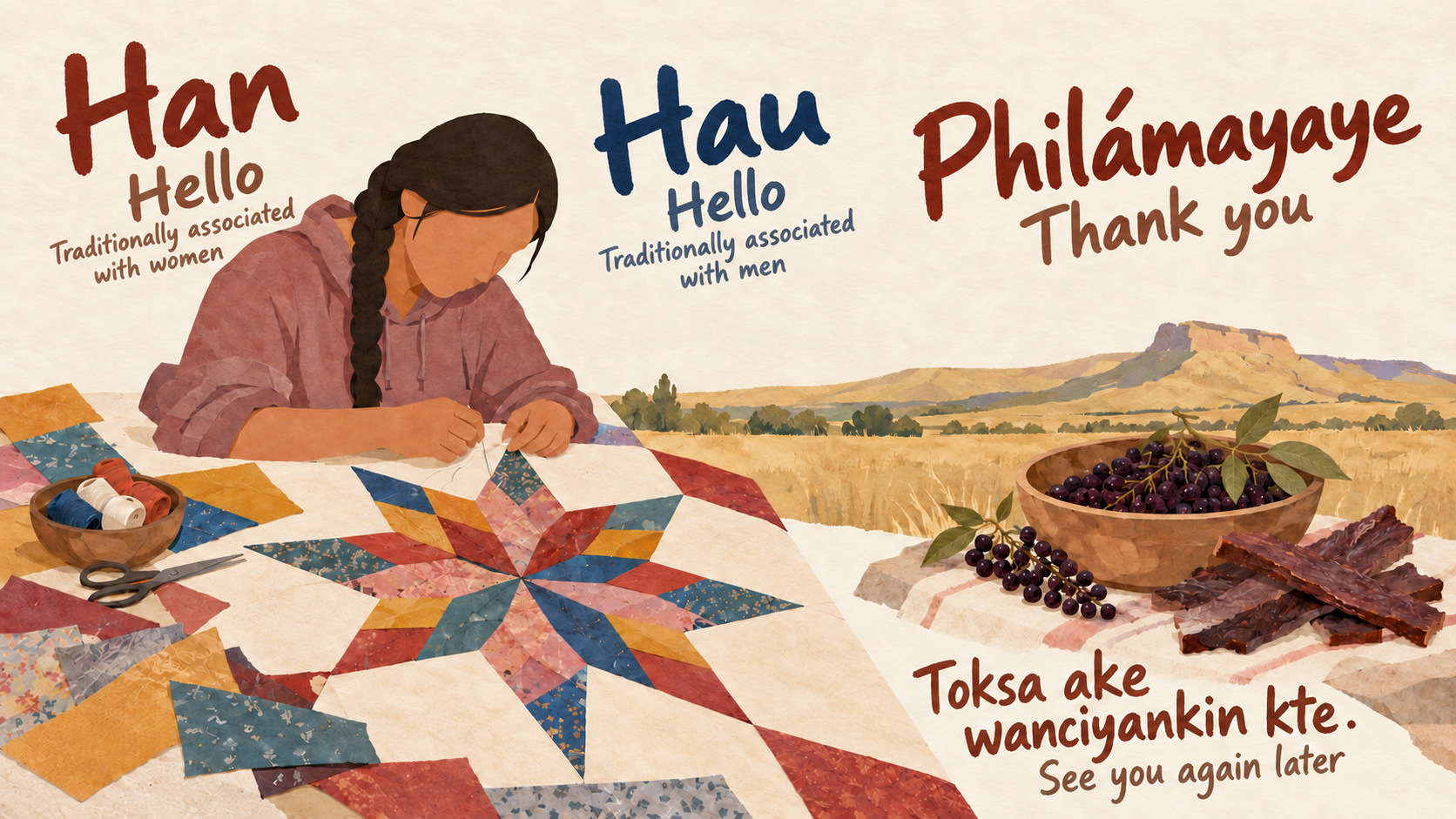
- Han — hello, traditionally associated with women speakers.
- Hau — hello, traditionally associated with men speakers.
- Philámayaye — thank you.
- Toksa ake wanciyankin kte. — see you again later.
What are some memorable Lakota sayings?
Mitákuye Oyásʼiŋ, often rendered “all my relatives”, expresses relationship and responsibility. Lakota curators Clementine Bordeaux, Mary V. Bordeaux and Layli Long Soldier devoted an art exhibition to the obligations behind the saying.
What everyday customs might surprise a visitor?
Within Lakota families, relatives address one another by kinship terms alongside their personal names. Deanna Stands’s 2012 account describes this practice across the extended family: the term depends on the ages and genders of both people. Calling someone by a family term also acknowledges responsibilities towards that relative.
Which Lakota-language song and film offer a cultural introduction?
Benjamin Sitting Up’s “Love Song (1)” is a short performance in Willard Rhodes’s 1949 collection Music of the Sioux and the Navajo. The recording comes from Pine Ridge’s Lakota repertoire.
Joss Whedon’s The Avengers received a Lakota dub in 2024 through Grey Willow Studios and Standing Rock participants. Apple’s Hong Kong catalogue lists Lakota audio and English subtitles.
What is available for someone curious about the language now?
Standing Rock’s Wóoyake archive has Dakota and Lakota recordings and written materials, with searchable records and transcripts. Some recordings have registration or seasonal access conditions. St. Joseph’s Indian School also provides Lakota Word Wednesday videos and free downloadable flashcards.
Fun Facts
- A word for horse, Šúŋkawakȟáŋ, combines the ideas of dog and something mysterious or sacred.
- A month name can evoke a winter sound. Čhaŋnápȟopa wí is the “Moon of Popping Trees” in a Lakota seasonal calendar.
- Reeds can make a “hairy lake”. Ble-híŋšma denotes a lake covered in reeds.
Sources
- Regina Pustet; Lakota Texts: Narratives of Lakota Life and Culture in the Twentieth Century; University of Nebraska Press and American Indian Studies Research Institute; 2021. Publisher preview.
https://api.pageplace.de/preview/DT0400.9781496226426_A49427232/preview-9781496226426_A49427232.pdf - Jan Ullrich; Modification, Secondary Predication and Multi-Verb Constructions in Lakota; doctoral dissertation, Heinrich Heine University Düsseldorf; 2018.
https://rrg.caset.buffalo.edu/rrg/Ullrich.pdf - William Bright; A Glossary of Native American Toponyms and Ethnonyms from the Lewis and Clark Journals; Names 52(3), 163–237; September 2004. University of Nebraska–Lincoln edition.
https://lewisandclarkjournals.unl.edu/item/lc.sup.bright.01 - St. Joseph’s Indian School; Lakota Language; n.d.
https://www.stjo.org/native-american-culture/lakota-language/ - Jillian Waln, Siċaŋġu Co; Uŋčí Wóslolye: Launching a Lakota Language Learning App for the Wakanyeja; August 5, year not displayed.
https://www.sicangu.co/news/languageapp - Deanna Stands, Center for American Indian Research and Native Studies; Han, Unci! Han, Tunkasila!; June 29, 2012.
https://www.nativecairns.org/resources/digital/lessonplans/ewExternalFiles/Han,%20Unci!%20Han,%20Tunkasila!.pdf - Racing Magpie; Responsibilities and Obligations: Understanding Mitákuye Oyásʼiŋ; n.d.
https://www.racingmagpie.org/mitakuye-oyasin-exhibit - Smithsonian Folkways; Music of the Sioux and the Navajo, recorded by Willard Rhodes; album released 1949; catalogue n.d.
https://folkways.si.edu/music-of-the-sioux-and-the-navajo/american-indian/album/smithsonian - Willard Rhodes, Folkways Records; Music of the Sioux and the Navajo, liner notes, with later Smithsonian Folkways errata by Marco Joven Dominguez and Sage Bond; 1949; errata n.d.
https://folkways-media.si.edu/docs/folkways/artwork/FW04401.pdf - Standing Rock Sioux Tribe; Lakota Avengers; June 16, 2024, reproducing a June 14, 2024 release.
https://www.standingrock.org/2024/06/16/lakota-avengers/ - Apple TV, Hong Kong catalogue; The Avengers; n.d.
https://tv.apple.com/hk/movie/the-avengers/umc.cmc.7i757ymuvffa02onn3uva0emx?l=en - Standing Rock Sioux Tribe Iyápi Program, Wóoyake; About; n.d.
https://www.wooyake.org/about - St. Joseph’s Indian School; The Horse; n.d.
https://www.stjo.org/native-american-culture/important-animals/horse-sunkawakhan/ - St. Joseph’s Indian School; Seasons and Moon Calendar; n.d.
https://www.stjo.org/native-american-culture/native-american-beliefs/seasons-moon-calendar/ - Patricia A. Shaw; Theoretical Issues in Dakota Phonology and Morphology; 1980, Routledge reprint 2019. Publisher preview.
https://api.pageplace.de/preview/DT0400.9780429881831_A34990402/preview-9780429881831_A34990402.pdf
Start learning today
Explore these books to keep learning.