Languages & Culture
Lithuanian
Lithuanian is an East Baltic language in the Indo-European family and the official language of Lithuania. Its close living relative is Latvian. This article concerns modern Lithuanian, including the relationship between its standard form and regional usage. Older writing remains essential evidence, but contemporary Lithuanian also belongs to classrooms, publishing, research and communities whose connections extend beyond the country's borders.
A printed history with more than one centre
An important landmark is Martynas Mažvydas's catechism, printed in Königsberg in 1547. Vilnius University Library identifies it as the first printed Lithuanian book and describes its combination of religious instruction, an elementary teaching text and hymns with musical notation. A single small book thus connected reading, belief and singing. Its publication is a date in the history of literacy, rather than a starting date for the spoken language.
The University of Texas's academic introduction to Baltic languages traces the importance of East Prussia in Lithuanian religious publishing, grammars and dictionaries. It also explains the later development of a common written standard on a western Aukštaitian basis. At the end of the nineteenth century and into the twentieth, linguists including Kazimieras Būga and Jonas Jablonskis contributed to codification, while writers and cultural activists expanded literary usage. The standard consequently has a documented history of choices, analysis and collective work.
Why books became a public cause
Between 1864 and 1904, imperial Russian authorities restricted Lithuanian printing in the Latin alphabet. The restriction's script-specific character matters when describing it accurately. Books and newspapers printed largely in East Prussia were brought across the border by the people remembered as knygnešiai, or book smugglers. The European Network Remembrance and Solidarity connects this history with Lithuania's Press Recovery, Language and Book Day on 7 May, marking the ban's lifting in 1904. The commemoration gives access to reading a particular place in public cultural memory.
What a dictionary can preserve
The Institute of the Lithuanian Language's large historical dictionary brings a different kind of continuity into view. Its twenty printed volumes appeared between 1941 and 2002, drawing on writings and dialect records across several centuries. The institute describes entries that record meanings, grammatical and accentual information, word formation and examples of use. Those examples can preserve social relationships and details of everyday life as well as vocabulary. A historical dictionary therefore offers evidence about who used a word and in what setting, alongside its possible meanings.
Digitising that material requires more than reproducing pages. In a 2022 research article, Jolita Urbanavičienė describes how E. kalba, the Lithuanian language resources system, links dictionaries with card catalogues and other resources. Her discussion includes practical problems in displaying dialect transcription, such as preserving the signs for vowel length and reduction. She also notes that much card material remained undigitised at the time. Searchable access can reveal connections among records, but a missing search result is not proof that a word was never documented.
Regional language and new routes into learning
Regional variation is an ongoing research subject. The institute's Research Centre of Geolinguistics combines dialect archives, texts and dictionaries with investigation of present-day change. Its programme explicitly considers new regional formations, speakers' evaluations, contact with other languages and interaction with the standard. This approach treats the language map as something to investigate through people's usage, not as a set of permanently fixed boundaries.
Beyond Lithuania, the Foreign Ministry's diaspora portal describes Lithuanian schools in countries including Brazil and Canada, as well as opportunities for online education. Such institutions provide organised settings for maintaining or developing language knowledge abroad. Participation in them is evidence of educational activity; it cannot be converted into a total of fluent speakers or assumed to represent every family's language practices.
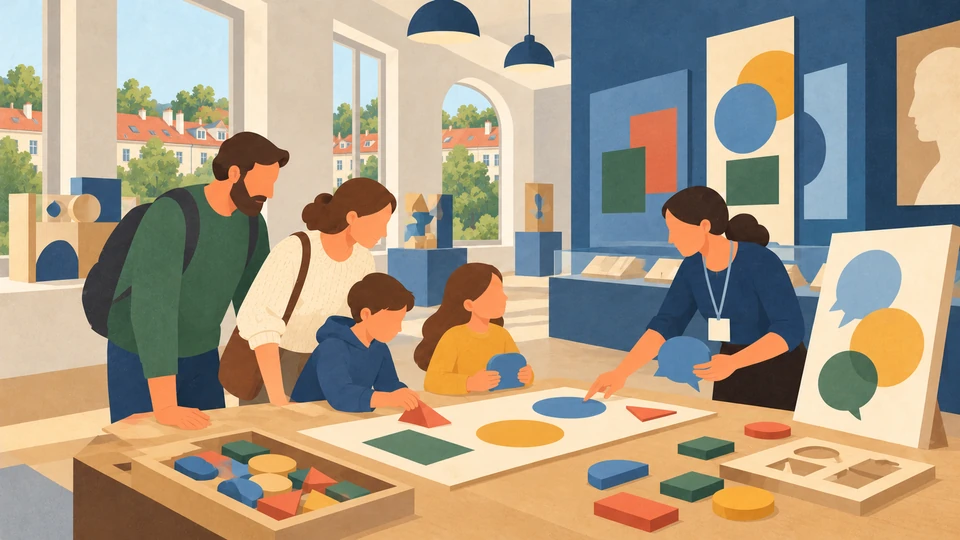
In Vilnius, the institute's Lituanistikos židinys museum brings linguistic questions into a physical learning space. Founded in 2006, it combines books and documents with specially designed language games and interactive activities. The institution describes visits by school pupils, university students, older learners and visitors from abroad. Alongside dictionaries and archives, this is another way to encounter Lithuanian: through curiosity, participation and conversation about how language works.
Sources
- Indiana University, Center for Language Technology. Lithuanian. https://celt.indiana.edu/portal/Lithuanian/index.html
- Virginija Vasiliauskiene, Lilita Zalkalns and Jonathan Slocum; Linguistics Research Center, University of Texas at Austin. Baltic Online: Series Introduction. https://lrc.la.utexas.edu/eieol/litol/0
- Vilnius University Library, Digital Collections. The first book in the Lithuanian language Catechismusa prasty szadei…. https://kolekcijos.biblioteka.vu.lt/en/stories/mazvydo-katekizmas
- European Network Remembrance and Solidarity. Press Recovery, Language and Book day in Lithuania. https://enrs.eu/news/press-recovery-language-and-book-day-in-lithuania
- Institute of the Lithuanian Language, Lexicography Centre. Dictionary of the Lithuanian Language. https://old.lkz.lt/en/dze.htm
- Jolita Urbanavičienė; Institute of the Lithuanian Language; Lietuvių kalba 17, 109–121. Lexicographic Data on Dialects in the Lithuanian Language Resources Information System E-Language (2022-12-30). https://www.zurnalai.vu.lt/lietuviu-kalba/en/article/view/31442
- Institute of the Lithuanian Language. Research Centre of Geolinguistics. https://lki.lt/en/geolingvistikos-centras/
- Ministry of Foreign Affairs of the Republic of Lithuania, Global Lithuania. Lithuanian education. https://globalilietuva.urm.lt/en/living-abroad/lithuanian-education/277
- Institute of the Lithuanian Language. Muziejus „Lituanistikos židinys“. https://lki.lt/muziejus-lituanistikos-zidinys/