Language & culture
Louisiana Creole: Kouri-Vini and Its Communities
Language at a glance
- Speakers in Louisiana
- Under 10,000 (2013)
Proficiency undefined; worldwide total remains uncertain.
- Local names
- Louisiana Creole · Kouri-Vini
Names used by community speakers.
- Communities
- Southern Louisiana
Also Texas, California and Illinois diasporas.
- Language type
- French-lexifier creole
Developed through contact in colonial Louisiana.
- Writing
- 35 entries · 2016 Kouri-Vini guide
Latin-based; the guide also states 36.
- Regional varieties
- Pointe Coupée · Breaux Bridge
Among Louisiana’s documented local speech varieties.
Who speaks Louisiana Creole, and what do they call it?
Kouri-Vini is a name for Louisiana Creole, which developed through contact among African, European and Indigenous peoples under colonial slavery. French supplied much of its vocabulary. It is distinct from both Cajun French, a regional variety of French, and Haitian Creole.
Its communities include Pointe Coupée, St. Martin, St. Landry and Iberia parishes in southern Louisiana, with diaspora communities in Texas, California and Illinois.
How many people speak Louisiana Creole worldwide?
Fewer than 10,000 speakers were estimated in Louisiana in 2013, without a uniform proficiency definition. A worldwide total remains uncertain.
Where did Louisiana Creole come from, and who spoke it in the past?
Louisiana Creole developed in eighteenth-century Louisiana. Court testimony from 1758 contains features associated with Louisiana Creole, and a description appeared in 1807. Both predate the large arrival of refugees from Saint-Domingue in 1809–1810, who strengthened an existing French- and Creole-speaking population. Later, English-dominated schooling helped interrupt transmission within families.
Which Louisiana Creole words might an English speaker already recognise?
Rou means roux, while gombo names the stew English speakers know as gumbo.
How does Louisiana Creole vary from region to region?
The word for butter appears as diboer or dibè, reflecting different pronunciations. Other local alternatives include lœr and lèr for hour. Pointe Coupée and Breaux Bridge have documented differences in speech.
What is Standard Louisiana Creole, and where is it used?
The 2016 community orthography developed by Christophe Landry and fellow contributors provides shared spelling conventions that reflect local pronunciation. Ti Liv Kréyòl uses a teaching variant, generally choosing one written form for each word.
Which alphabet does Louisiana Creole use, and what might surprise an English speaker?
The 2016 Kouri-Vini guide’s Latin-based alphabet lists 35 entries, counting accented forms and pairs such as Ch and Ou separately. Its prose gives a conflicting total of 36.
Two less familiar letters appear in Mærsi, thank you, and lœr, hour: æ and œ.
Does Louisiana Creole have grammatical gender?
Nouns do not generally change form for gender, but articles, possessives and some adjectives can distinguish masculine and feminine, especially around Breaux Bridge.
How do you say hello, thank you and goodbye in Louisiana Creole?
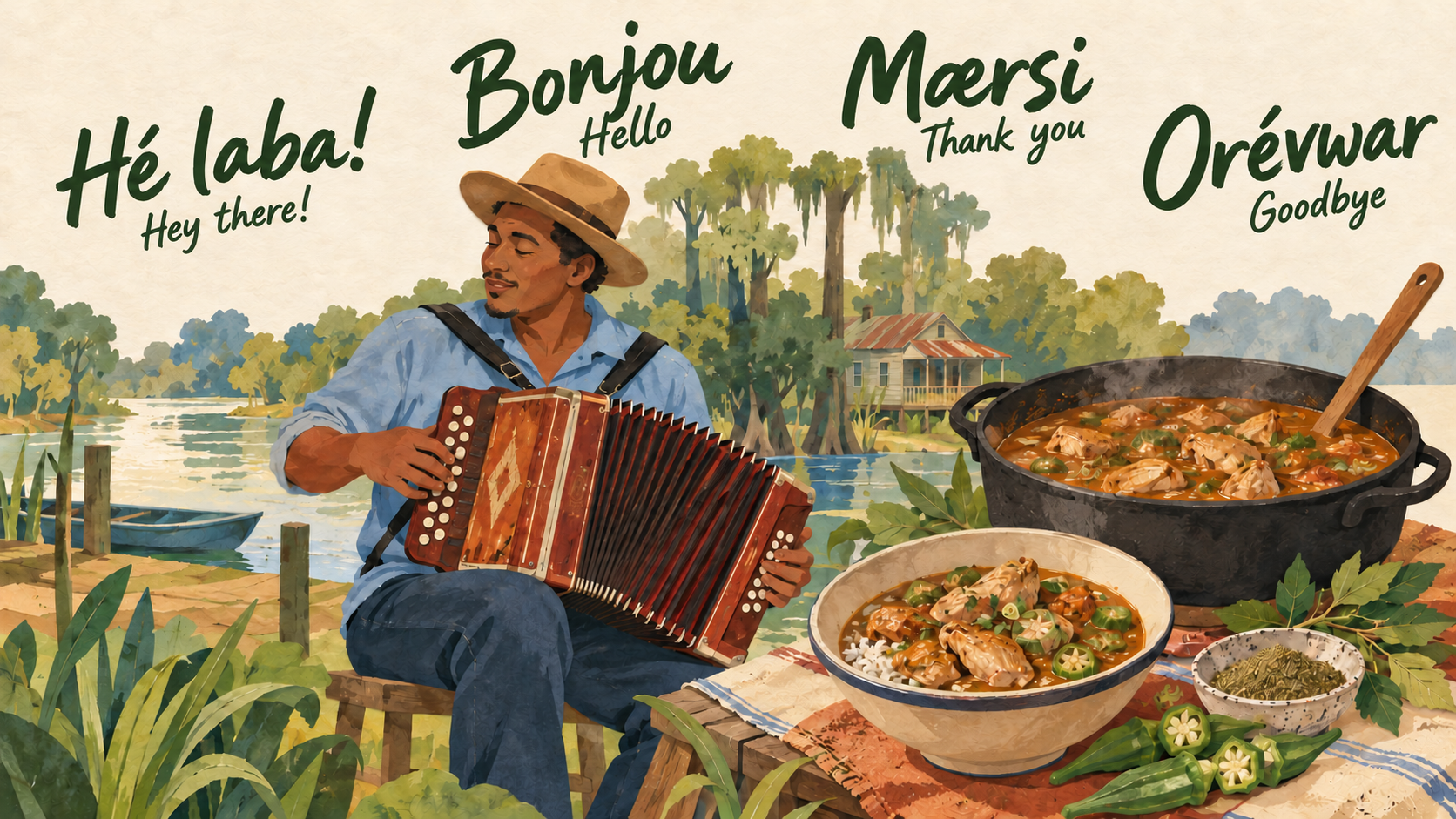
- Bonjou — hello.
- Mærsi — thanks.
- Orévwar — goodbye.
Hé laba! means hey there.
What are some memorable Louisiana Creole sayings?
Two nineteenth-century Louisiana sayings:
- Piti à piti, zozo fait son nid. A bird builds its nest little by little: steady small efforts add up.
- Laguerre vertie pas tchué beaucoup soldats. A warning of war saves soldiers’ lives: someone forewarned has time to prepare.
What everyday customs might surprise a visitor?
A ti-nom, literally a little name, is a nickname that may be better known than someone’s name on a birth certificate. It can refer to appearance, behaviour or something memorable the person has done, using words from Creole, French or English.
Which Louisiana Creole-language song and film offer a cultural introduction?
Bruce Sunpie Barnes’s San Malo remembers Juan San Malo, a leader of people who escaped enslavement. It appears among fifteen Creole songs in the 2019 book and recording Le Kèr Creole. The book, by Barnes and Rachel Breunlin, pairs Creole lyrics with English translations; songs and arrangements are by Barnes and Leroy Etienne.
Luke Harris’s short film Tambou (2022) follows Emmanuel, an older New Orleans man facing the loss of his home, as he goes out busking with his grandson. It uses Kouri-Vini, with English subtitles.
What is available for someone curious about the language now?
The free online Ti Liv Kréyòl includes recorded dialogues in which people introduce themselves, ask after one another and exchange names.
Nous Foundation and L’Union Française’s New Orleans beginner course, taught by Alex Hibou LeBlanc, runs for six Saturdays from 26 September to 7 November 2026. No previous French or Louisiana Creole instruction is required.
West Baton Rouge Museum also hosted Kamp Kréyol in June 2026, combining language sessions with contributions from cultural practitioners.
Fun Facts
- In en latab, a table, la comes from an old French article and belongs to the Creole noun itself.
- In shawi, a raccoon, shares its animal name with Louisiana French un chaoui through Indigenous language contact. Standard French uses raton laveur.
Sources
- Council for the Development of French in Louisiana. Louisiana French & Creole. Undated. https://codofil.org/louisiana-french-creole/
- Thomas A. Klingler and Ingrid Neumann-Holzschuh. Louisiana Creole. The Survey of Pidgin and Creole Languages / APiCS Online, 2013. https://apics-online.info/surveys/53
- Adrien Guillory-Chatman, Oliver Mayeux, Nathan Wendte and Herbert Wiltz. Ti Liv Kréyòl, second edition: Introduction. TSÒHK, 2020. https://sites.google.com/view/learnlouisianacreole/introduction
- Adrien Guillory-Chatman, Oliver Mayeux, Nathan Wendte and Herbert Wiltz. Ti Liv Kréyòl, second edition: Lesson 1. TSÒHK, 2020. https://sites.google.com/view/learnlouisianacreole/lessons/lesson-1
- Adrien Guillory-Chatman, Oliver Mayeux, Nathan Wendte and Herbert Wiltz. Ti Liv Kréyòl, second edition: Lesson 2. TSÒHK, 2020. https://sites.google.com/view/learnlouisianacreole/lessons/lesson-2
- Christophe Landry, Cliford St. Laurent and Michael Gisclair. Kouri-Vini: A Guide to Louisiana Creole Orthography. Louisiana Historic & Cultural Vistas, 2016. https://www.mylhcv.com/wp-content/uploads/2016/01/Creole-Orthographic-Guide.pdf
- Louisiana Historic & Cultural Vistas. Spelling Louisiana Dishes. Undated. https://www.mylhcv.com/spelling-louisiana-dishes/
- Oliver Mayeux. Racial segregation and language variation in Louisiana Creole: Social meaning in language loss. Sociolinguistica 38(1), 2024, pp. 27–52. https://www.repository.cam.ac.uk/bitstreams/1195c677-ac28-4397-8388-b5043028f51e/download
- C.R.E.O.L.E., Inc. Greetings. Undated. https://www.creoleinc.net/learncreole/greetings
- Lafcadio Hearn. Gombo Zhèbes: Little Dictionary of Creole Proverbs. 1885. Project Gutenberg edition. https://www.gutenberg.org/cache/epub/44866/pg44866-images.html
- Neighborhood Story Project. Le Kèr Creole. 2019. https://www.neighborhoodstoryproject.org/le-ker-creole
- University of New Orleans Press. Le Kèr Creole: Creole Compositions and Stories from Louisiana. 2019. https://www.lsuneworleans.edu/lsuneworleanspress/le-ker-creole
- New Orleans Film Society. Tambou. French Film Festival programme, 2023; film directed by Luke Harris, 2022. https://watch.eventive.org/fff2023/play/63e2d603343db900d1cd11e1/63d969041cd8cf0030eecc28
- West Baton Rouge Museum. Tambou: Film Screening and Discussion. 1 April 2023. https://www.westbatonrougemuseum.org/Calendar.aspx?EID=1616&calType=0&day=1&month=4&year=2023
- Nous Foundation. Classes & Workshops: Fall Semester 2026. 2026. https://www.nous-foundation.org/classes
- West Baton Rouge Museum. Kamp Kréyol. Programme for 1–5 June 2026. https://www.wbrparish.org/1102/Kamp-Kryol
Start learning today
Explore these books to keep learning.