Languages & Culture
Malayalam
Malayalam is a Dravidian language associated especially with Kerala in southwestern India and also spoken in Lakshadweep. Its historical development is closely connected with Tamil, while its vocabulary reflects sustained contact with Sanskrit and other languages. A language's ancestry and the sources of its borrowed words are different questions: Sanskrit influence does not make Malayalam an Indo-Aryan language. Malayalam also has its own writing system and grammatical tradition, so its relationship with Tamil should not be mistaken for identity with modern Tamil.
More than one route into written history
Malayalam's literary history includes communities with different religious and intellectual connections. A 2020 study by historian P. K. Yasser Arafath examines Arabi-Malayalam in the multilingual world of the Malabar coast. Its published abstract describes a writing and literary tradition that supported Islamic texts in the vernacular from the seventeenth century. Arafath studies the relationship between Muslim scribes and their audiences, including the poetic work Muhiyuddinmala. This approach makes readers and acts of transmission central to the history, alongside the forms of a script. It also cautions against reducing the tradition to a simple story of traders needing a shared language.
Another route is through working papers and collected books. Tübingen University Library's Hermann Gundert Portal contains printed works, manuscripts, notebooks and drafts connected with the nineteenth-century missionary and language scholar. It also includes other nineteenth-century South Indian works in the library, beyond his estate. The materials range across several languages and genres. They can help researchers study the making and circulation of texts; their survival in this particular collection does not make Gundert the origin of Malayalam literature.
The archive has also become part of collaboration with scholars in Kerala. Thunchath Ezhuthachan Malayalam University records the establishment of its Gundert Chair at Tübingen in 2015 and publications based on materials there, including editions of Keralanatakam and Nalacharitam Manipravalam. Editing these works is a different task from simply scanning them: researchers must make historical texts usable for new readers. The university's account documents that scholarly partnership without treating a European repository as the only centre of knowledge about the language.
Recording the language beyond the printed page
Local speech presents different research questions. Malayalam University's linguistics department describes a 2014–15 dialect survey in Malappuram district within a broader project to document variation in spoken Malayalam. The survey used questionnaires with word and sentence lists; the larger stated aim was a dialect atlas. The project listing marks the Malappuram work as published, but that does not establish that the whole proposed atlas is complete.
The same department describes a phonetic database combining words, glosses, recordings and transcriptions for research and teaching. Written spellings, recorded voices and regional information answer different questions. A spelling may help identify a word, while a recording can preserve details of its pronunciation. Keeping these kinds of evidence connected makes local variation available for study instead of treating everything outside a textbook norm as an error.
Learning across distance, watching together
Malayalam also belongs to communities outside India. The Greater Atlanta Malayalee Association describes language teaching as a way for younger generations to communicate with extended family and participate in literature, media and community activities. Its Malayalam Academy joined the Government of Kerala's Malayalam Mission programme in 2024 after operating independently. This is a concrete example of heritage-language education organised by a diaspora association; it is not a measure of proficiency among all families in Atlanta.
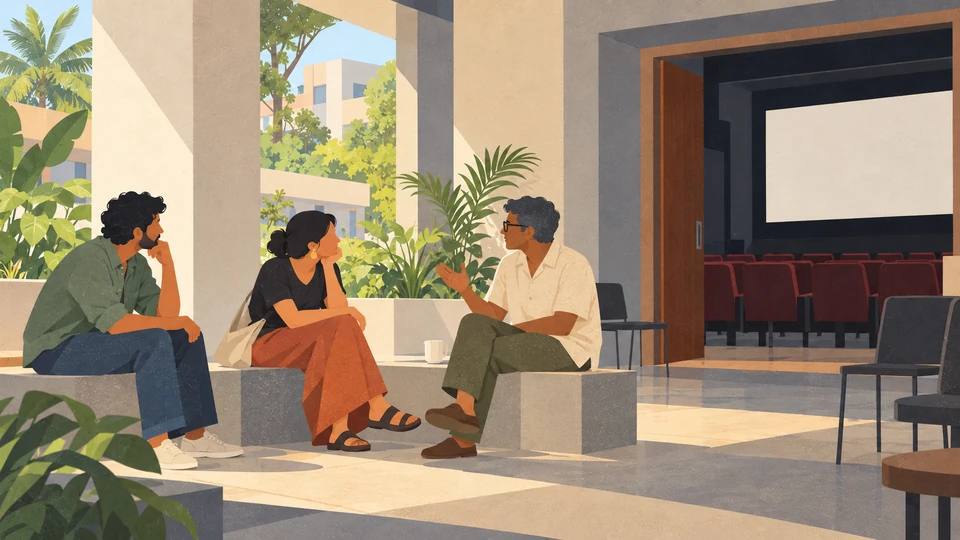
Cinema provides another setting for shared attention and discussion. The Kerala State Chalachitra Academy describes Malayalam Cinema Today as a section of the International Film Festival of Kerala in Thiruvananthapuram, alongside international selections. Its programme also includes audience forums and workshops. Malayalam cinema thus appears within a conversation with filmmaking elsewhere, with opportunities for audiences to discuss what they watch.
The connection between language learning and cultural interpretation is visible in university teaching too. UT Austin lists Malayalam topics including contemporary short stories, screenplays and cinema, modern drama and short novels by Basheer. A learner can move from recognising words to considering a speaker's situation, a character's voice or a writer's choices. These different materials offer ways into Malayalam that extend beyond memorising a single formal style.
Sources
- University of Pennsylvania, Department of South Asia Studies. Malayalam. https://www.southasia.upenn.edu/languages/explore-languages/malayalam
- University of Texas at Austin, Department of Asian Studies. Malayalam. https://cla.utexas.edu/asianstudies/languages-in-asian-studies/malayalam.html
- P. K. Yasser Arafath; Journal of the Royal Asiatic Society 30(3), 517–539. Polyglossic Malabar: Arabi-Malayalam and the Muhiyuddinmala in the age of transition (1600s–1750s). https://www.cambridge.org/core/journals/journal-of-the-royal-asiatic-society/article/abs/polyglossic-malabar-arabimalayalam-and-the-muhiyuddinmala-in-the-age-of-transition-1600s1750s/65608DE0D0113699E7907ECC08E899C0
- Tübingen University Library. Hermann Gundert Portal - Home. https://gundert-portal.de/
- Thunchath Ezhuthachan Malayalam University. Chairs & Centres. https://malayalamuniversity.edu.in/en/chairs-centers/
- Thunchath Ezhuthachan Malayalam University, Department of Linguistics. Projects-Linguistics. https://malayalamuniversity.edu.in/en/our-departments/linguistics/projects-linguistics/
- Greater Atlanta Malayalee Association (GAMA). Malayalam Academy. https://gamaatl.org/language-classes/
- Kerala State Chalachitra Academy; official International Film Festival of Kerala portal. International Film Festival of Kerala. https://iffk.in/aboutiffk