Language & culture
Māori: A Language at Home in Aotearoa
Language at a glance
- Speakers · New Zealand
- 213,849 · 2023
Conversational ability, including later learners.
- Local name
- te reo Māori
Also te reo, “the language”.
- Communities
- Aotearoa New Zealand
Across the North and South Islands.
- Language family
- Polynesian
Part of the Austronesian language family.
- Writing
- 15 Latin letters
Includes ng and wh; macrons mark length.
- Regional varieties
- Eastern · Western · Southern
Two North Island groups; one southern.
Who speaks Māori, and what do they call it?
Māori is the language of the Māori people of Aotearoa New Zealand. Its names include te reo Māori and, in context, te reo, “the language”. It is used in homes, communities, classrooms, broadcasting and public institutions.
How many people speak Māori worldwide?
A worldwide total is uncertain. New Zealand’s 2023 census recorded 213,849 people able to converse in Māori about everyday things, including people who learned it later in life.
Where did Māori come from, and who spoke it in the past?
Māori belongs to the Polynesian branch of the Austronesian family, alongside relatives such as Tahitian and Cook Islands Māori. Polynesian settlers brought an ancestral language to Aotearoa in the late thirteenth century. It developed locally over subsequent generations.
Written records came much later. Cook’s voyages of 1769–1779 produced the first known attempts to write down Māori words. In 1820, the rangatira Hongi Hika and Waikato worked with Thomas Kendall and Samuel Lee on a grammar and vocabulary that helped establish written Māori.
Which Māori words might an English speaker already recognise?
English has borrowed haka, now familiar far beyond New Zealand. New Zealand English puckerooed, meaning broken, comes from Māori pakaru.
How does Māori vary from region to region?
The three broad dialect groupings are eastern North Island, western North Island and South Island. Southern usage can have k where other varieties have ng, as in Ngāi Tahu / Kāi Tahu. Tūhoe speech can have n where other varieties have ng.
Waikato writing has used doubled vowels where other publications use macrons to show vowel length.
What is Standard Māori, and where is it used?
The Māori Language Commission, Te Taura Whiri i te Reo Māori, promotes shared writing conventions used in dictionaries, education, broadcasting and public agencies. Regional speech and iwi spelling traditions continue alongside this written standard.
Which alphabet does Māori use, and what might surprise an English speaker?
Māori has 15 letters: five vowels, eight single-letter consonants, and the digraph letters ng and wh.
Macrons in ā, ē, ī, ō, ū mark long vowels; they are not five extra letters.
Does Māori have grammatical gender?
Māori has no masculine or feminine noun classes; ia can mean “he” or “she”.
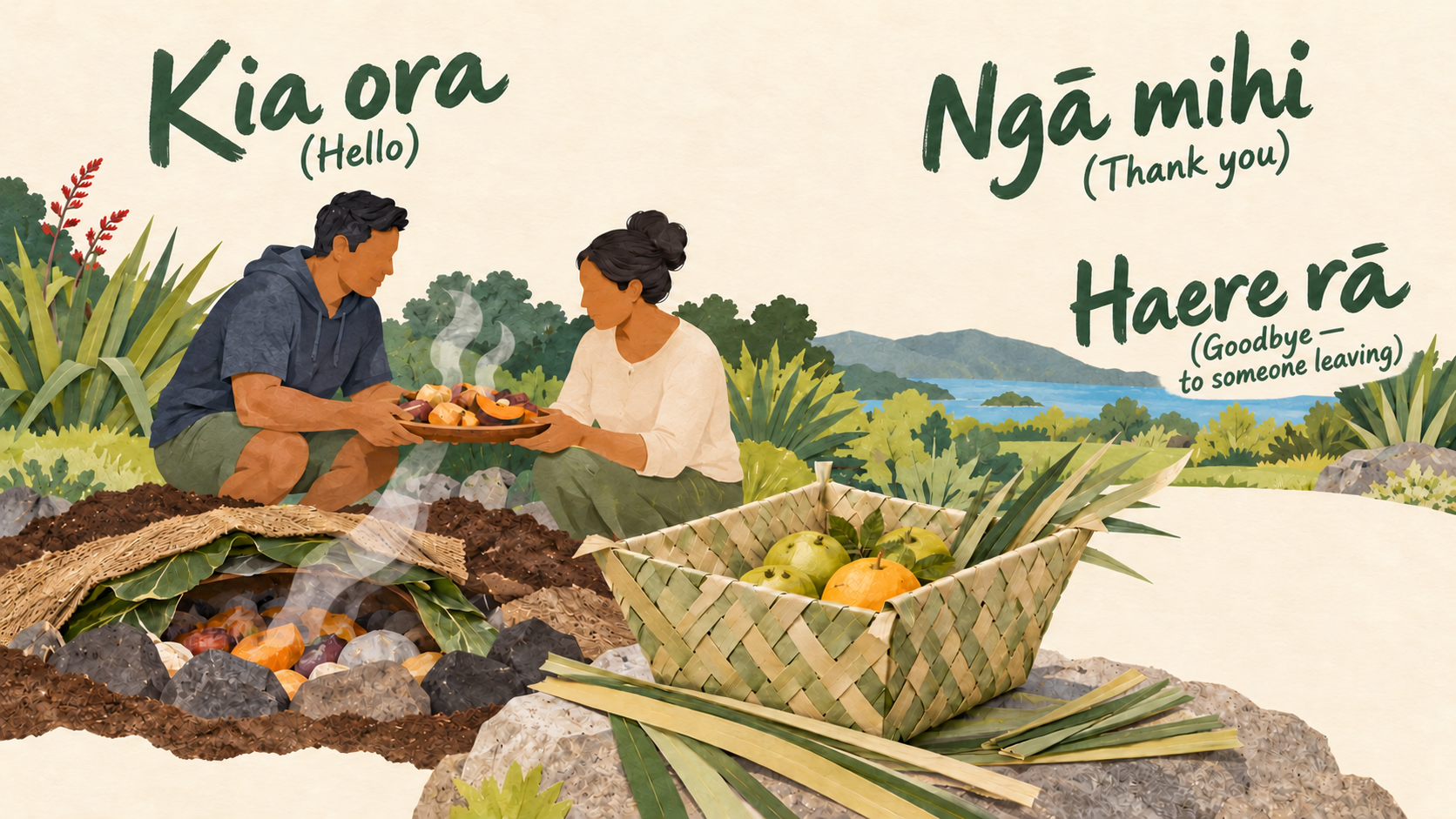
How do you say hello, thank you and goodbye in Māori?
- Kia ora — hello; also used for thanks.
- Ngā mihi — thank you.
- Haere rā — goodbye, said to the person leaving.
- E noho rā — goodbye, said to the person staying.
What are some memorable Māori sayings?
- Ka pai ki muri, ka pai ki mua. When work behind the scenes goes well, things go well out front. In hospitality, it recognises the kitchen workers supporting those welcoming guests.
- He waka eke noa. A canoe open for everyone to board. The saying describes people taking part together and sharing resources: what belongs to one supports others.
What everyday customs might surprise a visitor?
At a marae, shoes are usually removed before entering the wharenui, or meeting house, and food is not eaten inside. People keep their shoes on at some southern marae because of the cold.
In the wharekai, the dining room, elders commonly enter first. Eating begins after a karakia, or blessing.
Which Māori-language song and film offer a cultural introduction?
The Pātea Māori Club’s “Poi E” combines Māori words by Ngoi Pēwhairangi and music by Dalvanius Prime with synthesiser, bass and drum-machine rhythms. It was recorded in 1983 to reach young Māori and spent four weeks at number one in New Zealand in 1984.
Toa Fraser’s The Dead Lands (2014), written by Glenn Standring, follows a young chief’s son seeking revenge with an older warrior’s help. It is a fictional precolonial action story with Māori dialogue. The New Zealand Film Commission’s on-demand edition has English subtitles.
What is available for someone curious about the language now?
- Te Aka Māori Dictionary offers bilingual entries, idioms and explanatory notes.
- Te Whanake provides free animated modules, listening activities and podcasts alongside its textbooks.
- Kotahi Mano Kāika supports language use in Kāi Tahu homes, with songs, sayings and downloadable resources.
Fun Facts
- The Tahitian navigator Tupaia could communicate with Māori during Cook’s 1769–1770 voyage, showing how much the related Polynesian languages still shared.
- Moa names New Zealand’s extinct giant birds, while related Polynesian uses of the word refer to chickens.
Sources
- Rawinia Higgins and Basil Keane / Te Ara – The Encyclopedia of New Zealand. Te reo Māori – the Māori language. n.d. https://teara.govt.nz/en/te-reo-maori-the-maori-language/print
- Te Tai / Manatū Taonga Ministry for Culture and Heritage. 1200s–1300s Te reo Māori origins: a Polynesian language. n.d. https://tetai.nz/en/te-mana-o-te-reo-maori-chapter1
- Stats NZ. Languages spoken – 2023 Census: Information by concept (version 64). 2024-09-19 https://datainfoplus.stats.govt.nz/item/nz.govt.stats/dcbae0ce-f19e-464c-905f-b7236e10437c/64
- Kotahi Mano Kāika. He aha tēnei kaupapa? What is KMK? n.d. https://www.kmk.maori.nz/our-kaupapa
- Waipapa Taumata Rau / University of Auckland. Greetings and sign-offs. n.d. https://www.auckland.ac.nz/en/on-campus/life-on-campus/maori-life-on-campus/revitalising-te-reo-maori/kuputaka/greetings-and-sign-offs.html
- New Zealand Ministry of Education / Tāhūrangi. Special Foods. n.d. https://kauwhatareo.tahurangi.education.govt.nz/special-foods/5637171590.p
- Manatū Taonga Ministry for Culture and Heritage / NZ History. 'Poi E' by the Patea Maori Club. Updated 6 October 2021. https://nzhistory.govt.nz/comment/1586
- Te Taura Whiri i te Reo Māori. State of Te Reo Māori Report 2025. 2025 https://assets.nationbuilder.com/ttw/pages/5951/attachments/original/1767816282/State_of_Te_Reo_Ma%CC%84ori_(English).pdf?1767816282=
- Te Tai / Manatū Taonga Ministry for Culture and Heritage. 1769–1835 New contact and new words. n.d. https://tetai.nz/en/te-mana-o-te-reo-maori-chapter2
- Dianne Bardsley / Te Ara – The Encyclopedia of New Zealand. English language in New Zealand. n.d. https://teara.govt.nz/en/english-language-in-new-zealand/print
- Te Taura Whiri i te Reo Māori. FAQs. n.d. https://en.tetaurawhiri.govt.nz/faq
- Te Taura Whiri i te Reo Māori. Guidelines for Māori Language Orthography. 2012 https://assets.nationbuilder.com/tetaurawhiri/pages/27659/attachments/original/1644789635/Guidelines_for_Maori_Language_Orthography.pdf
- W. L. Williams. First Lessons in the Maori Language, with a Short Vocabulary. 1862 https://www.gutenberg.org/files/47371/47371-h/47371-h.htm
- Julia de Bres / Massey University. Eight thoughts on gender-inclusive language. Updated 2022-03-22 https://www.massey.ac.nz/about/news/eight-thoughts-on-gender-inclusive-language/
- John C. Moorfield / Te Aka Māori Dictionary. He waka eke noa. n.d. https://maoridictionary.co.nz/word/48434
- University of Otago. Marae visits. n.d. https://www.otago.ac.nz/maori/world/tikanga/marae-visits
- Basil Keane / Te Ara – The Encyclopedia of New Zealand. Te kawa o te marae. n.d. https://teara.govt.nz/en/te-kawa-o-te-marae/print
- New Zealand Film Commission. The Dead Lands. 2014 film; page undated https://www.nzfilm.co.nz/films/dead-lands
- New Zealand Film Commission On Demand. The Dead Lands. 2014 film; page undated https://ondemand.nzfilm.co.nz/film/the-dead-lands/
- John C. Moorfield / Te Whanake. Māori Language Learning. n.d. https://tewhanake.maori.nz/
- Kotahi Mano Kāika. Downloads. n.d. https://www.kmk.maori.nz/downloads
- Te Māngai Pāho. Annual Report 2015. 2015.
https://www.tmp.govt.nz/en/documents/21/TMP_AR15_web.pdf
Start learning today
Explore these books to keep learning.