Languages & Culture
Māori
Māori, or te reo Māori, is the Indigenous Māori language of Aotearoa New Zealand. It belongs to the Polynesian branch of the Austronesian family and developed from the language brought by the ancestors of Māori from eastern Polynesia. Its relationships with Cook Islands Māori and Tahitian are close, but those names do not designate the same language. This article concerns Māori in Aotearoa, including regional voices and contemporary efforts to strengthen transmission between generations.
A history carried in speech and writing
There is no single regional accent that exhausts Māori. Te Ara distinguishes eastern North Island, western North Island and South Island dialect groupings. Written conventions developed through collaboration as well as debate: Hongi Hika and his relative Waikato worked with Thomas Kendall and the linguist Samuel Lee in the process leading to an influential grammar and vocabulary in 1820. A printed standard therefore has its own history; it should not be mistaken for the moment when the language began.
The later disruption of language transmission was shaped by colonisation. NZHistory documents schooling that discouraged or punished Māori speech and the growing pressure to use English in work and urban life. Families made decisions within those unequal conditions. Describing language shift merely as a preference for English would leave out the institutions and attitudes that constrained their choices.
Organised resistance also belongs in this history. In 1972, Ngā Tamatoa, Victoria University's Te Reo Māori Society and Te Huinga Rangatahi petitioned Parliament to promote the language. Māori Language Day developed into Māori Language Week, and in 1987 Māori gained official-language recognition. These milestones record sustained advocacy; they do not mean that the work of restoring everyday opportunities to speak was finished.
Children learn within relationships
The first kōhanga reo opened at Pukeatua in Wainuiomata in 1982. The movement's own national trust explains its purpose through daily Māori immersion, family decision-making and responsibility, and children's and families' wellbeing. Families participate in running the centres and developing their own knowledge and skills. This account makes the educational model more specific than simply a preschool with a language lesson attached: the organisation of the setting is part of how language is sustained.
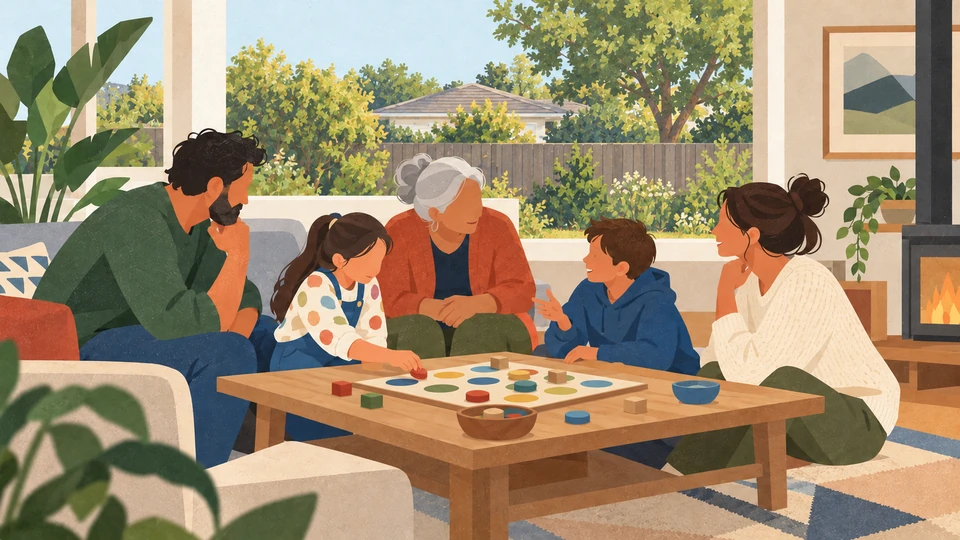
Community initiatives give that work a regional focus. Kotahi Mano Kāika, the Kāi Tahu language strategy, places intergenerational transmission and ordinary home communication at the centre of its programme. Its resources support people at different stages of learning. From this perspective, a household is an important place for developing the language because conversation can recur throughout the day, alongside the activities family members already share.
Anna Brankin's 2025 account in the community publication Te Karaka describes grandparents learning alongside grandchildren and parents raising children with Māori. It traces the strategy's launch to 2000 while acknowledging that its original household-language aspiration had not yet been fully realised. One participant recalls immersion camps at Hāwea, where Māori became part of childhood activity and connection with place. These particular experiences show what transmission can involve: relationships, recurring occasions to speak, and support that continues beyond an introductory course.
Learning from dictionaries and recorded voices
Care with written forms is useful even at the beginning. The Te Aka dictionary's guide explains that macrons mark long vowels and that vowel length can distinguish meaning. Its entries also provide grammatical information, examples and guidance on idioms. Yet a dictionary has editorial limits: Te Aka includes regional vocabulary but does not systematically list every dialect form arising from sound differences. Consulting its guide helps learners understand both the information an entry provides and what they may still need to learn from local speakers and teachers.
Research can illuminate change without reducing speakers to a single model. A 2009 paper by Peter Keegan and colleagues compared historical recordings with later recorded groups in the MAONZE project. It identified changes in vowel quality and duration and discussed implications for teaching. The study's evidence came from selected male speakers, so it is not a complete account of all Māori speech. Its combination of recordings, careful comparison and explicit limits provides a useful example of scholarship working alongside language education. Māori can be studied as a changing language while its communities continue to decide how they want to speak, teach and pass it on.
Sources
- Te Tai Treaty Settlement Stories, presented by iwi and Manatū Taonga — Ministry for Culture and Heritage. 1200s–1300s Te reo Māori origins: a Polynesian language. https://tetai.nz/en/te-mana-o-te-reo-maori-chapter1
- Rawinia Higgins and Basil Keane; Te Ara — The Encyclopedia of New Zealand, Manatū Taonga. Te reo Māori – the Māori language. https://teara.govt.nz/en/te-reo-maori-the-maori-language/print
- Angela Ballara; NZHistory, Manatū Taonga — Ministry for Culture and Heritage. History of the Māori language. https://nzhistory.govt.nz/culture/maori-language-week/history-of-the-maori-language
- Te Kōhanga Reo National Trust. Te Orokohanganga. https://www.kohanga.ac.nz/kaupapa/te-oorokohanganga
- Kotahi Mano Kāika; Kāi Tahu language strategy. He aha tēnei kaupapa? What is KMK?. https://www.kmk.maori.nz/our-kaupapa
- Anna Brankin; Te Karaka, Te Rūnanga o Ngāi Tahu. Kotahi Mano Kāika -- 25 years strong (2025-02-12). https://ngaitahu.iwi.nz/opportunities-and-resources/publications/te-karaka/kotahi-mano-kaika-25-years-strong/
- Te Aka Māori Dictionary; work of John C. Moorfield, continued by Te Murumāra Foundation. Understanding The Māori Dictionary Entries. https://maoridictionary.co.nz/dictionary-info
- Peter J. Keegan, Jeanette King, Margaret Maclagan, Catherine I. Watson and Ray Harlow; University of Waikato, LED 2007 refereed conference proceedings. Changes in the pronunciation of Māori and implications for teachers and learners of Māori. https://researchcommons.waikato.ac.nz/entities/publication/75e3cc6a-762a-4df7-86be-790a40853b29