Languages & Culture
Marathi
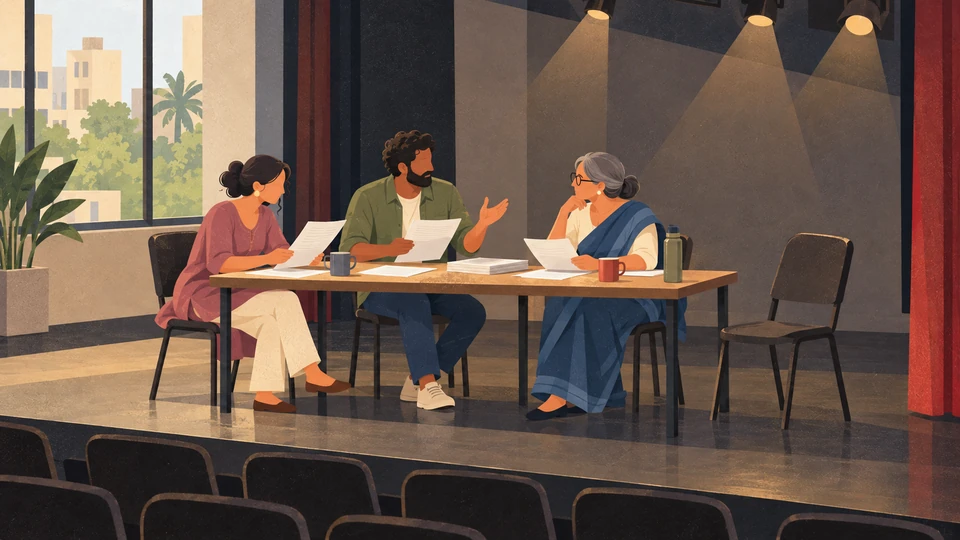
A manuscript notebook, a village recording and a programme for a staged reading offer different ways to approach Marathi. The language belongs to the Indo-Aryan branch of Indo-European and is associated principally with Maharashtra in western India. It is also used by communities abroad. Modern Marathi is written in Devanagari, a script shared with other languages, but its written history includes Modi as well. Understanding Marathi therefore requires distinguishing a language from its writing systems and a standard from the range of speech used by its communities.
Pages made for use
The British Library's catalogue of digital copies from the Marathi Manuscript Centre in Pune provides a revealing view of literary history. The collection includes works of Varkari poet-saints of the thirteenth to seventeenth centuries and Pandit poets of the seventeenth and eighteenth centuries. It also contains badas, notebooks used by performers of kirtans, alongside manuscripts on subjects including yoga and astrology. These are descriptions of the collection's contents, not a claim that every surviving copy was made in its author's lifetime.
A performer's notebook helps connect literary history with the practical work of remembering, selecting and presenting material. The catalogue makes that relationship visible even before someone begins reading the manuscript itself. It also warns against assuming that a historical collection contains only a single genre. Poems, performance aids and texts addressing other kinds of knowledge can share an archive while serving different purposes.
Access also depends on knowing how a text was written. The Centre for Development of Advanced Computing describes Modi as a cursive script associated with historical administrative writing. Its publicly documented tools include lessons on characters and conjuncts, and a converter designed to display Marathi Devanagari web text in Modi. The learning package is dated 2016; that description does not establish compatibility with every current device. The important linguistic distinction is that changing how Marathi is displayed is not the same as translating it into another language. Older writing systems remain relevant to research even when learners begin with modern Devanagari.
Mapping speech without erasing its differences
The Survey of Dialects of the Marathi Language asks a different set of questions. Its project description identifies a collaboration between Deccan College in Pune and Rajya Marathi Vikas Sanstha in Mumbai, beginning in 2017. The aim is a digital account of regional variation in Maharashtra, bringing lexical and grammatical features into geographical comparison. A map of words and constructions can show where particular alternatives occur without assuming that a single preferred form exhausts Marathi.
The survey's methodology explains how those data were produced. Researchers used pictures to elicit vocabulary, short videos to prompt grammatical constructions, and recordings of traditional stories and personal experiences. Narrative material was transcribed, analysed and translated. These methods provide complementary evidence: a targeted prompt makes responses easier to compare, while a longer account lets a speaker connect ideas over several sentences. Neither should be mistaken for an unfiltered recording of every part of daily life.
The sample's boundaries matter. The methodology dates fieldwork to 2018–2022 and specifies rural and semi-urban communities; Mumbai City and Mumbai Suburban were excluded. It also includes people who reported another first language but used Marathi for village interaction. This distinction recognises multilingual participants without relabelling their first languages as Marathi dialects. The resulting resource offers substantial regional evidence, but cannot by itself describe all urban speech or every Marathi-speaking community outside Maharashtra.
Giving written words a voice
Public readings offer a contemporary connection between literature and listening. Mumbai's National Centre for the Performing Arts advertised Abhijaat Marathi for 1 May 2026 as part of its Page to Stage programme. The announcement proposed performative readings of essays, short stories and poetry, including work by P. L. Deshpande, Kusumagraj, Indira Sant and Shanta Shelke. It is evidence of the organiser's planned format, rather than confirmation of the performance's eventual attendance or reception.
That format gives listeners a reason to attend to pacing, emphasis and interpretation as well as the words on a page. For a learner, a text and its performance offer related questions: what does the passage say, and how does a particular reader present it? The organiser's proposed combination of several genres also shows why a Marathi cultural article need not choose between books and performance. The same literary material can invite both quiet reading and a shared listening experience.
Sources
- University of Pennsylvania, Department of South Asia Studies. The Marathi Language. https://www.southasia.upenn.edu/languages/explore-languages/marathi-language
- British Library, Endangered Archives Programme; catalogue reference EAP023/1. Surrogate copies of the Manuscript collection at the Marathi Manuscript Centre, Pune. https://searcharchives.bl.uk/catalog/032-002749049
- Centre for Development of Advanced Computing (C-DAC), GIST. Modi-Script Tools. https://www.cdac.in/index.aspx?id=lu_modi_script
- Department of Linguistics, Deccan College (Deemed University), Pune, and Rajya Marathi Vikas Sanstha, Mumbai. About the Project. https://sdml.ac.in/about
- Survey of Dialects of the Marathi Language; Deccan College and Rajya Marathi Vikas Sanstha. Project Methodology. https://sdml.ac.in/methodology
- National Centre for the Performing Arts, Mumbai. Page to Stage - Abhijaat Marathi. https://www.ncpamumbai.com/event/page-to-stage-abhijaat-marathi/